How to Find Simple Percentages of a Number

How to Find Simple Percentages of a Number

videolesson.JPG

rules for finding simple percentages poster

Rules for Finding Basic Percentages

poster of rules for finding basic percentages

  • To find 1%, divide the number by 100.
  • To find 5%, divide the number by 20 or find half of 10%.
  • To find 10%, divide the number by 10.
  • To find 20%, divide the number by 5 or find 10% and double it.
  • To find 25%, divide the number by 4.
  • To find 33.̄3%, divide the number by 3.
  • To find 50%, divide the number by 2.
  • To find 75%, divide the number by 4 and then multiply by 3.
Find simple percentages of a number by dividing using the rules shown above.

videolesson.JPG

example of finding a simple percentage of an amount

  • We want to find 20% of 40.
  • To find 20% of a number, divide the number by 5 or find 10% and double it.
  • 40 ÷ 5 = 8 and so, 20% of 40 = 8.
  • Alternatively, we can find 10% and double it.
  • To find 10% of 40, divide it by 10.
  • 10% of 40 = 4.
  • We double 10% to find that 20% = 8.

videolesson.JPG

Teaching and Introducing Simple Percentages

Finding Simple Percentages: 10%, 25%, 50% and 100%

Finding Simple Percentages: 1%, 5%, 20% and 75%

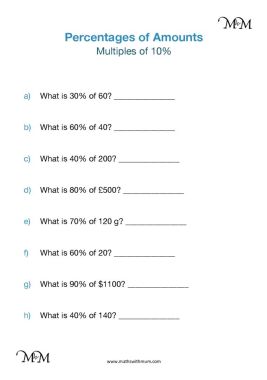
Finding Multiples of 10%

practiseqs.JPG

Calculating Simple Percentages (1%, 5%, 20% and 75%): Interactive Activity

1%, 5%, 20% and 75% of an Amount: Interactive Questions

Calculating Simple Percentages (10%, 25% and 50%) : Interactive Activity

Finding 10%, 25% and 50% of an Amount: Interactive Questions

Calculating Multiples of 10% of an Amount

Multiples of 10 Percent: Interactive Questions

Simple Percentages as Fractions Worksheets and Answers

Simple Fractions of Amounts Worksheets and Answers

Finding Multiples of 10% of a Number Worksheets and Answers

Simple Percentages of Amounts

Rules for Finding Simple Percentages of a Number

The rules for finding simple percentages of a number are shown in the following table:

Percentage Rule
1% ÷ 100
5% ÷ 20
10% ÷ 10
20% ÷ 5
25% ÷ 4
33.̄3% ÷ 100
50% ÷ 2
75% ÷ 4 then × 3

To find the percentages of a number shown in the table above, simply divide the number using the rules provided.

Simple percentages are percentages of amounts that can be found with a simple division or multiplication. They do not require any addition of any smaller percentages.

For example, 50% is a simple percentage because we simply divide by 2 to find it. 31% is not a simple percentage we would need to calculate 30% and 1% and add them together.

Here is a poster showing how to calculate basic percentages.

poster of how to find percentages of amounts

To introduce percentages, it is best to start with simple percentages and showing them as a fraction out of 100. For example, 50% means 50 out of 100, which is half. To find 50% of a number, simply half it.

Before looking at larger percentages, it is best to introduce basic percentages with a visual guide to how large they are. To teach how large a percentage is, you can show the percentage as a fraction of 100 squares.

percentages to fractions list

Start by introducing the following percentages first: 10%, 20%, 25%, 50%, 75% and 100%.

How to Calculate 1% of a Number

To calculate 1% of a number, divide the number by 100. To divide by 100, move the decimal point two places left. For example, 1% of 135.6 = 1.356.

1% means 1 out of 100. 1% is the same as the fraction   1/100  .

To teach 1%, we can show 1 square shaded out of 100 squares.

diagram showing 1% for teaching

1% means   1/100   and so, finding 1% of a number means to find   1/100   of that number.

To find 1% of a number without a calculator, divide the number by 100. The easiest way to do this is to move the decimal point 2 places to the left.

Here are some examples of finding 1%,

Question Answer
1% of 300 3
1% of 150 1.5
1% of 25 0.25
1% of 8 0.08
1% of 3.6 0.036
1% of 0.205 0.00205

To find 1% of a number with a calculator, divide the number by 100. You can also multiply the number by 0.01.

1% is a basic percentage because it can be found with one simple division. 1% is a very useful percentage to know how to find because you can use it to find any larger, whole number percentage of a number. Simply multiply the percentage required by the value of 1%.

How to Calculate 5% of a Number

To find 5% of a number, divide the number by 20. This can be done by dividing the number by 10 and then halving it. For example, 5% of 40 = 2.

5% means 5 out of 100. 5% is the same as the fraction   5/100  , which can be simplified to   1/20  .

5% is a twentieth of the whole number. diagram showing 5% for teaching

5% means   1/20   and so, finding 5% of a number means to find   1/20   of that number.

To find 5% of a number without a calculator, divide the number by 20. The easiest way to do this is to divide by 10 and then halve the result.

Here are some examples of finding 5%,

Question Answer
5% of 200 10
5% of 60 3
5% of 30 1.5
5% of 8 0.4
5% of 1.6 0.08
5% of 0.402 0.0201

To find 5% of a number with a calculator, divide the number by 20. You can also multiply the number by 0.05.

Finding 5% is best to introduce after you have already learnt how to find 10%.

How to Calculate 10% of a Number

To calculate 10% of a number, divide the number by 10. The easiest way to do this is to move the decimal point one place to the left. For example, 10% of 14.5 = 1.45.

10% means 10 out of 100. 10% is the same as the fraction   10/100  , which simplfies to   1/10  .

To teach 10%, we can show 10 squares shaded out of 100 squares.

teaching and introducing 10% as a fraction

10% means   1/10   and so, finding 10% of a number means to find   1/10   of that number.

To find 10% of a number without a calculator, divide the number by 10. The easiest way to do this is to move the decimal point 1 place to the left.

Here are some examples of finding 10%,

Question Answer
10% of 1200 120
10% of 600 60
10% of 50 5
10% of 9 0.9
10% of 5.3 0.53
10% of 0.105 0.0105

To find 10% of a number with a calculator, divide the number by 10. You can also multiply the number by 0.1.

10% is a basic percentage because it can be found with one simple division. 10% is a very useful percentage to know how to find because we can easily multiply 10% to find other multiples of 10%, such as 20%, 30% etc.

Multiples of 10% of a Number

To find multiples of 10% of a number, use these rules:

Percentage Rule
10% ÷ 10
20% ÷ 10 then × 2
30% ÷ 10 then × 3
40% ÷ 10 then × 4
50% ÷ 10 then × 5
60% ÷ 10 then × 6
70% ÷ 10 then × 7
80% ÷ 10 then × 8
90% ÷ 10 then × 9

Here is a poster showing how to find all of the multiples of 10% of a number.

poster showing how to find multiples of 10% of a number

For example, to find 30% of 50, divide 50 by 10 to find 10% and then multiply this by 3 to get 30%.

example of finding 30% of 50

To find 10% of 50, divide it by 10. 10% of 50 = 5.

Now that we have 10%, we simply multiply it by 3 to find 30%. 30% of 50 = 15.

how to find 30% of a number example of 30% of 50

Here is another example of finding a multiple of 10 percent. What is 40% of 70 grams?

To find 40% of a number, divide it by 10 to find 10% and then multiply this by 4.

how to calculate 40% of an amount

10% of 70 grams = 7 grams.

To find 40%, we multiply 10% by 4. 40% of 70 grams = 28 grams.

working out 40% of the amount 70 grams

Here we will find 80% of 120.

how to calculate 80% of a number

To calculate 80% of a number, divide the number by 10 to get 10% and then multiply this by 8.

10% of 120 = 12.

80% is 10% multiplied by 8. 80% = 96, therefore 80% of 120 = 96.

how to find 80% of a number 120

How to Calculate 20% of a Number

To calculate 20% of a number, divide it by 5. Alternatively, divide the number by 10 and then double it. For example, 20% of 30 = 6.

20% means 20 out of 100. 20% is the same as the fraction   20/100  , which can be simplified to   1/5  .

20% is a fifth of the whole number. diagram for teaching and introducing 20%

20% means   1/5   and so, finding 20% of a number means to find   1/5   of that number.

To find 20% of a number without a calculator, divide the number by 5. Alternatively, divide the number by 10 and then double it.

Here are some examples of finding 20%,

Question Answer
20% of 400 80
20% of 20 4
20% of 70 14
20% of 5 1
20% of 6.1 1.22
20% of 0.303 0.0606

To find 20% of a number with a calculator, divide the number by 5. You can also multiply the number by 0.2.

How to Calculate 33   1/3   % of a Number

To calculate 33   1/3   % of a number, divide it by 3.

3   1/3   is the same as 33.̄3%. To find 3   1/3   or 33.̄3%, divide the number by 3.

diagram for teaching that 33% is one third

33.̄3% means   1/3   and so, finding 33.̄3% of a number means to find   1/3   of that number.

To find 33.̄3% of a number without a calculator, divide the number by 3.

To find 33.̄3% of a number with a calculator, divide the number by 3. You can also multiply the number by 0.̄3.

How to Calculate 50% of a Number

To calculate 50% of a number, divide the number by 2. For example, 50% of 20 = 10.

50% means 50 out of 100. 50% is the same as the fraction   50/100  , which simplfies to   1/2  .

To teach 50%, we can show 50 squares shaded out of 100 squares.

diagram for teaching 50 percent

50% means   1/2   and so, finding 50% of a number means to find   1/2   of that number.

To find 50% of a number without a calculator, divide the number by 2. To divide an odd number by 2, subtract one, half it and then add 0.5

Here are some examples of finding 50%,

Question Answer
50% of 800 400
50% of 300 150
50% of 20 10
50% of 7 3.5
50% of 2.6 1.3
50% of 0.804 0.402

To find 50% of a number with a calculator, divide the number by 2. You can also multiply the number by 0.5.

How to Calculate 75% of a Number

To calculate 75% of a number, divide the number by 4 and then multiply this result by 3. For example 75% of 20 = 15.

75% means 75 out of 100. 75% is the same as the fraction   75/100  , which simplfies to   3/4  .

75% is three quarters of an amount.

To teach 75%, we can show 75 squares shaded out of 100 squares. It is helpful to shade the squares in the four corners as shown.

diagram for explaining 75 percent as three quarters, 75% = 3/4

75% means   3/4   and so, finding 75% of a number means to find   3/4   of that number.

To find 75% of a number without a calculator, divide the number by 4 and then multiply by 3.

Here are some examples of finding 75%,

Question Answer
75% of 800 600
75% of 300 225
75% of 60 45
75% of 4 3
75% of 6.8 5.1
75% of 0.334 0.2505

To find 75% of a number with a calculator, divide the number by 4 and then multiply by 3. You can also multiply the number by 0.75.

What is 100% of a Number?

100% of a number is the whole of the number. 100% means one whole and so, 100% of a number is simply the number itself.

100% means 100 out of 100. 100% is the same as the fraction   100/100  , which simplfies to 1 whole.

We can see in this diagram that 100% shows all 100 squares shaded in.

what is 100%? diagram explaining 100%.

To find 100% of something simply means to find the whole amount of it. For example, 100% of 25 = 25.

nextlesson.JPG

Now try our lesson on How to Calculate Percentages of Numbers where we learn how to find any percentage of a number.

Inverse Operations: Multiplication and Division

Inverse Operations: Multiplication and Division

videolesson.JPG

Writing Multiplication as Division

writing multiplication as a division example of 3 × 2 = 6

division as the inverse of multiplication example of 3 × 2 = 6

  • Multiplication and division are inverse operations. This means that they are opposites.
  • All multiplication sentences can be rewritten as division sentences and all division sentences can be rewritten as multiplication sentences.
  • Every multiplication sentence can be written as two different division sentences.
  • Here is the multiplication sentence 3 × 2 = 6.
  • The answer of a multiplication sentence is the number that is divided at the beginning of a division sentence.
  • The answer of 6 is written at the start of the division sentence.
  • The two numbers that are multiplied together are then written next in the division sentence.
  • 3 × 2 = 6 can be written as 6 ÷ 3 = 2 or 6 ÷ 2 = 3.
  • Two numbers are multiplied together in the multiplication sentence. One is the number we divide by in the division sentence and the other is the answer.

Writing Division as Multiplication

writing division as multiplication example of 10 ÷ 2 = 5

how to write a multiplication as a division question

  • To write a division sentence as a multiplication sentence, simply rearrange the numbers.
  • Every division sentence can be written as two different multiplication sentences.
  • The number that is being divided in the division sentence is now the answer of the multiplication sentence.
  • 10 is being divided and so, it is the answer of the multiplication sentence.
  • The number being divided by and the answer of a division sentence are both written multiplied together.
  • The answer of 6 is written at the start of the division sentence.
  • The two numbers that are multiplied together are then written next in the division sentence.
  • 10 ÷ 2 = 5 can be written as 2 × 5 = 10 or 5 × 2 = 10.

Multiplication and division are opposites.

Division and multiplication sentences can be made by rearranging the numbers.

videolesson.JPG

how to write a multiplication from a division example of 18 ÷ 6 = 3

  • We can write every division sentence as a multiplication sentence.
  • The number being divided by is the answer to a multiplication sentence.
  • 18 moves from the start of the division to become the answer of the multiplication.
  • The number being divided by and the answer to the division are both multiplied together in the multiplication sentence.
  • 18 ÷ 6 = 3 can be written as 3 × 6 = 18 or 6 × 3 = 18.

videolesson.JPG

Writing Multiplication as Division

Writing Division as Multiplication

Inverse Operations: Multiplication and Division

What are Inverse Operations?

Inverse operations are two different types of calculation that have the opposite effect on each other. For example, subtraction is the inverse operation to addition and division is the inverse operation to multiplication.

In maths, the word inverse means the opposite.

Inverse operations can be used to undo the original operation. This has the effect of returning a value that we started with before the first calculation.

For example, we can start with the number 5 and then multiply it by 4.

5 × 4 = 20. We started with 5 but now have 20.

example of inverse operations 5 × 4 = 20 written as a division

To return from 20 to 5, we use the inverse operation.

20 ÷ 4 = 5. We can return from 20 to 5 by dividing by 4.

We say that multiplying by 4 is the inverse operation to dividing by 4.

Multiplying 5 by 4 resulted in 20.

Dividing 20 by 4 took us back to 5.

Multiplication and division are examples of inverse operations.

inverse means opposite and multiplication is the inverse of division

What is the Inverse of Multiplication?

The inverse of multiplication is division. If you multiply by a given number and then divide by the same number, you will arrive at the same number you started with. Division has the opposite effect to multiplication.

For example here is 3 × 2 = 6.

We started with the number 3.

We multiplied it by 2 to increase 3 to 6.

division is the inverse of multiplication example of 3 × 2 = 6

An inverse operation must be used to return from 6 to 3.

The opposite of multiplying by 2 is to divide by 2.

We divide 6 by 2 to return to our original number of 3.

Division had the inverse effect to the multiplication done in the original calculation.

Division and multiplication are only inverses if the division and multiplication are by the same number. In this example we multiplied and divided by 2.

What is the Inverse of Division?

The inverse of division is multiplication. If you divide by a given number and then multiply by the same number, you will arrive at the same number you started with. Multiplication has the opposite effect to division.

For example, here is 10 ÷ 2 = 5.

We started with the number 10.

We divided it by 2 to decrease 10 to 5.

10 ÷ 2 = 5 example of inverse operations division and multiplication

To return from 5 to our original number of 10, we must use an inverse operation.

We can multiply 5 by 2 to get back to our original number of 10. 5 × 2 = 10.

Dividing by 2 and multiplying by 2 are inverse operations. Multiplying by 2 had the effect of undoing the division by 2.

How to Write Multiplication as Division

To write a multiplication as a division, follow these steps:

  1. Write the answer of the multiplication at the start of the division before the division sign.
  2. Write the two numbers being multiplied after the division sign and after the equals sign respectively.
  3. The two numbers in step two can be written in either order to form two different divison sentences.

For example, here is 7 × 8 = 56. We will write this multiplication as a division.

Every multiplication can be rewritten as a division using the same numbers but in a different order.

If you know the answer to a given multiplication, you can immediately use this to create a division without performing any calculations. Simply rearrange the numbers.

The first step is to write the answer to the multiplication at the start of the division sentence. The answer of the multiplication is now the number being divided by.

56 is the answer to the multiplication in 7 × 8 = 56. We will start our division with 56.

how to write a multiplication as a division example

The next step is to write the numbers being multiplied in the multiplication sentence after the division sign and after the equals sign in any order.

The two numbers being multiplied are 7 and 8. We will write 7 after the division sign and 8 after the equals sign.

We rearrange the multiplication 7 × 8 = 56 to the division 56 ÷ 7 = 8. The numbers involved are the same but they are written in a different order.

Whilst 56 needs to go at the start of the division, the other two numbers of 7 and 8 can be written in either order. There are two different divisions that can be written for each multiplication.

This time we will write these two numbers in a different order.

how to write a multiplication as a division example

We rearrange the multiplication 7 × 8 = 56 to the division 56 ÷ 8 = 7.

7 × 8 = 56 can be written as either 56 ÷ 7 = 8 or 56 ÷ 8 = 7.

two different multiplication sentences using the same numbers

How to Write Division as Multiplication

To write a division as a multiplication, follow these steps:

  1. Write the number being divided as the answer at the end of the multiplication.
  2. Write the remaining two numbers in the division sentence multiplied together in the multiplication sentence.
  3. The two numbers in step two can be written in either order to form two different multiplication sentences.

For example, here is 18 ÷ 6 = 3

The first step is to write the number being divided, at the start of the division as the answer at the end of the multiplication.

18 is the number being divided. It will form the answer at the end of the multiplication.

writing a division as a multiplication 18 ÷ 6 = 3 is 6 × 3 = 18

The next step is to write the remaining two numbers from the division multiplied together in the multiplication sentence.

The other two numbers in the division are 6 and 3.

We can write 18 ÷ 6 = 3 as 6 × 3 = 18.

We can also write 18 ÷ 6 = 3 as 3 × 6 = 18. It does not matter which order the two numbers are multiplied in.

example of writing a division as a multiplication

Each division sentence can be written as two different multiplication sentences.

18 ÷ 6 = 3 can be written as either 6 × 3 = 18 or 3 × 6 = 18.

two multiplication sentences with the same numbers in a different order

nextlesson.JPG

Now try our lesson on Division by Sharing Equally where we learn how to introduce the idea of division as sharing equally.

Multiplication as Equal Groups

Multiplication as Equal Groups
videolesson.JPG

grouping multiplication in equal groups of counters for 16

  • Here we have 16 counters arranged in an
    arrayA rectangular collection. Here our number is represented in rows and columns.
    .
  • We can write a
    times table multiplicationA common multiplication fact that we should learn, from 1 x 1 up to 12 x 12.
    for every equal group of items that we have.
  • A group is an equal group if it has the same number of items as all of the other groups.
  • Multiplication means ‘equal groups of’ and is written with a multiplication sign: ‘×’.
  • For example: 4 × 4 can be read as ‘4 equal groups of’ 4.
The amount of groups multiplied by the number of counters in each group form our total.

videolesson.JPG

Multiplication by Grouping into equal groups Example

  • Here we have 16 counters and we will group together counters that form the number 16.
  • We have 1 group of 16, so 1 × 16 = 16.
  • We have 2 equal groups of 8 counters, so 2 × 8 = 16.
  • We have 4 equal groups of 4 counters, so 4 × 4 = 16.
  • We have 8 equal groups of 2 counters, so 8 × 2 = 16.
  • We have 16 equal groups of 1 counter, so 16 × 1 = 16.
  • The number of groups multiplied by the number of counters in each group form our times tables.

videolesson.JPG

Supporting Lessons

practiseqs.JPG

Equal Groups Multiplication Worksheets and Answers

Introducing Multiplication by Grouping Objects into Equal Groups

Multiplication by grouping into equal groups is a visual and hands-on approach to introducing multiplication. Equal groups are collections of items formed by sorting the total number of items into piles that have exactly the same number of items in each pile.

Multiplication by grouping equal parts would be one of the first ways of introducing multiplication to a child and should be taught using physical objects, such as counters or food items. We use this method to introduce our

times tablesCommon multiplication facts that we should learn, from 1 x 1 up to 12 x 12.
before we memorise them. The idea behind multiplication as grouping is to represent multiplication as collecting equal groups of an amount.

In our first example of multiplication by grouping, we have 16 counters:

When teaching multiplication by grouping, you should count the total number first with your child by counting the items individually.

an array of 16 counters for teaching multiplication arrays

We will look at all of the different ways in which we can group the total amount of 16 into equal portions.

an array of 16 counters arranged in four equal groups of 4 to show multiplication

We can have 4 equal groups, with each containing exactly 4 counters.

This can be written as 4 ‘equal groups of’ 4.

We can rewrite this in maths with multiplication.

The multiplication sign: ‘x’, means ‘lots of’ or ‘equal groups of’.

We can write 4 ‘equal groups of’ 4 as: 4 x 4.

Here is another example of a multiplication group that makes 16: an array of 16 counters arranged in equal parts as the multiplication: 2 x 8

We have 2 lots of 8.

We have two groups, each containing exactly 8 counters. So again we have equal groups.

We can write this as 2 x 8.

a multiplication array of 16 counters arranged as 8 equal groups of 2

We can have 8 equal groups of 2, which we can write as 8 x 2.

a multiplication array with a group of 16 counters arranged as 1 x 16

If we look at the entire collection of 16 counters as one group we can have 1 group of 16.

We can write this as 1 x 16.

an array of 16 counters arranged as 16 x 1

Finally, we can have 16 groups of 1.

Again, all of the 16 parts contain an equal amount of counters. There is 1 counter in every group.

We can write this as 16 x 1.

an array of 16 counters arranged as all its factors in different groups of arrays

Above is a summary of the five different ways that we can put 16 counters into equal groups of the same number. This shows the different ways that we can multiply numbers to equal 16.

We have formed these multiplication groups by dividing the total amount into equal parts, however when teaching multiplication as grouping, you may want to separate the groups of counters out.

The main concept to teach here is that we already know the total number of counters and therefore we already know the answer to our multiplication.

We count the number of counters in a group and because we know they are divided into equal groups, we know that there are the same number of counters in all of the groups.

We just need to count the total number of groups to create our times table multiplication sum.

Use the ‘multiplication as equal groups’ worksheets above to practice this concept with your child, by circling equal groups of counters.

nextlesson.JPG

Now try our lesson on ‘What are Multiplication Arrays?‘ where we learn what multiplication arrays are and how to use arrays to teach times tables.

Rounding Decimals to the Nearest Whole Number

Rounding Decimals to the Nearest Whole Number
videolesson.JPG

example of rounding the decimal number 1.3 to the nearest whole number

  • Rounding a decimal to the nearest whole number means to write down the whole number that the decimal number is closest to.
  • The decimal number of 1.3 is in between the whole numbers of 1 and 2.
  • 1.5 is directly in between 1 and 2.
  • 1.3 is closer to 1 than it is to 2 because it is on the left of 1.5.
  • We look at the first decimal place, immediately after the decimal point to decide whether to round up or down to the nearest whole number.

how do you round to the nearest whole number guide

  • To decide whether to round up or down, look at the first decimal place, immediately after the decimal point.
  • If this digit is less than 5 then round down.
  • Rounding down to the nearest whole number has the same effect as removing the decimal point and everything after it.
  • 1.3 rounds down because the ‘3’ is less than ‘5’ and it is rounded down to 1.
  • If the digit immediately after the decimal point is 5 or more, then round up.

Look at the digit immediately after the decimal point.

If the digit is 5 or more, round up.

Otherwise, if the digit is 4 or less, round down.

videolesson.JPG

Rounding Decimals to the nearest whole number example of looking at the first decimal place to decide if it is 5 or more.

  • We will round the decimal number 17.491 to the nearest whole number.
  • The choice of two numbers to round to will be the part of the number before the decimal point or the next number after this.
  • The part of 17.491 before the decimal point is ’17’ and the number after 17 is ’18’.
  • 17.491 can round down to 17 or round up to 18.
  • To decide whether to round up or down look at the first digit after the decimal point.
  • The rule is if the first decimal place is 5 or more, round up, otherwise round down.
  • The digit after the decimal point is a ‘4’, which is less than 5 and so, we round down.
  • 17.491 rounds down to 17 because it is nearer to 17 than 18.
  • We can see on the number line that 17.491 is on the left of 17.5, which is mid-way between 17 and 18.

practiseqs.JPG

Rounding Decimals to the Nearest Whole Number Worksheets and Answers

Rounding Decimals to the Nearest Whole Number: Interactive Questions

Rounding Decimals to the Nearest Whole Number: Interactive Questions

How to Round a Decimal Number to the Nearest Whole Number

To round a decimal to the nearest whole number we follow these steps:

  • Look at the digit immediately after the decimal point.
  • If this digit is 5 or more, then round up.
  • Instead, if this digit is 4 or less, then round down.
  • Rounding a decimal to the nearest whole number means to write down the whole number that the decimal number is closest to in size.

    Rounding down to the nearest whole number means to write down the whole number which is immediately before the decimal number.

    Rounding up to the nearest whole number means to write down the whole number that is immediately after the decimal number.

    In the example below, we are asked to round the decimal number of 1.3 to the nearest whole number.

    rounding the decimal number 1.3 to the nearest whole number shown on a number line

    We want to know which whole number is closest to 1.3.

    We can see from the number line, that 1.3 is in between 1 and 2.

    The whole number before the decimal point in ‘1.3’ is ‘1’.

    We need to choose whether we round down to ‘1’ or round up to the next number, ‘2’.

    Deciding how to round the decimal 1.3 to the nearest whole number. 1 or 2.

    We can see on the number line, that 1.3 is nearer to ‘1’ than it is to ‘2’.

    We can see that 1.5 is directly in between 1 and 2.

    The first decimal place is the digit immediately after the after the decimal point. In the number of 1.3, the first decimal place is ‘3’, since ‘3’ appears immediately after the decimal point.

    Because ‘3’ is less than 5, we know that we need to round down because 1.3 is nearer to 1 than 2.

    Rounding the decimal 1.3 to the nearest whole number using a number line to teach it

    In the next example we look at rounding the decimal number 1.6 to the nearest whole number.

    the decimal number 1.6 shown on a number line broken down into tenths

    Again the number 1.6 will round down to ‘1’ or round up to ‘2’.

    We know this because the choice is to round to the part of the number directly before the decimal point, or the number after this.

    The digit before the decimal point of 1.6 is ‘1’ and the number after 1 is 2.

    deciding whether to round the decimal 1.6 up to 2 or down to 1

    We can see that 1.6 is nearer to 2 than to 1.

    We round 1.6 up to 2.

    Again we can use our rule to do this.

    We look at the digit after the decimal point. This digit is ‘6’.

    6 is ‘5 or more’ and so we round up.

    Teaching rounding decimals up to the next whole number using a number line example of 1.6 rounding up to 2

    In the example below we are asked to round 1.5 to the nearest whole number.

    We can see that 1.5 is actually directly in between the whole numbers of 1 and 2.

    1.5 shown on a number line in between 1 and 2

    We need to decide whether to round 1.5 up to 2 or down to 1.

    rounding the decimal number 1.5 up to 2

    We use our rule to decide whether to round up or down.

    rule for rounding decimals to the nearest whole number

    If the digit after the decimal point is 5 or more, round up.

    If the digit after the decimal point is 4 or less, round down.

    The digit is ‘5’ and so it is included in the rule to round up.

    rounding 1.5 up to 2 shown on a number line

    We round 1.5 up to 2.

    Rounding decimals up to the nearest whole number if five or more round up

    The reason we choose to round the digit 5 up rather than down is because if there are any further digits after the ‘5’ then we will be nearer to the number above.

    For example, all of the numbers: 1.51, 1.58, 1.50001 etc. are slightly nearer to 2 than they are to 1.

    1.5 is directly in the middle of 1 and 2, however if there are any digits at all after the 5 then we move to be nearer to the number above.

    If we include 5 in our rule to round up, then the rule will still work for any numbers that contain a 5 in the first decimal place.

    When teaching and introducing rounding it can be helpful to begin by showing the size of the decimal numbers on a number line. However once the method is understood, it is better to move on to looking at the first decimal place to decide.

    We will now look at some examples of rounding decimals to whole numbers by just using this rule, rather than drawing them on a number line.

    In this example we are asked to round 2.8 to the nearest whole number.

    The choice is to round down to 2 or round up to 3.

    We look at the first decimal place, which is ‘8’.

    rounding the decimal number of 2.8 up to the nearest whole number of 3 by looking at the first decimal place in the tenths column

    If the digit after the decimal point is 5 or more, we round up.

    The digit of ‘8’ is 5 or more and so we round up.

    2.8 is nearer to 3 than it is to 2.

    2.8 rounds up to 3 when written to the nearest whole number.

    Rounding the decimal 2.8 up to the nearest whole number of 3

    Next we look at the decimal number of 5.38.

    Only look at the digit that is immediately after the decimal point.

    This is a ‘3’.

    rounding the decimal number of 5.38 down to the whole number 5 by looking at the first decimal place and using the rounding rule

    The rule for rounding this number is to decide whether the digit in the first decimal place is 5 or more or 4 or less.

    The digit ‘3’ is 4 or less and so, we round down 5.38 to 5.

    Notice that we did not use the digit ‘8’ at the end of the decimal to help us decide. Do not look at any digits past the first decimal place to decide whether to round up or down.

    Rounding the decimal 5.38 down to the nearest whole number of 5 using the rounding rule

    Here is another example with 3 decimal places.

    We are asked to round 17.491 to the nearest whole number. We choose between rounding down to 17 or rounding up to 18.

    The digit after the decimal point is ‘4’.

    And so we round down to 17.

    rounding the decimal number 17.491 down to 17 by using the rounding rule

    A common mistake is to look past the first decimal place at the ‘9’. It is common to look at the 9 and use it to round the 4 up to a 5, which then rounds the whole number up to 18 because it is a 5.

    We do not do this. We only look at the digit immediately after the decimal point and use this digit alone to decide.

    When rounding numbers, we never round up multiple times in the same number like in the common mistake mentioned above.

    This is such a common mistake that when teaching rounding, it is worth point this out.

    To overcome this mistake, it helps to show the size of the number on a number line.

    17.491 is nearer to 17 than it is to 18 because it is on the left of 17.5, which is halfway.

    example of rounding decimal numbers to the nearest integer using rounding rules

    The next example of rounding a decimal to the nearest whole number is 29.503.

    We look at the digit immediately after the decimal point. If it is 5 or more, we round up. If it is 4 or less, we round down.

    The digit after the decimal point is a ‘5’, and so, we round up.

    rounding a decimal up to the nearest whole number because it has a digit that is 5 or more

    We can see that the number 29.503 is slightly nearer to 30 than it is to 29.

    29.503 rounds up to 30, when written to the nearest whole number.

    The rounding off rule for decimals is if the digit is five or more then round up.

    Don’t forget to use our online question generator for infinite practise of rounding decimals to whole numbers.

nextlesson.JPG

Now try our lesson on Converting Decimals to Percentages where we learn how to write a decimal as a percentage.

Rounding to the Nearest Ten

Rounding to the Nearest Ten

summary

Rounding to the Nearest Ten Calculator

Rounding to the Nearest Ten Summary

Rounding Nearest 10 Summary

  • Rounding to the nearest ten means to find the nearest number in the ten times table.
  • 163 is nearer to 160 than it is to 170.
  • 166 is nearer to 170 than it is to 160.
  • 165 is exactly in between 160 and 170 but we still decide to round it up to 170.
  • We always look at the digit in the units column to help us decide whether to round up or round down.

If a whole number ends in: 0, 1, 2, 3 or 4, we round down.

If a whole number end in: 5, 6, 7, 8 or 9, we round up.

example

Rounding Nearest 10 Example

  • We want to round 1782 to the nearest ten.
  • We look at the units column to help us decide whether to round down to 1780 or up to 1790.
  • If the digit in the units column is 5 or more, we round up. Otherwise we round down.
  • 2 is less than 5 so we will round down.
  • 1782 rounded to the nearest ten is 1780.

practiseqs.JPG

Rounding 3-Digit Numbers to the Nearest Ten Interactive Questions

Rounding to the Nearest Ten Worksheets and Answers

Rules for Rounding Off Numbers to the Nearest 10

Rounding Numbers (or rounding off numbers) to the nearest ten means that we write down the nearest number in the ten times table to our original number.

We actually replace the original number with a less-accurate but often easier-to-use number.

When we round to the nearest ten we will always replace our original number with the nearest number in the ten times table and numbers in the ten times table can be easier to work with in some calculations.

For example, round 163 to the nearest 10.

163 on a number line

The number line shows that the two nearest tens to 163 are 160 and 170.

To decide whether we round down to 160 or up to 170, we look at which number is the nearest.

163 already contains 16 tens (160) plus 3 more units.

Notice that our choice of values to round off to will be either to keep the 160 that we have (rounding down) or to go up to the next ten along (rounding up).

163 on a number line in between its nearest tens, 160 and 170

163 is nearer to 160 than to 170.

Therefore, we round 163 down to 160.

Here’s another example of rounding off:

Round 166 to the nearest 10.

163 on a number line

The two nearest tens to 166 are 160 and 170.

166 already contains 16 tens (160) plus 6 more units.

Notice that our choice of values to round off to are the same as in the previous example. We can keep the 160 we have (rounding down) or we can go up to the next ten along (rounding up).

To decide whether we round down to 160 or up to 170, we look at which number is the nearest to 166 on our number line.

163 on a number line in between its nearest tens, 160 and 170

166 is nearer to 170 than to 160. Therefore, we round 166 up to 170.

Here’s our next rounding off example with a number ending in 5:

We are asked to round 165 to the nearest 10.

165 on a number line in between its nearest tens

The two nearest tens to 165 are 160 and 170.

To decide whether we round down to 160 or up to 170, we look at which number is the nearest.

165 on a number line in between its nearest tens, 160 and 170

165 is the same distance to 160 as it is to 170. So, does 5 round up or down?

We round a whole number ending in 5 or more up to the nearest ten.

This is because if any other digits were to follow the 5, they would make the number slightly closer to the larger number than the smaller number.

For example, if the number was 165.1, it would be slightly closer to 170 than to 160. By always rounding a number with 5 in the units column up, we keep a consistent rounding method even when decimal numbers are involved.

From the examples that we have looked at, we can create a general rule for rounding whole numbers to the nearest 10:

If the digit in the units column is less than 5, we round down.

If the digit in the units column is 5 or more, we round up.

Another way to think of this rounding rule is:

If the digit in the units column is 0, 1, 2, 3 or 4, we round down.

If the digit in the units column is 5, 6, 7, 8 or 9, we round up.

Rounding Example 1:

Round 145 to the nearest ten.

rounding up because we have 5 in the units column of 145

The two nearest tens to 145 are 140 and 150.

Remember, the two choices of tens that we could round to is between the amount of tens we already have: 140, or the next ten along: 150.

To decide whether we round up or down, we only look at the units column.

Because we have 5, we round up to 150.

Rounding Example 2:

rounding down because we have a number less than 5 in the units column of 1782

Round 1782 to the nearest ten.

The two nearest tens are 1780 and 1790.

To decide whether we round up or down, we look at the units column. 2 is less than 5, so we round down to 1780.

Rounding Example 3:

Round 297 to the nearest ten.

rounding up because our units column of 297 is greater than 5

The two nearest tens are 290 and 300.

To decide whether we round up or down, we look at the units column.

7 is greater than 5, so we round up to 300.

This rounding rule for looking at the units column will work with all numbers being rounded to the nearest ten.

nextlesson.JPG

Now try our lesson on Rounding Decimals to the Nearest Whole Number where we extend our rounding rules to decimal numbers to allow us to find the closest whole number.

How to Convert Percentages to Fractions

How to Convert Percentages to Fractions

videolesson.JPG

50 percent as a fraction

  • In the word percent, per means ‘out of’ and cent means ‘100’.
  • To convert a percent into a fraction, we write the number out of 100.
  • 50% means 50 out of 100 or written as a fraction,   50 / 100   .
  • We simply remove the percentage sign and write the number as a fraction out of 100.
  • We can then simply the fraction afterwards if necessary.
  •   50 / 100   is   1 / 2   because 50 is half of 100.
Remove the % sign and write the number as a fraction out of 100.

videolesson.JPG

example of converting a decimal percentage into a fraction

  • To convert a percentage to a fraction, remove the % sign and write the number as a fraction out of 100.
  • 25.4% is   25.4 / 100  .
  • We don’t normally include decimals in fractions, so we can multiply the numerator and denominator both by 10.
  •   25.4 / 100   is an equivalent fraction to   254 / 1000  .
  • We can now simplify the fraction by dividing the numerator and denominator by 2.
  •   254 / 1000   can be simpified to   127 / 500  .
  • 25.4% can be written as a fraction in simplified form as   127 / 500  

videolesson.JPG

Converting Percents to Fractions

Converting a Percent with a Decimal to a Fraction

practiseqs.JPG

Converting Percentages to Fractions: Interactive Activity

Converting Percentages to Fractions: Interactive Activity

Converting Percentages to Fractions Worksheets and Answers

Converting Percents with a Decimal to Fractions Worksheets and Answers

Writing Percentages as Fractions

How to Convert a Percentage to a Fraction

To convert a percentage to a fraction, use these steps:

  1. Remove the percentage sign and write the remaining number as a fraction out of 100.
  2. For each decimal place in this number, multiply the numerator and denominator of the fraction by 10.
  3. Simplify the fraction if possible.

Here is an example of converting a percentage to a fraction in simplest form. We have 50%.

example of converting 50 percent to a fraction out of 100

Step 1: Remove the percentage sign and write the remaining number as a fraction out of 100.

We remove the % sign and write 50 out of 100.

Step 2: For each decimal place in this number, multiply the numerator and denominator of the fraction by 10.

We do not need to change the fraction because it does not have any decimal places. 50 does not have any decimal parts.

Step 3:Simplify the fraction if possible.

example of how to write a percent as a fraction in simplest form

We can simplify the fraction   50 / 100   to   1 / 50  . We can notice that 50 is one half of 100 or simply divide the numerator on top and the denominator on the bottom both by 50.

writing 50 percent as a fraction in simplest form

Here are a series of examples of percentages written as fractions.

In all of these examples, the number can simply be written as a fraction out of 100 in one step.

17% can be written as   17 / 100  .

33% can be written as   33 / 100  .

89% can be written as   89 / 100  .

There is no need to simplify these fractions because there is not a number that divides exactly into each of 17 and 100, 33 and 100 or 89 and 100.

Percentages are written out of 100 because the word derives from the Latin words ‘Per Centum’. Per means ‘out of’ and cent means ‘one hundred’. Put together, percent means ‘out of 100’. The percentage symbol % is a shorter way to write ‘out of 100’.

Whilst all percentages can be written as a fraction out of 100, not every percentage will always be out of 100. If the fraction contains a decimal, it will be changed to an equivalent fraction that is not out of 100. Also, if a fraction is simplified, it will no longer be out of 100.

How to Write a Percent as a Fraction in its Simplest Form

To write a percent as a fraction in its simplest form, follow these steps:

  1. Remove the percentage sign.
  2. Write the remaining number as the numerator above a denominator of 100.
  3. If the numerator and denominator can both be divided exactly by the same amount without remainder then divide them by this amount.
  4. Repeat step 3 as many times as necessary there is no number that divides exactly into both the numerator and denominator.

For example, here is the percentage 15%.

Following step 1, we remove the percentage sign and write 15 out of 100,   15 / 100  .

writing a percent as a fraction example of 15%

The numerator and denominator end in 5 and 0 respectively. Therefore both 15 and 100 are both in the 5 times table. We can divide them both by 5.

writing 15 percent as a fraction in simplest form

15 / 100   can be written as   3 / 20  . This is because 15 ÷ 5 = 3 and 100 ÷ 5 = 20. We must divide the numerator and denominator by the same amount to keep the fractions equivalent, or the same size.

We cannot divide both 3 and 4 by another number without decimals forming in our fraction. We do not write decimals in fractions and so, we leave 15% as   3 / 20  .

15% is 15 out of 100 as a fraction, which simplifies to 3 out of 20

Here is another example of writing a percentage as a fraction in its simplest form.

We have 75%. 75 percent means 75 out of 100. We write this as   75 / 100  .

writing 75 percent as a fraction

We can then simplify this fraction. We know that the fraction can be simplified because 75 and 100 end in 5 and 0 respectively. Numbers that end in 5 and 0 can be divided by 5.

75% is 75 out of 100 as a fraction which simplifies to three quarters

We can divide the top and bottom by 5 to get   15 / 20  , however, we can simplify this further by dividing by 5 one more time.

We can fully simplify   15 / 20   to   3 / 4  .

We can see that   75 / 100   can be simplified to   3 / 4   in one go by dividing the numerator and denominator both by 25.

writing 75 percent as a fraction in its simplest form

75 ÷ 25 = 3

100 ÷ 25 = 4

Here is another example of writing a percentage as a fraction in its simplest terms.

We have 4% and will show it as a fraction by writing 4 out of 100.

4% is 4 out of 100 as a fraction

We can then see that both 4 and 100 are even as they end in an even number. This means that both the numerator and the denominator can be divided by 2.

4 ÷ 2 = 2

100 ÷ 2 = 50

4 / 100   can be written as   2 / 50  . Both 2 and 50 also end in even numbers and so, can be halved once more.

2 ÷ 2 = 1

50 ÷ 2 = 25

showing 4 percent as a fully simplified fraction

4% is   4 / 100   which can be fully simplified to   1 / 25  .

If you spot that 4 and 100 are both divisible by 4, then this simplification can be done in one step.

4% is 4 out of 100 as a fraction which simplifies to 1 out of 25

4 ÷ 4 = 1

100 ÷ 4 = 25

How to Write a Percent with a Decimal as a Fraction

To write a percent with a decimal as a fraction, follow these steps:

  1. Remove the percentage sign and write the remaining number as a fraction out of 100.
  2. For every digit after the decimal point, multiply the numerator and denominator by 10.
  3. Simplify the fraction if possible.

For example, here is 25.4%.

decimal percentage example of 25.4%

Step 1: Remove the percentage sign and write the remaining number as a fraction out of 100.

We have 25.4 out of 100.

25.4% means 25.4 out of 100

Step 2: For every number after the decimal point, multiply the numerator and denominator by 10.

25.4 has one digit after the decimal point. Only the one digit of 4 comes after the decimal point.

We make 25.4 into a whole number by multiplying by 10.

25.4 × 10 = 254.

100 × 10 = 1000

We can write   25.4 / 100   as   254 / 1000  .

example of writing a percent with a decimal as a fraction

We can then simplify   254 / 1000   by dividing the numerator and denominator by 2.

We arrive at the fully simplified answer of   127 / 500  .

In this next example we have a percentage with two decimal places.

39.04% has two digits after the decimal point, the 0 and the 4.

The first step is to write it as a fraction out of 100.

the decimal percentage 39.04% written as a fraction as 39.04 out of 100

Since 39.04 has two decimal places, we will need to multiply the numerator and denominator by 10 twice. This means that we need to multiply by 100.

39.04 × 100 = 3904

39.04% means 39.04 out of 100 which is 3904 out of 10000

And 100 × 100 = 10,000.

39.04% means 39.04 out of 100 which is 3904 out of 10000

39.04% can be written as a fraction as   3904 / 10,000  .

writing the decimal percentage of 39.04% as a fraction

We can simplify this fraction since 3904 and 10000 both end in an even number.

The numbers with some fractions can be very large, but it is possible to simplify them in chunks, particularly by looking for divisibility by 2, 3, 5 and 10.

3904 / 10000   can be simplified by dividing by 2 to get   1952 / 5000  .

1952 / 5000   can be simplified by dividing by 2 to get   976 / 2500  .

976 / 2500   can be simplified by dividing by 2 to get   488 / 1250  .

488 / 1250   can be simplified by dividing by 2 to get   244 / 625  .

So 39.04% can be written as a fraction in its simplest form as   244 / 625  .

nextlesson.JPG

Now try our lesson on How to Write a Percentage as a Decimal where we learn how to write percentages as decimal numbers.

Shading and Identifying Fractions of Shapes

Shading and Identifying Fractions of Shapes

videolesson.JPG

Shading Fractions of Shapes Summary

  • The number on the bottom of the fraction, below the dividing line is called the denominator.
  • The denominator tells us how many equal parts to divide the shape into.
  • The denominator is two, therefore the shape is divided into two equal parts.
  • The number on the top of the fraction, above the dividing line is called the numerator.
  • The numerator tells us how many of the equal parts are shaded in.
  • The numerator is one and therefore only one part is shaded in.
  • We can read the fraction 'one half' as 'one out of two'.
  • This means that 'one out of two' equal parts are shaded in.
The denominator of our fraction tells us how many equal parts to divide the shape into.

The numerator of the fraction tells us how many of these parts to shade.

videolesson.JPG

Shading Fractions of Shapes Example of shading two thirds

  • Our fraction is   2 / 3.
  • The denominator of three means that we will divide our shade into three equal parts.
  • The numerator of two means that we will shade two of these three parts.
  • It does not matter which two out of the three parts are shaded in.

videolesson.JPG

Supporting Lessons

Shading Fractions of Shapes

Identifying the Fraction of the Shape that is Shaded

practiseqs.JPG

Fractions of Shapes: Interactive Activity

Fractions of Shapes: Interactive Activity

Shading Fractions of Shapes Worksheets and Answers

Identifying Fractions Worksheets and Answers

Fractions of Shapes

What are the Parts of a Fraction

There are two parts of every fraction:

  1. The numerator is the number on the top of the fraction, above the dividing line.
  2. The denominator is the number on the bottom of the fraction, below the dividing line.

the numerator of one half is 1 and the denominator of one half is 2

For example in the fraction   1 / 2  , the numerator is 1 and the denominator is 2.

what are the parts of a fraction called

A fraction is a given amount out of a total. Fractions tell us how many equal parts an amount has been divided into and how many of these parts we have.

The denominator on the bottom of a fraction tells us how many equal parts a shape has been divided into.

The numerator on the top of a fraction tells us how many of these parts we have.

In the fraction   1 / 2  , the denominator of 2 tells us that the shape is divided into 2 equal parts.

The numerator of 1 then tells us to shade in 1 of these 2 parts of the shape.

the numerator of one half is 1

The three parts of a fraction are the numerator on top, the denominator on the bottom and the dividing line which separates them.

The fraction of   1 / 2   means that the shape is divided into 2 equal parts and only 1 of these 2 parts is shaded.

the parts of a fraction

The dividing line of a fraction can be read as meaning 'out of'. For example,   1 / 2   can be read as 1 part out of 2.

The dividing line of a fraction means to divide the number above it by the number below it.   1 / 2   means 1 ÷ 2. One whole divided into 2 equal parts.

How to Shade Fractions of Shapes

To shade a fraction of a shape, follow these steps:

  1. Read the denominator, which is the number on the bottom of the fraction.
  2. Divide the whole shape into this many equally sized parts.
  3. Read the numerator, which is the number on the top of the fraction.
  4. Shade in this many of the equally sized parts.

For example, here is the example of shading the fraction   2 / 3  

In this question we are going to shade two thirds of this whole rectangle.

Shading the fraction two thirds of a shape

The first step is to read the denominator on the bottom of the fraction. The denominator is 3.

This means that the rectangle will be divided into 3 equally sized parts.

To divide a shape into a given numbers of parts, use one less line than parts required. So to divide a shape into 3 parts, only 2 lines are needed.

shade the fraction of a shape question of two thirds

The next step is to read the numerator on the top of the fraction. The numerator is 2.

This means that 2 of these 3 parts will be shaded in.

Shading the fraction of two thirds of a rectangle shape

It does not matter which parts are shaded in when shading a fraction of a shape. The fraction   2 / 3   simply tells us to shade any 2 of the 3 parts in.

example of shading a fraction of a shape

Two thirds of the rectangle is shaded.

Here is another example of colouring a given fraction. We have the question of   1 / 4  .

example of shading one quarter of a shape

The fraction   1 / 4   means that one out of four equal parts is to be shaded.

The denominator is 4, so the rectangle is divided into 4 equal parts.

The numerator is 1, so 1 of the 4 equal parts is shaded in.

It does not matter which of these 4 parts is shaded in. You can pick any part you like.

Most typical shading fractions questions will already show shapes divided into equal parts and ask you to shade the correct number in. If so, then the numerator on the top of the fraction tells you how many to shade.

Here is another example of drawing the fraction   5 / 6  . This means that 5 out of 6 equal parts are shaded in.

example of drawing the fraction five sixths

The first step is to read the denominator on the bottom, which is 6. The shape is divided into 6 equal parts.

The next step is to read the numerator on top, which is 5. 5 of the 6 parts are shaded in.

6 / 6   would have been 6 out of 6, which is the whole shape. When shading in   5 / 6  , there will be 5 parts shaded in, which means that there will be one part that is not shaded in. It does not matter which of the 6 parts you have chosen to not shade in here.

There are several possible answers when asked to colour in a fraction of a shape because you can choose different parts to shade in each time.

Here are just some alternative answers for colouring the fraction   5 / 6  .

colouring in a fraction of a shape example

example of colouring in 5 sixths of a shape

how to colour in a fraction of a shape

What is the Fraction Shaded?

To find the fraction of a shaded shape, follow these steps:

  1. Count the total number of parts the shape is divided into.
  2. This number is the denominator and is written below the dividing line of the fraction.
  3. Count the number of parts that are shaded in.
  4. This number is the numerator and is written above the dividing line of the fraction.

For example, here is a fraction showing one out of 3 parts shaded in. We are asked to fill in the blanks of the fraction in this question.

writing one third as a fraction example of a filling in the blanks question

The first step is to count the total number of equal parts that the shape is divided into.

This shape is divided into 3 equal parts in total, so we write a 3 on the bottom of the fraction. 3 is the denominator of the fraction.

3 is the denominator of the fraction one third

The next step is to count the number of parts that are shaded.

Only 1 part of this rectangle is shaded. We write a 1 on the top of the fraction as the numerator.

We have a horizontal dividing line separating the two numbers in a fraction.

one third is the fraction that is shaded in

The fraction of the shaded shape shown is   1 / 3  , which means one out of 3.

We have coloured in 1 of the 3 parts of this shape.

Here is an example of dientifying the fraction shown. There are 3 parts shaded in out of 4 parts in total. One part is not shaded in.

example of writing the shaded fraction of a shape

To identify the fraction of a shaded shape, use these steps:

  1. Count how many equal parts the shape is divided into in total.
  2. Write this number as the denominator on the bottom of the fraction.
  3. Draw the dividing line of the fraction above this number.
  4. Count how many parts are shaded in.
  5. Write this number as the numerator on the top of the fraction.

There are 4 parts in total, so the denominator is written as 4.

3 parts are shaded in, so the numerator is 3.

The fraction shown is written as   1 / 3  .

It does not matter where the parts are coloured in. When writing a fraction, it only matters how many parts there are and how many are coloured in.

Here is an example of writing the fraction of this coloured shape. We are asked to fill in the blanks of the fraction for this question.

example of finding what fraction is coloured for the fraction four sixths

Counting the number of parts, the shape is divided into 6 equally sized parts.

writing four sixths as a fraction with a denominator of 6

We write 6 on the bottom of our fraction as the denominator below the dividing line.

In total, four parts are shaded in so a 4 is written on top of the fraction as its numerator.

the numerator of the fraction four sixths is 4

Four parts out of six parts are shaded in and so the fraction that is shaded is   4 / 6  . This fraction is identified as four out of 6 or four sixths.

example identifying a shaded fraction

nextlesson.JPG

Now try our lesson on Adding Fractions with Common Denominators where we learn how to add two fractions that have the same denominator.

Number Grid: Subtracting Two-Digit Numbers

Number Grid Subtraction: Video Lesson – Maths with Mum Download the Number Grid to 100 below:

Supporting Lessons

Addition on the Number Grid: Worksheets and Answers

How to Subtract Numbers on the Number Grid

When we subtract tens using the number grid, we are moving up the grid.

When we are subtracting units, we are moving to the left.

In this lesson, we will be looking at subtracting 2-digit numbers using the number grid.

For example:

What is 59 – 24?

59-24 on the number grid

We’ll begin by looking at the tens. We have 2 in the tens column.

This means that we have 2 lots of 10.

So, we start at 59 and move 2 places up the number grid.

We stop at 39.

subtraction of 59 - 24 = 35 on the number grid

Next, we’ll look at the units.

We have 4 in the units column. This means that we have 4 lots of 1.

So, we move 4 places to the left on the number grid.

We stop at 35.

Therefore,

59 – 24 =35.

Here is another example:

What is 76 – 48?

76 - 48 on the number grid

We’ll begin by looking at the tens.

We have 4 in the tens column. This means that we have 4 lots of 10.

So, we start at 76 and move 4 places up the number grid.

We stop at 36.

the subtraction of 76 - 48 = 28 on the number grid

Next, we’ll look at the units.

We have 8 in the units column. This means that we have 8 lots of 1.

So, we want to move 8 places to the left on the number grid.

After moving 5 places to the left, we stop at 31, which is at the beginning of the row.

We can’t move any more places to the left.

So, we move to the end of the previous row.

So far, we have moved 6 places. We need to move 2 more places to the left. We stop at 28.

Therefore,

76 – 48 = 28.

blankspace

Adding 2-Digit Numbers on the Number Grid

Adding 2-Digit Numbers on the Number Grid
videolesson.JPG

Number Grid - Adding Two-Digit Numbers Summary

  • To add 10 on a number grid we move down one row.
  • For example, 25 + 10 = 35, since we start at 25 and move down one row.
  • To add 1 on the number grid we move right one column.
  • For example, 56 + 1 = 57, since we start at 56 and move right one column.
To add 10 we move down one row.

To add 1 we move right one column.

Printable Number Grid 1 – 100

videolesson.JPG

Number Grid Adding Two-Digit Numbers Example

  • We are adding the 2-digit numbers 27 and 45.
  • 45 is made up of 40 + 5.
  • 40 is four lots of 10 and to add 40 we move down four rows.
  • 27 + 40 = 67.
  • We will now add the 5 by moving to the right.
  • We add 3 and get to 70. To add one more, we move to the beginning of the next row.
  • We arrive at 72 having added 5.
  • 27 + 45 = 72.

practiseqs.JPG

Adding 2-Digit Numbers Worksheets and Answers

How to Add 2-Digit Numbers using a Number Grid

To add 2-digit numbers using a number grid we can move down and right on our grid.

To add ten using the number grid, we move down on row of the grid.

To add one, using a number grid, we move one column to the right on the grid.

When we get to the end of a row and want to add one, we move to the beginning of a new row.

In this lesson, we will be looking at adding 2-digit numbers using the number grid for numbers between 1 and 100.

Here is our first example of adding 2-digit numbers:

What is 15 + 34?

15 + 34 on the number grid

We’ll begin by looking at the tens column of 34.

We have 3 in the tens column. This means that we have 3 lots of 10.

So, we start at 15 and move 3 rows down the number grid.

We stop at 45.

15 + 34 = 49 shown on the number grid

Next, we will add the units.

We have 4 in the units column of 34. This means that we have 4 lots of 1.

Every time we add one we move one column to the right.

So, we move 4 places to the right on the number grid.

We stop at 49.

Therefore,

15 + 34 = 49.

Here is another example of adding 2-digit numbers:

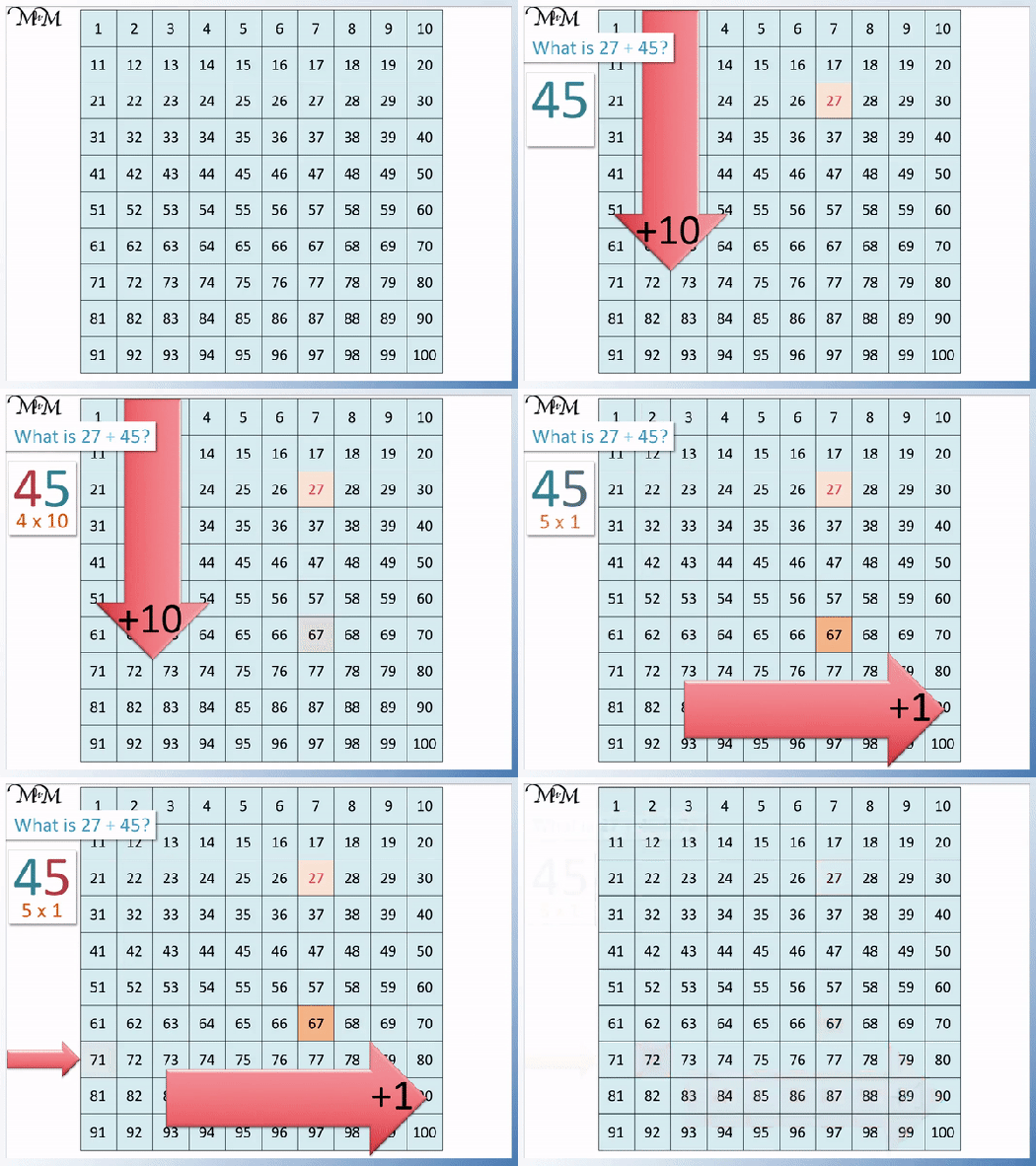
What is 27 + 45?

27 + 45 on the number grid

We’ll begin by looking at the tens column of 45.

We have 4 in the tens column. This means that we have 4 lots of 10.

So, we start at 27 and move 4 rows down the number grid.

We stop at 67.

27 + 45 = 72 shown on the number grid

Next, we’ll look at the units column of 45. We have 5 in the units column.

This means that we have 5 lots of 1. So, we want to move 5 places to the right on the number grid.

After moving 3 places, we reach the end of the row.

The next step is to move to the beginning of the next row.

We moved 3 places to get to the next row, now we need to move 2 more places to the right.

We stop at 72.

Therefore,

27 + 45 = 72.

nextlesson.JPG

Now try our lesson on Subtracting 2-Digit Numbers on the Number Grid where we learn how to subtract 2-digit numbers using the hundred number grid.

Reading Large Numbers in the Millions and Billions

Reading Large Numbers in the Millions and Billions

videolesson.JPG

guide to reading large numbers in the millions and billions in words

  • Separate the number into groups of 3 digits.
  • Starting from the right and moving left, we have the following group names:
  • ‘Hundreds, Tens and Units’, ‘Thousands’, ‘Millions’ and ‘Billions’.
  • Read the digits from left to right, starting with the billions group.
  • Read each group like the hundreds, tens and units group with the group name afterwards.
  • Read the groups from left to right as a list of words.
  • Write ‘and’ between the ‘tens and units’ part of each group.
  • Notice that we put a hyphen ‘-‘ between every word ending in ‘y’ and the following word.

Group digits of 3 as billions, millions, thousands and HTU.

Read each group as HTU, with the group name following it.

videolesson.JPG

example of reading large numbers in the billions in words using a place value chart

  • Group the digits into groups of 3 from right to left as HTU, Thousands, Millions and Billions.
  • Read these place value groups in words as Hundreds, Tens and Units, from left to right.
  • There is 625 in the billions group, so six hundred and twenty-five billion.
  • There is 338 in the millions group, so three hundred and thirty-three million.
  • There is 45 in the thousands group, so forty-five thousand.
  • There is 9 in the HTU group, so we have nine.
  • We read the total large number in words as a list from left to right.
  • Six hundred and twenty-five billion, three hundred and thirty-three million, forty-five thousand and nine.
  • Put a hyphen ‘-‘ between words ending in ‘y’ and the next word.
  • Put a comma ‘,’ between each place value group.
  • Write ‘and‘ before every ‘tens and units’ part in each group.

practiseqs.JPG

Writing Numbers in Words Worksheets and Answers (Millions and Billions)

Blank Printable Place Value Charts for Reading Numbers in the Millions and Billions

How to Write Large Numbers in the Millions and Billions in Words

Digits are any of the numerals: 0, 1, 2, 3, 4, 5, 6, 7, 8 or 9 that are written to make a number.

A number with 3 digits contains hundreds, tens and units.

A number with 4-6 digits is a number in the thousands.

A number with 7-9 digits is a number in the millions.

A number with 10-12 digits is a number in the billions.

In this lesson we are learning how to write large numbers in the millions and billions using words.

To write a large number in words use the following steps:

  1. Separate the number into groups of 3 digits.
  2. Label these groups from right to left as: HTU, Thousands, Millions and then Billions.
  3. Read each group from left to right as though they are hundreds, tens and units but with their group name afterwards.
  4. Write a hyphen between any word ending in ‘y’ and the following word.
  5. Write a comma between each group in the list and write ‘and’ before the ‘tens and units’ part of each group.

We will use this guide to writing numbers in words with some examples below.

In the first example we will read the number 625 338 045 009.

Numbers are normally written with a space between every three digits, such as in this example. This can help us to separate the number into groups of 3 digits when reading it.

Sometimes commas are used to separate the groups of three and you might see this number written as 625, 338, 045, 009.

Large Numbers Millions Billions 1 We put each group of 3 digits into the groups: HTU, Thousands, Millions and Billions from right to left.

We read each group in the same way that we read the HTU group:

  • The first digit is the number of hundreds
  • Write a hyphen between words ending in ‘y’ and the next word.
  • Write ‘and’ between the hundred and the ‘tens and units’ part of the word in each group.

We have 625 in the billions, which is read in words as six hundred and twenty-five billion.

We have 338 in the millions, which is read in words as three hundred and thirty three million.

We have 45 in the thousands, which is read in words as forty-five thousand.

We have 9 in the HTU group, which is read in words as nine.

Putting this list of words together would read as:

Six hundred and twenty-five billion, three hundred and thirty three million, forty-five thousand, nine.

Remember that we need to write ‘and‘ before the list word in the list. We write ‘and‘ before the ‘nine’ in the list above.

This large number written in words is:

Six hundred and twenty-five billion, three hundred and thirty three million, forty-five thousand and nine.

writing a large number in the billions in words using a place value chart example with 6 hundred billion

We will look at another example of writing a number in the billions in words. Again we will use a place value chart.

We will write the number 74 802 194 351 in words.

We make groups of 3 digits and read from left to right.

Example of writing Large Numbers in the billions in words with 74 billion

We have 74 in the billions, which is read in words as seventy-four billion.

We have 802 in the millions, which is read in words as eight hundred and two million.

We have 194 in the thousands, which is read in words as one hundred and ninety-four thousand.

We have 351 in the HTU group, which is read in words as three hundred and fifty-one.

This large number written in words is:

Seventy-four billion, eight hundred and two million, one hundred and ninety-four thousand, three hundred and fifty-one.

writing a number that is 74 billion large in words using a place value chart

In this example we will read the number 148 006 555 327 in words.

reading a large number in words example with 148 billion 6 million

We have 148 in the billions, which is read in words as one hundred and forty-eight billion.

We have 006 in the millions, which is read in words as six million.

We have 555 in the thousands, which is read in words as five hundred and fifty-five thousand.

We have 327 in the HTU group, which is read in words as three hundred and twenty-seven.

This large number read in words is:

One hundred and forty-eight billion, six million, five hundred and fifty-five thousand, three hundred and twenty-seven.

reading and writing a number in the billions in words

Notice that any zero digits are simply ignored.

The next example of writing a number in the billions in words is 591 000 002 895.

example of reading billions in words with zero digits

We have 591 in the billions, which is read in words as five hundred and ninety-one billion.

We have 000 in the millions, which is not read at all because there are no significant digits. We will skip the millions group when reading it.

We have 002 in the thousands, which is read in words as two thousand.

We have 895 in the HTU group, which is read in words as eight hundred and ninety-five.

This large number read in words is:

Five hundred and ninety-one billion, two thousand, eight hundred and ninety-five.

example of reading and writing a number in the billions using place value charts

nextlesson.JPG

Now try our lesson on Place Value of Tenths and Hundredths where we introduce the idea of decimals.

error: Content is protected !!