The 5 Times Table

The 5 Times Table

videolesson.JPG

5 Times Table chart

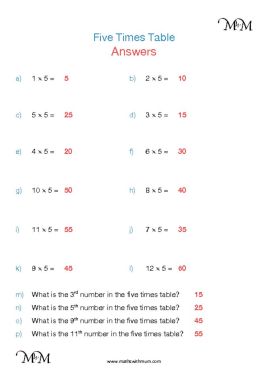
The 5 times table is:

  • 1 × 5 = 5
  • 2 × 5 = 10.
  • 3 × 5 = 15
  • 4 × 5 = 20
  • 5 × 5 = 25
  • 6 × 5 = 30
  • 7 × 5 = 35
  • 8 × 5 = 40
  • 9 × 5 = 45
  • 10 × 5 = 50
  • 11 × 5 = 55
  • 12 × 5 = 60

Learning the 5 Times Table

  • The five times table is made by counting up in fives.
  • The numbers repeat the pattern of ending in 5 and then 0.
  • Each ten contains two numbers. One number ending in 0 and one ending in 5.
  • To multiply any number by 5, multiply it by ten and halve it.
  • To multiply an even number by 5, we can simply halve it and put a zero on the end.
  • We can then work out the next number in the five times table by adding a 5 to this number.

To multiply a number by 5, multiply it by ten and then halve it.

The 5 times table repeats the pattern of ending in 0 and then 5.

videolesson.JPG

8 times 5 in the 5 times table

  • To multiply an even number by 5, halve the number and put a zero on the end.
  • Half of 8 is 4, so we write 4.
  • We put a zero on the end of 4 to get 40.
  • 8 × 5 = 40.
  • This is the same result as multiplying 8 by ten to get 80 and then halving it to get 40.

practiseqs.JPG

5 Times Table Flashcards

Click on the 5 times table flashcards below to memorise the 5 times table.

×
×

=

5 Times Table Worksheets and Answers

The 5 Times Table

What is the 5 Times Table?

The 5 times table is formed by counting up in fives:

  • 1 × 5 = 5
  • 2 × 5 = 10
  • 3 × 5 = 15
  • 4 × 5 = 20
  • 5 × 5 = 25
  • 6 × 5 = 30
  • 7 × 5 = 35
  • 8 × 5 = 40
  • 9 × 5 = 45
  • 10 × 5 = 50
  • 11 × 5 = 55
  • 12 × 5 = 60
  • Here is the 5 times table chart displaying the full 5 times table.

    We can see that each number in the 5 times table can be made by adding 5 to the previous number in the 5 times table.

    5 Times Table Chart

    How to Learn the 5 Times Table

    To learn the 5 times table, first notice the repeating pattern of each number ending in 5 and then 0.

    Even numbers can be easily multiplied by 5 by halving them and then writing a zero after them. We can simply add 5 to these answers to find any odd numbers multiplied by 5.

    This trick works because multiplying by 5 is the same as multiplying by ten and then halving the result. 5 is half of ten.

    To multiply any whole number by ten, we can simply write a zero after it.

    It is easier to halve the number first and then multiply it by ten.

    We can fill in the 5 times table chart below with the even multiples of 5. The trick for learning the 5 times table is to half the even numbers and then put a zero after them.

    Even numbers in the 5 Times Table chart

    For example here is the multiplication of 4 × 5.

    4 is an even number, so we can halve it to get 2.

    4 times 5

    We then put a zero digit on the end of 2 to make 20.

    4 × 5 = 20

    This is the same result we would get if we multiplied by 10 first and then halved our number.

    4 × 10 = 40 and half of 40 is 20.

    Here is 6 × 5. Again 6 is an even number and so we can use our 5 times table trick.

    We halve 6 to get 3 and then put a zero after 3 to get 30.

    how to work out 6 times 5

    6 × 5 = 30

    We would get this result if we first multiplied by 10 and then halved the answer afterwards.

    6 × 10 = 60 and half of 60 is 30.

    Here is the example of 8 × 5. Again 8 is even so we can use our 5 times table trick.

    Half of 8 is 4 and then putting a zero after 4 gives the answer of 40.

    8 times 5

    8 × 5 = 40

    Again, we can multiply 8 by 10 first and then halve it.

    8 × 10 = 80 and half of 80 is 40.

    The even multiples of 5 are the easiest numbers to learn in the 5 times table.

    We can then find all of the rest of the 5 times table by adding 5 on to the numbers that we already know.

    Here is the complete 5 times table chart being filled in by adding 5 to the even multiples.

    5 Times Table chart filled in by adding 5

    For example, if 2 × 5 = 10, then we can easily find 3 × 5 by adding 5 more on to this result.

    10 + 5 = 15 and so, 3 × 5 = 15.

    If we want to find 9 × 5, then we can first find 8 × 5 and then add 5 to this answer.

    8 × 5 = 40 and so 9 × 5 = 45.

    Below is the complete 5 times table list.

    We can see patterns in the 5 times table that help us to memorise it.

    Patterns in the 5 Times Table

    We can see that there are two numbers in each tens digit.

    There are two numbers with 1 as a tens digit: 10 and 15.

    There are two numbers with 2 as a tens digit: 20 and 25.

    There are two numbers with 3 as a tens digit: 30 and 35.

    There are two numbers with a 4 as a tens digit: 40 and 45.

    There are two numbers with a 5 as a tens digit: 50 and 55.

    12 × 5 = 60 and if we included 13 × 5, we would have an answer of 13 × 5 = 65.

    We would then also have two numbers with a 6 as a tens digit.

    We can see that each pair of numbers has a number ending in 0 and the next number ending in 5.

    We can work out any number in the 5 times table from the number before it.

    If the previous number ends in a 0, then the next number in the 5 times table is the same but the 0 becomes a 5.

    If the previous number ends in a 5, then the next number in the 5 times table ends in a 0 and the tens digit is one larger.

nextlesson.JPG

Now try our lesson on Multiplying by Multiples of 10 and 100 where we learn how to multiply by larger numbers ending in a zero.

The 4 Times Table

The 4 Times Table

videolesson.JPG

4 Times Table Poster

The 4 times table is:

  • 1 × 4 = 4
  • 2 × 4 = 8.
  • 3 × 4 = 12
  • 4 × 4 = 16
  • 5 × 4 = 20
  • 6 × 4 = 24
  • 7 × 4 = 28
  • 8 × 4 = 32
  • 9 × 4 = 36
  • 10 × 4 = 40
  • 11 × 4 = 44
  • 12 × 4 = 48

Learning the 4 Times Table from the 2 times table

  • To learn the four times table, it is helpful to already know the two times table.
  • The 4 times table is simply double the 2 times table.
  • To double the answers of the 2 times table, we simply add the number to itself.
  • For example if we know that 5 × 2 = 10, we can double 10 to see that 5 × 4 = 20.
  • To multiply a number by 4, double it and double it again.
  • The last digits of the 4 times table repeat the pattern of 4, 8, 2, 6 and 0.

To multiply a number by 4, double it and double it again.

videolesson.JPG

4 Times Table example of 3 times 4

  • To multiply a number by 3, double the number and double it again.
  • To double a number, add it to itself.
  • 3 + 3 = 6 and so, doubling 3 equals 6.
  • 6 + 6 = 12 and so, doubling 6 equals 12.
  • 3 × 4 = 12

practiseqs.JPG

4 Times Table Flashcards

Click on the 4 times table flashcards below to memorise the 4 times table.

×
×

=

4 Times Table Worksheets and Answers

The 4 Times Table

What is the 4 Times Table

The 4 times table is:

  • 1 × 4 = 4
  • 2 × 4 = 8
  • 3 × 4 = 12
  • 4 × 4 = 16
  • 5 × 4 = 20
  • 6 × 4 = 24
  • 7 × 4 = 28
  • 8 × 4 = 32
  • 9 × 4 = 36
  • 10 × 4 = 40
  • 11 × 4 = 44
  • 12 × 4 = 48

Below is a chart showing the complete 4 times table.

4 Times Table chart

The 4 times table can be formed by counting in fours.

Simply add 4 to any number in the 4 times table to get to the next number in the 4 times table.

How to Learn the 4 Times Table

The easiest way to learn the 4 times table is to double the answers in the 2 times table. To multiply a number by 4, simply double it and double it again.

To double a number, simply add it to itself.

The 4 times table repeats the pattern of digits ending in 4, 8, 2, 6 and 0. This pattern can help us to work out the next number in the 4 times table.

Below is the 2 times table chart.

We can make the 4 times table chart by doubling each answer in the 2 times table chart.

4 Times Table trick of doubling the 2 times table

For example, to find 2 × 4, we double two and then double it again.

2 + 2 = 4, so 2 doubled is 4.

We then double 4.

4 + 4 = 8.

4 times 2 by doubling and doubling again

Therefore 2 × 4 = 8.

If we know the 2 times table, then we can easily find the 4 times table.

By remembering 2 × 2 = 4, we can double it to see that 2 × 4 = 8.

Here is another example of 3 × 4.

We double 3 and then double it again.

3 + 3 = 6 and so, 3 doubled is 6.

We then double 6.

6 + 6 = 12 and so, 6 doubled is 12.

4 Times 3 by doubling and doubling again

Therefore 3 × 4 = 12.

If we remember that 3 × 2 = 6, then we can double the result to see that 3 × 4 = 12.

Here is the example of 5 × 4.

To multiply 5 by 4, we double 5 and then double it again.

5 + 5 = 10 and so, 5 doubled is 10.

10 + 10 = 20 and so, 10 doubled is 20.

4 Times 5 by doubling and doubling again

Therefore 5 × 4 = 20.

If we knew that 5 × 2 = 10, then we can double this result to see that 5 × 4 = 20.

We can also remember the 4 times table by recognising that we add 4 to get from one answer to the next.

To help us add 4, we can remember the pattern of the last digits ending in 4, 8, 2, 6 and then 0.

Because the 4 times table ends in only 4, 8, 2, 6 and 0, all numbers in the 4 times table are even. No numbers in the 4 times table are odd.

This pattern of 4, 8, 2, 6, 0 repeats as seen in the 4 times table chart below.

pattern of even numbers in the 4 times table

Therefore we can use this repeating pattern to help learn which number comes next.

For example, if we remember that 3 × 4 = 12, then we can use this answer to work out 4 × 4.

12 ends in a 2 and the next digit after 2 in the pattern of 4, 8, 2, 6, 0 is a 6.

12 + 4 = 16 and so, 4 × 4 = 16.

We can simply add on 4 from 3 × 4 to find 4 × 4.

If we remember that 10 × 4 = 40, then we can work out 9 × 4 by subtracting 4 from 40.

We can see that 6 is before 0 in the repeating pattern of 4, 8, 2, 6, 0 and so, 40 – 4 = 36.

If 10 × 4 = 40, then we can work out that 9 × 4 = 36.

nextlesson.JPG

Now try our lesson on Multiplying by 100 where we learn how to multiply by 100.

The 3 Times Table

The 3 Times Table

videolesson.JPG

3 Times Table Image

The 3 times table is:

  • 1 × 3 = 3
  • 2 × 3 = 6.
  • 3 × 3 = 9
  • 4 × 3 = 12
  • 5 × 3 = 15
  • 6 × 3 = 18
  • 7 × 3 = 21
  • 8 × 3 = 24
  • 9 × 3 = 27
  • 10 × 3 = 30
  • 11 × 3 = 33
  • 12 × 3 = 36

How to remember the 3 times table

  • To learn the three times table, it is helpful to already know the two times table.
  • We simply add the number that we are multiplying by 3 onto the answer to the 2 times table.
  • For example, 5 × 3 is just another 5 more than 5 × 2.
  • If we know that 5 × 2 = 10, we can add 5 to this answer to see that 5 × 3 = 15.
  • We can add the digits of the answers to the 3 times table and they will always repeat the pattern of 3, 6, and 9.

To multiply a number by 3, multiply it by 2 and then add the number on to the answer.

videolesson.JPG

5 times 3

  • To multiply a number by 3, multiply it by 2 and then add the number on to the answer.
  • 5 × 2 = 10.
  • We add 5 on to this answer.
  • 10 + 5 = 15 and so, 5 × 3 = 15

practiseqs.JPG

3 Times Table Flashcards

Click on the 3 times table flashcards below to memorise the 3 times table.

×
×

=

3 Times Table Worksheets and Answers

The 3 Times Table

What is the 3 Times Table?

The 3 times table starts at three and counts up in threes like so:

  • 1 × 3 = 3
  • 2 × 3 = 6.
  • 3 × 3 = 9
  • 4 × 3 = 12
  • 5 × 3 = 15
  • 6 × 3 = 18
  • 7 × 3 = 21
  • 8 × 3 = 24
  • 9 × 3 = 27
  • 10 × 3 = 30
  • 11 × 3 = 33
  • 12 × 3 = 36

To get from one answer in the 3 times table to the next, simply add three.

The full three times table list is shown below.

3 Times Table list

It is best to learn the three times table after the two times table. Knowing the two times table very well makes it much easier to learn the three times table.

How to Learn the 3 Times Table

The easiest way to learn the 3 times table is to remember that adding the digits of the numbers gives us the pattern of 3, 6 and then 9. Every time the pattern is repeated, we increase the tens digit by 1 and decrease the ones column by 1.

For example, we have 3, 6 and 9.

Next comes 12, 15 and 18, whose digits add to 3, 6 and 9.

Next comes 21, 24, and 27, whose digits add to 3, 6 and 9.

Finally we have 30, 33 and 36, whose digits add to 3, 6 and 9.

3 Times Table 4

We can see that we have groups of three numbers in each ten.

3, 6 and 9 have zero tens.

12, 15 and 18 have one ten.

21, 24 and 27 have two tens.

30, 33 and 36 have three tens.

3 times table pattern

We can see that we increase the tens digit by one each time we have the pattern of 3, 6 and 9.

The digit in the units column decreases by one each time the tens digit increases by one.

Teaching the 3 times table using a pattern

For example, if we know that we start with 3, 6 and 9, then we next have 12, 15 and 18.

12, 15 and 18 end in 2, 5 and 8 which is one less than 3, 6 and 9.

Next is 21, 24 and 27, which end in 1, 4 and 7. These are one less than 2, 5 and 8 in the previous group.

Finally, 30, 31 and 32 end in 0, 1 and 2, which are one less than 1, 4 and 7 in the previous group.

Provided that we remember the 3, 6, 9 pattern, we can learn the 3 times table quite quickly. The numbers come in groups of three with their digits adding to 3, 6 and 9. Every time that we repeat this pattern, the tens column increases by 1 and the ones column decreases by 1.

Teaching the 3 Times Table

The above trick is the easiest method for learning the three times table, however when first introducing it, it is helpful to remember that it is finding three lots of a number.

For example, 3 × 5 means 5 + 5 + 5. We add 5 three times.

If we already know the 2 times table, then we already have two lots of the number and we only need to add one more lot.

We can teach the three times table using the two times table. If we know our two times table well, we can simply add another lot on to the answer.

For example, here is 3 × 2.

We already know that 2 × 2 = 4 from our two times table.

learning the 3 times table using the 2 times table example of 3 times 2

We can add another 2 onto 4 to get 3 × 2 = 6.

2 × 2 means 2 + 2 and 3 × 2 means 2 + 2 + 2. We only have to add on another 2.

Here is another example of 5 × 3.

From the two times table, 5 × 2 = 10.

5 times 3 equals 15

We add another lot of 5 to our answer. 10 + 5 = 15 and so, 5 × 3 = 15.

Here is the full three times table shown below, where each number is added on to the two times table.

three times table list made by adding on to the two times table list.

whilst not the quickest method, this strategy can be useful to teach to help reinforce that if we know one times table, it can be used to find another times table that is close by.

The two times table is one of the easier ones to learn as it is simply doubling each number by adding it to itself. This means that it is one of the first times tables to be learnt and most children will learn this first.

If they remember the two times table, they can work out the threes by adding on the number again.

Overall, it is best to know the times tables by heart and not have to work them out. This is because there are many aspects of Mathematics that require times tables and knowing them inside out allows us to spend less times focusing on the times table and more time on the new methods we are learning.

The best way to remember the three times table is the pattern of 3, 6, 9 shown above.

Easy times table trick to memorise the 3 times table

The numbers in the three times table are always odd.

nextlesson.JPG

Now try our lesson on Multiplying by 0 and 1 where we learn how to multiply by 0 and 1.

The 2 Times Table

The 2 Times Table

videolesson.JPG

2 times table poster

The 2 times table is:

  • 1 × 2 = 2
  • 2 × 2 = 4.
  • 3 × 2 = 6
  • 4 × 2 = 8
  • 5 × 2 = 10
  • 6 × 2 = 12
  • 7 × 2 = 14
  • 8 × 2 = 16
  • 9 × 2 = 18
  • 10 × 2 = 20
  • 11 × 2 = 22
  • 12 × 2 = 24

How to learn the 2 times table by adding

  • To multiply a number by two, simply double it.
  • The easiest way to double a number is to add it on to itself.
  • It helps to know addition before trying to learn the 2 times table.
  • It is also useful to practise skip counting in twos before learning the 2 times table.
  • We can see that numbers the 2 times table follow a pattern of ending in 2, 4, 6, 8 and 0 in that order.

To multiply a number by 2, add it to itself.

The 2 times table repeats the pattern of ending in 2, 4, 6, 8 and 0.

videolesson.JPG

5 times 2 equals 10 as an example of the two times table.

  • To multiply a number by 2, add the number to itself.
  • To multiply 5 by 2, we add 5 to 5.
  • 5 + 5 = 10 and so, 5 × 2 = 10.

practiseqs.JPG

2 Times Table Flashcards

Click on the 2 times table flashcards below to memorise the 2 times table.

×
×

=

2 Times Table Worksheets and Answers

The 2 Times Table

What is the 2 Times Table?

The 2 times table is:

  • 1 × 2 = 2
  • 2 × 2 = 4.
  • 3 × 2 = 6
  • 4 × 2 = 8
  • 5 × 2 = 10
  • 6 × 2 = 12
  • 7 × 2 = 14
  • 8 × 2 = 16
  • 9 × 2 = 18
  • 10 × 2 = 20
  • 11 × 2 = 22
  • 12 × 2 = 24

Here is the 2 times table shown in a poster:

3 times 2 in the two times table is simply 3 + 3

How to Learn the 2 Times Table

To learn the 2 times table, double each number you are multiplying by 2. To double a number easily, simply add it on to itself. For example 3 × 2 can be found by working out 3 + 3, which is 6.

The 2 times table can be memorised since the numbers repeat the pattern of ending in 2, 4, 6, 8 and 0.

3 times 2 in the two times table is simply 3 + 3

Here is another example of multiplying by 2 by adding a number to itself.

Here we have 5 × 2.

We add 5 to itself. 5 + 5 = 10.

And therefore, 5 × 2 = 10.

2 Times Table example of 5 times 2 by adding it to itself.

We can use the trick of adding a number to itself to work out all of the numbers in the two times table easily.

The 2 times table trick of adding a number to itself

We can see that the answers in the times table always end in 2, 4, 6, 8 and then 0.

This pattern repeats and can help us to work out the next number along if we know the previous times table.

For example if we are asked what 9 × 2 is, we might already remember that 8 × 2 = 16.

16 ends in 6 and we know that the pattern repeats 2, 4, 6, 8, 0. After 6 comes 8.

If 8 × 2 = 16, then the next times table along is 9 × 2 = 18. We just remember that 8 comes after 6 in our two times table pattern.

9 times 2

Alternatively, we add 9 to itself. 9 + 9 = 18.

And therefore, 9 × 2 = 18.

Teaching the 2 Times Table

When teaching the 2 times table, it is important to first be strong in addition. This is because to work out the two times table, we need to add the number on to itself.

It is also important to practise skip counting in twos. Knowing how to count on in twos helps us to go from one times table to the next by adding two to the answer.

It is also helpful to teach the 2 times table arranged in rows of 5 so that we can easily see the pattern of the numbers ending in 2, 4, 6, 8 and 0.

For example, below is the full 2 times table arranged in rows of 5.

pattern in the two times table

We can see that each column has numbers ending in 2, 4, 6, 8 and then 0.

After we have a number ending in zero, we simply move to the next column.

We can teach that every time we go from ending in 8 to ending in 0, we must increase the tens digit by 1.

It is helpful to teach the two times table by skip counting through the answers by adding 2 to the previous answer.

The two times table list

We can start with 2 and add 2 more to get 4.

We add 2 to 4 to get 6.

We add 2 to 6 to get 8 and so on.

It is helpful for children to realise that they can just add 2 to the previous number to find out the next number in the 2 times table.

It is helpful to memorise the 2 times table by simply chanting through the answers by adding two each time.

nextlesson.JPG

Now try our lesson on 2-Digit Column Addition where we learn how to use the column addition method for adding two numbers.

Dividing Whole Numbers by Fractions

Dividing Whole Numbers by Fractions

videolesson.JPG

Dividing a whole number by fraction visual model of 2 divided by one half

  • 2 ÷   1 / 2   is the same as asking, “How many halves go into 2?”
  • We can count and see that 4 halves make up 2 wholes.
  • 2 ÷   1 / 2   = 4 because   1 / 2   goes into two 4 times.

Steps for dividing a whole number by a fraction example of 2 divided by one half

  • We keep the whole number the same.
  • We turn the division into a multiplication.
  • We flip the fraction we are dividing by.
  • 2 ÷   1 / 2   becomes 2 ×   2 / 1  .
  • To work this out, first multiply the whole number by the numerator on the top of the fraction.
  • 2 × 2 = 4.
  • Then divide this by the denominator on the bottom of the fraction.
  • 4 ÷ 1 = 4.
  • 2 ÷   1 / 2   = 4.
  • This means that one half goes into two 4 times or that 4 halves make 2.

Turn the division into a multiplication and flip the fraction you are dividing by.

Multiply the whole number by the top of the fraction and then divide by the bottom of the fraction.

videolesson.JPG

Dividing a whole number by a fraction example of 6 divided by two thirds = 9

  • We keep the whole number 6 the same.
  • We turn our division sign into a multiplication sign.
  • We flip the fraction we are dividing by.
  • 6 ÷   2 / 3   becomes 6 ×   3 / 2  .
  • We multiply the 6 by the numerator on the top.
  • 6 × 3 = 18.
  • We divide 18 by the denominator on the bottom of the fraction.
  • 18 ÷ 2 = 9.
  • 6 ÷   2 / 3   = 9.

practiseqs.JPG

Dividing Whole Number by Fractions Worksheets and Answers

Dividing Whole Numbers by Fractions

What does it Mean to Divide Whole Number by a Fraction?

Dividing a whole number by a fraction tells us how many of these fractions add together to make the whole number.

When teaching division by fractions, it is always best to start with a visual model.

We can first look at the division of whole numbers by whole numbers to remember what the division tells us.

Here we have 6 ÷ 2.

This division means, “How many twos go into 6?”

what does division mean example of 6 divided by 2

We can see that 2 goes into six 3 times. Therefore 6 ÷ 2 = 3.

We can think of division by fractions in a similar way.

Here we have 2 ÷  1 / 2  shown with a model.

This division means, “How many halves go into 2?”

how to divide whole numbers by fractions with a visual model

It can help to teach division of fractions using a visual model.

Each whole is made up of two halves. We can count and see that 4 halves make 2 wholes.

We can see that the 2 in the whole number can be multiplied by the 2 in the fraction to give us our answer of 4.

Whilst visual models are useful for first introducing division by fractions, it is useful to have a quicker, written method.

Division is the opposite of multiplication and so, we can turn the division into a multiplication provided that we flip the fraction.

We use the three steps of:

  • Keep
  • Multiply
  • Flip

to divide whole numbers by fractions.

Divide Whole Numbers by Fractions method for dividing 2 by one half

We keep 2 as 2.

We turn the division into a multiplication.

We flip the fraction  1 / 2  to become  2 / 1 .

We can multiply the whole number by the number on top of the fraction and divide by the number on the bottom of the fraction to work this out.

2 × 2 = 4

and 4 ÷ 1 = 4

2 ÷  1 / 2  = 4.

This means that 4 of the fraction  1 / 2  make up the whole number of 2.

Here is another model of dividing whole numbers by fractions.

We have 6 ÷  2 / 3 .

This question is asking, “How many of the fractions  2 / 3  make 6 wholes?”

The fraction of two thirds is 2 out of 3. We can see this fraction shown in the model below. every 2 blocks shaded is another two thirds.

a model of 6 divided by the fraction two thirds

We can see that there are 9 separate lots of two thirds that can fit inside 6 wholes.

6 ÷  2 / 3  = 9 because  2 / 3  goes into six 9 times.

We can see that we can use our 3 steps of

  • Keep
  • Multiply
  • Flip

to divide this whole number by a fraction and get the same answer.

method for dividing 6 by the fraction two thirds

We rewrite 6 ÷  2 / 3  as 6 ×  3 / 2 .

We multiply 6 by the 3 on top and then divide it by the 2 on the bottom to get our answer.

6 × 3 = 18 and then 18 ÷ 2 = 9.

This is the same answer we got by drawing our visual model but it is more of a methodical process that does not require a drawing.

How to Divide a Whole Number by a Fraction

To divide a whole number by a fraction:

  1. Keep the whole number the same.
  2. Change the division sign into a multiplication sign.
  3. Flip the fraction you are dividing by.
  4. Multiply the whole number by the number on the top of this flipped fraction.
  5. Divide this result by the number on the bottom of the flipped fraction.

We will use these steps to work out the following example. We have the division of the whole number 5 by the fraction   5 / 6  .

The first step is to keep the whole number 5 as 5.

The second step is to turn the division sign, ÷, into a multiplication sign, ×.

The third step is to flip the fraction   5 / 6   to   6 / 5  .

example of dividing a whole number by a fraction 5 divided by 5 sixths

5 ÷   5 / 6   can be written as 5 ×   6 / 5  .

To work this out, we use use steps 4 and 5.

The fourth step is to multiply the whole number, 5, by the numerator on the top of the flipped fraction, which is 6.

5 × 6 = 30

The fifth step is to divide this result by the denominator on the bottom of the flipped fraction, which is 5.

30 ÷ 5 = 6

And so, 5 ÷   5 / 6   = 6.

Here is another example of dividing whole numbers by fractions.

We have 8 ÷   1 / 4  .

We keep the 8 as 8 and turn the division into a multiplication.

We flip the fraction 5 / 6   to become 6 / 5  .

dividing the whole number 8 by the fraction one quarter

8 ÷   1 / 4   can be written as 8 ×   4 / 1  .

We multiply the 4 by 8 to get 32.

Then we divide 32 by 1, which is still 32.

8 ÷   1 / 4   = 32.

This means that 32 quarters make 8 wholes in total.

nextlesson.JPG

Now try our lesson on Translating Shapes where we learn what it means to translate a shape.

Learn Times Tables Game

< Learn Times Tables Game

Share on Google Classroom:

Choose a particular times table to practise:

What is x ?

Addition by Partitioning

Addition by Partitioning

videolesson.JPG

example of adding 32 + 21 using the partitioning strategy

  • We partition the two numbers by writing them as the sum of their tens and units.
  • Multiply the tens digit in each number by ten to see its value.
  • For example, 32 = 30 + 2 and 21 = 20 + 1.
  • We add the tens and the units separately.
  • We can see that 30 + 20 = 50 because 3 + 2 = 5.
  • Adding the units, 2 + 1 = 3.
  • Once we have added the tens and units separately, we add the two results together.
  • 50 + 3 = 53 and so, 32 + 21 = 53.
  • Addition using the partitioning strategy is also known as the split strategy for addition.

Split each number into its tens and units.

Add the tens and units separately and then add these results to find the total.

videolesson.JPG

Example of addition using the partitioning strategy to add 63 + 17

  • We first split the numbers into their tens and units.
  • 63 contains 6 tens and 3 units and so, 63 = 60 + 3.
  • 17 contains 1 ten and 7 units and so, 17 = 10 + 7.
  • We add the tens in each number.
  • 60 + 10 = 70.
  • Next we add the units.
  • 3 + 7 = 10.
  • Finally, we add these results.
  • 70 + 10 = 80 and so, 63 + 17 = 80.

videolesson.JPG

practiseqs.JPG

Addition by Partitioning Worksheets and Answers

Addition using the Partitioning Strategy

What is the Partitioning Strategy for Addition?

The partitioning strategy is also known as the split strategy. The partitioning strategy is a method used to break down larger additions into smaller additions that are easier to do.

Addition by partitioning involves splitting numbers into their hundreds tens and units. The hundreds, tens and units are added separately.

Addition by partitioning is useful because it provides us with an alternative strategy for adding numbers. It is a particularly important strategy for mental addition. This process can be learnt as shown in this lesson by writing out the steps and eventually, when this is method is mastered, addition by partitioning can be done mentally.

Addition by partitioning is one of the most effective strategies for mental addition.

For example, here is the addition of 32 + 21.

The addition is easier to work out by breaking it down into steps.

partitioning numbers using the split strategy for addition

32 contains 3 in the tens column and 2 in the ones column.

3 tens are 30. We simply put a zero digit on the end of the 3.

32 can be split into 30 + 2.

21 is made up of 2 tens and 1 one.

21 can be split into 20 + 1.

Splitting the numbers into their tens and ones is called partitioning. We can partition numbers in other ways. For example we can partition 32 into 28 + 4 but this is not a helpful way to break down the addition.

In the split strategy, we always partition the numbers into tens and ones.

Addition by Partitioning example of 32 + 21 with all working shown.

Once both numbers have been partitioned, we add the tens of one number to the tens of the other number.

We have 30 + 20. Adding the tens is simple because we can treat this as 3 + 2 but with a zero on the end.

30 + 20 = 50 because 3 + 2 = 5. The sum of the tens is 50.

We now add the ones. We have 2 + 1 = 3. The sum of the ones is 3.

Once we have added the tens and the ones, all that remains is to find the total to get our answer. We add the sum of the tens to the sum of the ones.

50 + 3 = 53 and so, 32 + 21 = 53.

Addition using the Partitioning Strategy

To add numbers using the partitioning strategy, use the following steps:

For example, here is 45 + 32. We will use the addition by partitioning method (or split strategy) to work this out.

the split strategy for the addition of 45 + 32

The first step is to look at each number and see that they are made up of a tens digit and a one digit.

45 is 40 + 5 and 32 is 30 + 2.

There are no hundreds to add in this number but we have tens and units.

We add the tens first. We have 40 and 30.

Addition by Partitioning 2

40 + 30 = 70

We now add the ones.

5 + 2 = 7

Having added the tens and ones separately, the final step is to now add these two answers together.

The sum of the tens is 70 and the sum of the ones is 7.

70 + 7 = 77

Therefore, 45 + 32 = 77.

We will use the split strategy in this next example of 29 + 25.

The first step is to partition the numbers into their tens and ones.

29 = 20 + 9 and 25 = 20 + 5.

partitioning strategy for the addition of 29 + 25

We now add the tens.

20 + 20 = 40

And now we add the ones.

9 + 5 = 14

Addition by Partitioning strategy for 29 + 25

We finally add the two answers together to find our total.

40 + 14 = 54 and so, 29 + 25 = 54.

We can see that using the partitioning strategy for addition results in simpler sums.

nextlesson.JPG

Now try our lesson on 2-Digit Column Addition where we learn how to use the column addition method for adding two numbers.

Dividing Fractions by Whole Numbers

Dividing Fractions by Whole Numbers

videolesson.JPG

Multiply the denominator on the bottom of the fraction by the whole number you are dividing by.

how to divide a fraction by a whole number

  • To divide a fraction by a whole number, multiply the bottom of the fraction by the whole number.
  • The bottom of the fraction is 2 and the whole number is 3.
  • 2 × 3 = 6.
  •   1 / 2   ÷ 3 =   1 / 6  .
  • We divide the fraction by 3 so we make the bottom of the fraction 3 times larger.
  • The number on the bottom of the fraction tells us how much it is divided into.
  • A larger number on the bottom of a fraction means that it is divided into more parts.

visual model to show the division of a fraction by a whole number. one half divided by 3.

  • When dividing a fraction by a whole number, the fraction gets even smaller.
  • Here, one half is divided into 3 equal parts.
  • After the division we now have 1 out of 6 parts.
  •   1 / 2   ÷ 3 =   1 / 6  .
  • The circle was originally split into 2 parts. Dividing this further by 3 meant that it was then divided into 6 parts.
  • The fraction   1 / 2   got smaller when it was divided by 3.

videolesson.JPG

Dividing a Fraction by a Whole Number – Method 1

steps for dividing fractions by a whole number example of 6 out of 7 divided by 2

  • To divide a fraction by a whole number, multiply the bottom of the fraction by the whole number.
  • The denominator on the bottom of this fraction is 7.
  • We will multiply 7 by 2.
  • 7 × 2 = 14 and so,   6 / 7   ÷ 2 =   6 / 14  .
  • We can simplify   6 / 14   by dividing both the top and bottom of the fraction by 2.
  •   6 / 14   =   3 / 7  .
  • Therefore,   6 / 7   ÷ 2 =   3 / 7  .
  • We can see in this example that we could have divided the top of the fraction by 3 to solve this more quickly.
  • 6 ÷ 2 = 3 and so,   6 / 7   ÷ 2 =   3 / 7  .

Dividing a Fraction by a Whole Number – Method 2

shortcut for dividing a fraction by a whole number

  • We can only use this method if the numerator on top can be divided exactly by the whole number.
  • Here is   9 / 10   ÷ 3.
  • There is a shortcut we can use if the numerator can be divided exactly by the whole number.
  • We divide the 9 on top by the whole number of 3 directly.
  • 9 ÷ 3 = 3 and so, the new numerator is 3.
  •   9 / 10   ÷ 3   =   3 / 10   .

videolesson.JPG

practiseqs.JPG

Dividing Fractions by Whole Numbers Worksheets and Answers

Dividing Fractions by Whole Numbers

How to Divide Fractions by Whole Numbers

To divide fractions by whole numbers use the following steps:

  1. Divide the top of the fraction by the whole number if it divides exactly.
  2. If not, multiply the bottom of the fraction by the whole number.

If you used step 2, you may need to simplify your answer by dividing the top and bottom of the fraction by the same number.

For example, calculate  4 / 5   ÷ 3.

We first look to see if we can divide the numerator on top by 3.

We have a 4 on the top of the fraction and 4 cannot be divided exactly by 3 to leave a whole number.

This means that we use step 2 instead to divide the fraction.

Dividing the fraction 4 fifths by the whole number 3

We multiply the denominator on the bottom by the whole number we are dividing by. 5 is the denominator of the fraction.

5 × 3 = 15 and so, 15 is the denominator on the bottom of the answer.

  4 / 5   ÷ 3 =   4 / 15  .

We have multiplied the denominator by 3 to divide the whole fraction by 3.

Calculate   6 / 7   ÷ 2.

We can follow the method shown in the previous example, where we can multiply the denominator by 2.

  6 / 7   ÷ 2 =   6 / (7 × 2)  .

  6 / 7   ÷ 2 =   6 / 14  .

This can then be simplified because both 6 and 14 can be divided by 2.

  6 / 14   =   3 / 7  .

different methods for dividing a fraction by a whole number

However, it is much easier to use step 1 in our steps for dividing fractions by whole numbers.

We can see that the numerator on top can be divided straight away.

6 ÷ 2 = 3 and so, the numerator can be divided exactly.

We can simply divide the numerator in   6 / 7   by 3 to get our answer of   3 / 7  .

It is easier to do this method as there is no simplification required afterwards.

To divide a fraction by a whole number, we can either multiply the denominator by the whole number or we can divide the numerator by the whole number.

Notice that we only need to do one method or the other.

Here is another example of using this method to divide a fraction by a whole number.

We have   9 / 10   ÷ 3.

We can immediately see that 9 ÷ 3 = 3 and it divides exactly. We use method 1.

Example of dividing a fraction by a whole number easily with 9 tenths divided by 3

We divide the numerator and leave the denominator the same.

  9 / 10   ÷ 3 =   3 / 10  .

Notice that we only divide the 9 by 3. We do not multiply the 10 on the bottom by three because we have already done our division by dividing the 9 by 3.

Model for Dividing Fractions by Whole Numbers

When we divide we are sharing an amount into equal parts. Dividing a fraction by a whole number also means to split it into equal parts.

When we divide a fraction by a whole number it gets smaller.

Here is an example of dividing the fraction  1 / 2   by 3.

 1 / 2   means that we have 1 out of 2 equal parts.

Dividing fractions by whole numbers with a visual model showing one half divided by 3 When we divide one half by 3, we split it into 3 equal parts.

Divide Fraction by Whole Number 2

The answer is smaller than one half.

It is 1 out of 6 equal parts.

Divide Fraction by Whole Number 1 & 2

We say that   1 / 2   ÷ 3 =   1 / 6  .

We can see in the visual model that final shaded area is a smaller fraction than we started with but the number at the bottom of the fraction increased from 2 to 6.

We multiplied the denominator on the bottom of the fraction by 3 to divide the fraction by 3.

Dividing Fractions by Whole Numbers method for one half divided by 3

Without drawing a visual model, the method is simply to multiply the bottom of the fraction by 3.

Here is another example of dividing a fraction by a whole number.

We have   3 / 4   ÷ 2 =   shown with a visual model.

  3 / 4   means that we have 3 out of 4 equal parts. This is shown below.

How to divide 3 quarters by 2 when dividing a fraction by a whole number shown with a visual model

When we divide   3 / 4   by 2, we will only have half of the original shaded fraction.

We can split each quarter in two so that there are 8 pieces in total. 3 quarters is the same as 6 out of 8 parts.

If we divide by 2, we will only have 3 out of 8 parts.

We can see that half of   3 / 4   is   3 / 8  .

The circle was divided into twice as many parts. Instead of 3 out of 4 we now only have 3 out of 8 parts.

We can see this division without a visual model below.

Dividing the fraction 3 quarters by 2 shown step by step.

We can see that it is easier to simply multiply the bottom of the fraction by 2. Multiplying the bottom of the fraction by 2 has the same effect as dividing the fraction by 2.

When teaching dividing fractions by whole numbers, it is important to remember that increasing the number on the top of the fraction makes the fraction bigger but increasing the number on the bottom of the fraction makes it smaller.

Some children can be confused with the division resulting in multiplying the denominator on the bottom but it is important to remember that the number on the bottom of the fraction is how many parts we have shared our amount into.

The bigger the denominator on the bottom, the smaller the fraction.

nextlesson.JPG

Now try our lesson on Converting Fractions to Decimals where we learn how to write a fraction as a decimal.

Are Addition and Subtraction Commutative?

Are Addition and Subtraction Commutative?

videolesson.JPG

Addition is Commutative

teaching the commutative property of addition using cubes

  • Addition is commutative.
  • This means that it does not matter in which order we add numbers together.
  • For example, both 4 + 6 = 10 and 6 + 4 = 10.
  • The word ‘commute’ means to move.
  • We can see that moving the positions of 4 and 6 in the sum does not change the answer.
  • To teach the commutative property of addition we can use multilink cubes.
  • We can see that 4 + 6 = 6 + 4 because the cubes are the same length.

The commutative property of addition simply means that it does not matter in which order we add numbers together.

Subtraction is Not Commutative

The order of subtraction matters. Subtraction is not commutative

  • Subtraction is not commutative.
  • This means that the order of the numbers in the subtraction matters.
  • For example, 10 – 2 = 8.
  • We can take 2 away from 10 because 2 is less than 10.
  • If we switch the order of the numbers, 2 – 10 = -8.
  • Without using negative numbers, we cannot take 10 from 2.
  • We cannot subtract more than we start with without going into negative numbers.
  • We say that the largest number in a subtraction comes first (unless we are using negative numbers).
  • 10 – 2 does not equal the same as 2 – 10.

Subtraction is not commutative because changing the order of the numbers changes the answer.

videolesson.JPG

An example of the addition commutative property with 3 + 5

  • Addition is commutative, which means that the order in which we add numbers does not matter.
  • 3 + 5 = 5 + 3.
  • Both 3 + 5 = 8 and 5 + 3 = 8.
  • Because both additions have a 3 and a 5 added together, the answer to both sums is the same.
  • We can teach this commutative property by adding both 3 + 5 and 5 + 3 using cubes and showing that they are the same length.

videolesson.JPG

Addition is Commutative: Video Lesson

Subtraction is Not Commutative: Video Lesson

practiseqs.JPG

Commutative Property of Addition Worksheets and Answers

Commutative Property Worksheets and Answers

Are Addition or Subtraction Commutative?

What is the Commutative Property?

The commutative property simply means that switching the order of the numbers in a calculation does not affect the answer.

Addition and multiplication are both commutative. Subtraction and division are not commutative.

We can remember that the word ‘commute’ means to move. If moving the numbers in a calculation by switching their places does not affect the answer, then the calculation is commutative.

Addition is commutative. For example, 3 + 5 = 8 and 5 + 3 = 8.

The commutative property of addition shown with counters in the sum 3 + 5

We can see that 3 + 5 = 5 + 3.

The commutative law of addition states that a + b = b + a.

‘a’ and ‘b’ are just different numbers and the commutative law means that if we switch the order of the numbers in an addition, the answer remains the same.

Multiplication is commutative. For example, 3 × 5 = 15 and 5 × 3 = 15.

commutative property of multiplication example of 3 × 5 = 15

We can see that 3 × 5 = 5 × 3.

The commutative law of multiplication states that a × b = b × a.

‘a’ and ‘b’ are just different numbers and the commutative law means that if we switch the order of the numbers in a multiplication, the answer remains the same.

Is Addition Commutative?

Addition is always commutative. This means that it does not matter in which order two or more numbers are added together, the answer will be the same.

Switching the order of any two numbers in an addition does not affect the answer.

For example 4 + 6 = 10 and 6 + 4 = 10. Both additions are the same except for the two numbers in the addition, 4 and 6, have switched positions. The answer to both sums is both 10.

The order of addition does not matter. 4 + 6 = 6 + 4 because of the commutative property of addition.

We can teach the commutative property of addition by using multilink cubes or counters.

To show the addition of 4 + 6, we take 4 cubes of one colour and 6 cubes of another. We connect them together to show the addition.

We can see that 4 + 6 = 6 + 4 because both rows of cubes are both the same length. Both rows of cubes are 10 cubes long. 4 + 6 = 10 and 6 + 4 = 10.

The order of addition does not matter.

Here is another example of teaching the commutative property of addition.

We have 3 + 5 and 5 + 3.

the order of numbers in an addition does not matter and 3 + 5 = 5 + 3

We can see that both 3 + 5 = 8 and 5 + 3 = 8.

When teaching commutativity with cubes, we can see that both rows of cubes are the same length.

We can see that as long as the numbers being added are the same, it does not matter which order they are in, the answer is always the same.

Both sums have 3 and 5 next to the addition sign and so, both answers are 8.

When teaching commutativity in addition, multilink cubes are the best because they connect together without gaps.

We can also teach this property using counters as seen in the example of 3 + 2 below.

teaching the commutative property of addition using counters to show that 3 + 2 = 2 + 3

We can see that there are the same number of counters in each pile.

We can use two piles of counters to show each sum. We can use this to show that 2 + 3 = 3 + 2.

There are 5 counters in both piles.

Is Subtraction Commutative?

Subtraction is not commutative. This means that the order of the numbers in the subtraction does matter.

For example, 10 – 2 = 8 but 2 – 10 = -8. Switching the order of the numbers in the subtraction changed the answer.

We can look at the subtraction 10 – 2 by using counters.

10 – 2 means to start with 10 and take 2 away.

We can see that after removing 2 counters, 8 counters remain.

Subtraction is not commutative. The order matters. 10 - 2 is shown with counters and compared to 2 - 10.

We can switch the order of the 10 and the 2 in the subtraction.

We will try and work out 2 – 10.

We cannot subtract 10 counters because we do not have enough. We only have 2.

We will not look at negative numbers in this lesson and so, we cannot take away a larger number from a smaller number.

We can see that the order of the subtraction matters. We need to subtract the smaller number from the larger number.

When teaching the order of numbers in a subtraction, we can say that the largest number must come first in a subtraction.

the largest number comes first in the order of numbers in a subtraction.

We can subtract 2 from 10 because 10 is larger than 2.

We cannot subtract 10 from 2 because if we only have 2 counters, we will run out before we subtract all 10.

After taking away 2 counters, we would still need to subtract another 8 more. We can say that we would owe 8 counters.

We can write this as 2 – 10 = -8, which means 2 counters subtract 10 counters means that we owe another 8 counters.

We will not introduce negative numbers in this lesson. Instead we will just say that we cannot subtract a larger number from a smaller one without being in debt.

There is no commutative law of subtraction because a – b ≠ b – a..

The order of subtraction matters.

Here is another example in which the order of subtraction matters.

Here is 6 – 5.

We are subtracting a smaller number away from a larger number.

We can teach the order of subtraction with counters by starting with the 6 counters and subtracting 5 to see how many are left over.

After subtracting 5 counters, 1 counter remains.

6 – 5 = 1

The order of subtraction matters and can be seen when comparing 6 - 5 to 5 - 6

If we switch the order of the numbers in a subtraction, the answer is not the same.

5 – 6 does not equal 1.

We can start with 5 counters and try to take away 6 counters but we will run out of counters before we subtract all 6.

Again, without going into debt or negative numbers, in a subtraction the largest number comes first.

the largest number comes first in a subtraction such as 6 - 5 = 1

6 is bigger than 5 and so, 6 belongs at the front of the subtraction.

It is possible to have 5 – 6 but the answer is -1.

When first teaching subtraction, it can help to show children that the largest number comes first. When negative numbers are introduced at a later stage, this rule is no longer true.

nextlesson.JPG

Now try our lesson on Order of Multiplication where we learn the commutative law of multiplication.

Rounding to the Nearest Thousand

Rounding to the Nearest Thousand

videolesson.JPG

Rounding to the Nearest Thousand Calculator

Rounding to the Nearest Thousand Summary

How to round to the nearest thousand example of 6614

  • Rounding to the nearest thousand means to write down the multiple of 1000 that is nearest to our number.
  • The thousands digit will either remain the same or it will increase by one.
  • 6614 is in between 6000 and 7000, so the options are to round down to 6000 or round up to 7000.
  • To decide whether we round up or down, we look at the digit in the hundreds column.
  • If the digit is 4 or less, we round down.
  • If the digit is 5 or more, we round up.
  • This is because 6500 is halfway between 6000 and 7000.
  • 6614 has a 6 as its hundreds digit and 6 is ‘5 or more’.
  • This means that 6614 rounds up to 7000.
  • This means that 6614 is nearer to 7000 than 6000.
  • We always look at the hundreds digit to decide how to round our number to the nearest hundred.

Look at the digit in the hundreds column.

If it is 4 or less, round down. If it is 5 or more, round up.

videolesson.JPG

Rounding to the nearest thousand example of 4392

  • 4392 has a 4 as its thousands digit so we can choose to round down to 4000 or round up to 5000.
  • We look at the digit in the hundreds column, which is 3.
  • This digit is ‘4 or less’ and so we round down.
  • 4392 rounds down to 4000.
  • This means that 4392 is nearer to 4000 than it is to 5000.
  • We can see that it is less than 4500, which is the halfway point between 4000 and 5000.

videolesson.JPG

practiseqs.JPG

Rounding to the Nearest Thousand: Interactive Questions

Rounding to the Nearest Thousand: Interactive Questions

Rounding to the Nearest Thousand Worksheets and Answers

Rounding Numbers to the Nearest Thousand

What does Rounding to the Nearest Thousand Mean?

Rounding a number to the nearest thousand means to write down the closest multiple of 1000 to the number. If the nearest multiple of 1000 is larger than the number, we say that we round up. If the nearest multiple of 1000 is less than the number, we say that we round down.

Below is the number 300.

It is in between 0 and 1000 but which is nearer?

rounding 300 to the nearest thousand

300 is nearer to zero than it is to 1000.

This is because it is less than 500, which is halfway between 0 and 1000.

We say that 300 rounds down to zero.

Here is 600.

Again, we will see if it rounds down to 0 or up to 1000.

rounding 600 to the nearest thousand on a number line

We can see that 500 is directly in between zero and 100.

We must decide whether it rounds up to 1000 or rounds down to 0.

500 rounds up when rounding to the nearest thousand

Even though 500 is directly between 0 and 1000, we say we round it up.

This is because numbers like 501, 502, 503 etc are all nearer to 1000 than to 0.

We can make a rule for rounding that all numbers with a 5 or more in the hundreds column round upwards to the next thousand.

Because 501, 502, 503 etc are all nearer to 1000 than to 0, they all round up to 1000.

It makes sense to round 500 up as well.

The rule for rounding numbers to the nearest thousand

We say that all numbers with a ‘5 or more’ in the hundreds column round up to the next thousand.

All numbers with a ‘4 or less’ in the hundreds column round down to the previous thousand.

Basically, in each thousand, if we have any number up to 499, it rounds down. If we have any number from 500 to 999, then we round up.

When teaching rounding to the nearest thousand, it is helpful to use a number line to show the relative size of each number. We can use it to see which thousand the number is nearest to.

However, once this concept is understood, it is better to look at the digits and use our rounding rule to decide whether to round up or down.

Here is 872. We need to decide whether to round down to 0 or up to 100.

We look at the hundreds digit to decide.

We have 8 hundreds in 872.

how to round 872 to the nearest 1000 using the rounding rule

8 is ‘5 or more’, so we round up.

872 rounds up to 1000 because it is nearer to 1000 than it is to 0.

How to Round to the Nearest Thousand

To round to the nearest thousand:

  1. Read the hundreds digit.
  2. If this digit is 4 or less, then round down.
  3. If this digit is 5 or more, then round up.

To round up, increase the digit in the thousands column by one and set the hundreds, tens and ones digits to zero.

To round down, keep the digit in the thousands column the same and set the hundreds, tens and ones digits to zero.

For example we will round 4392 to the nearest thousand.

The first step is to look at the digit in the hundreds column.

4382 has a 3 in the hundreds column.

3 is ‘4 or less’ and so we round 4392 down.

Rounding 4392 down to the nearest thousand

To round 4392 down, we keep the thousands digit the same and set the hundreds, tens and ones digits to zero.

We keep the 4 as 4 and set the 3,9 and 2 to zero.

4392 rounds down to 4000.

This means that 4392 is nearer to 4000 than it is to 5000.

In this example, we have 6614.

We first read the digit in the hundreds column.

We have a 6 in the hundreds column, which is ‘5 or more’.

how to round 6614 to the nearest 1000

The rule for rounding tells use that if the digit in the hundreds column is ‘5 or more’ then we round up to the next thousand.

We increase the 6 to a 7 and set the following digits to zero.

6614 rounds up to 7000, which means that it is nearer to 7000 than it is to 6000.

In this example of rounding to the nearest thousand we have 29803.

We can see that we have 29 thousands in 29803.

This means that we have the choice of rounding between 29 thousand and 30 thousand.

We either round 29803 down to 29000 or round it up to 30000.

Rounding a number in the ten thousands to the nearest thousand

We use our rounding rule to decide how to round this number. We look at the digit in the hundreds column of 29803.

We have an 8 in the hundreds column of 29803.

8 is ‘5 or more’ and so, we round up.

We round up to 30 thousands, which is written as 30000.

29803 is nearer to 30000 than it is to 29000.

nextlesson.JPG

Now try our lesson on Roman Numerals 1 to 10 where we learn how read Roman numerals from 1 to 10.

error: Content is protected !!