
What is the total sum of the coins below? Enter your answer in dollars with a decimal point.
Click on each value as you count it.
$


Counting American Money with Examples


- We want to find the total amount of money shown.
- We have a dollar bill, three dimes, a nickel and two penny coins.
- The dollar bill is worth 100 cents.
- Each dime is worth 10 cents, so three dimes are 30 cents.
- The nickel is worth 5 cents.
- The two penny coins are worth 2 cents in total.
- We add the total using column addition to get 137 cents.
- We can write this in dollars as $1.37 by dividing 137 by 100
We write our answer with a dollar sign, ‘$’ and no longer write the cent sign, ‘¢’.


- We will count the amount of money shown.
- We have one dollar bill, two dimes and four nickels.
- The dollar bill is worth 100 cents.
- The two dimes are worth 20 cents because 2 x 10 = 20.
- We can add the dollar and the two dimes to make 120 cents.
- The four nickles are worth 20 cents because 4 x 5 = 20.
- We add this 20 cents to our existing 120 cents to make 140 cents in total.
- We divide 140 cents by 100 to convert our value in cents to a value in dollars.
- We have $1.40.

Supporting Lessons
- What are Number Bonds to Ten? Explained for Primary School Parents
- What are Number Bonds to Ten? Explained for Primary School Parents
- Addition using the Compensation Strategy
- 2-Digit Column Addition: Carrying / Regrouping Explained for Parents
- Counting US Coins: Dimes, Nickels, Pennies & Quarters
- How to Make a Dollar with Coins

Counting Money: Interactive Question Generator
Counting Money: Interactive Question Generator
Counting US Money Worksheets and Answers


Counting Money with Regrouping Worksheets and Answers


Adding American Money
In this lesson, we learn how to add dollar bills and count cent coins to make a total.
In the example below, we have some American money. We will add the values of the cent coins to the value of the dollar bill to see how much money there is in total.
We can do this by first adding up our total entirely in cents.
There is a $1 bill, which is worth 100¢.
The dollar is larger in value than the American cent coins and so we write this 100 cents first.
We then have three one dime coins (each worth 10¢), one nickel (worth 5¢) and two penny coins (each worth 1¢).
To add up our total we use vertical column addition.
We can add the ‘ones’ column:
0 + 0 + 5 + 1 + 1 = 7.
We now add the ‘tens’ column:
0 + 3 = 3.
In the hundreds column, we only have 1.
Therefore our total value of money is 137¢.

If the total amount of money is more than 100 cents in value, we usually write this amount of money in terms of how many dollars we have. We will convert our total cents into dollars.
There are one hundred cents in a US dollar.
To convert from cents to dollars, we divide by 100.
137 ÷ 100 = 1.37
We write our total as $1.37. We separate the dollars and the cents with a decimal point.
So, we say we have one dollar and thirty-seven cents. You will notice that we only write the dollar sign, ‘$’ in front of our total and if we choose to write our amount in dollars, we do not write the cent sign, ‘¢’ anymore.
We write how many dollars we have made in front of the decimal and then the two digits that come after the decimal point represent how many more cents that we have.
Below, we have another example of counting US money:

There are two $1 notes, which are each worth 100¢. There are also five 1¢ coins, which are worth 5¢ in total.
We write the largest values of money first.
Using column addition, we will add up the total of our money.
In the ‘units’ column of our cents we have:
0 + 0 + 5 = 5
We have no ‘tens’.
Counting the ‘hundreds’ column, we have:
1 + 1 = 2
In total, the amount of money is 205 cents.
Remember that we usually write our amount of money in terms of dollars if we have more than 100 cents in total.

There are one hundred cents in a US dollar, so to convert our cents to dollars, we divide the amount by 100.
205 ÷ 100 = 2.05
So we can write our total as $2.05.
We can say that we have two dollars and five cents.
When converting our cents to dollars and then writing our answer in dollars, we always write two digits after the decimal point. However, the five cents is only one digit.
Therefore, we must keep the zero in front of the five to ensure that there are two digits after the decimal point.
And so, we write this as $2.05. We separate the dollars and the cents with a decimal point.
Adding Dollars and Cents
To add amounts of money that contain both dollars and cents, it is helpful to count the dollars separately to the cents and add them at the end. It is also useful to count the cents in groups that make multiples of ten cents or a dollar. Add the larger value coins first.
To help count the cent coins, it is useful to know the groups of coins which make a dollar.

The dollar bill is worth 100 cents.
The following amounts of money can be replaced with a dollar:
- 100 penny coins
- 10 dimes
- 20 nickels
- 4 quarters
Any combination of coins that make 100 cents can be replaced with one dollar.
Here is an example of adding a sum of money involving dollars and cents.
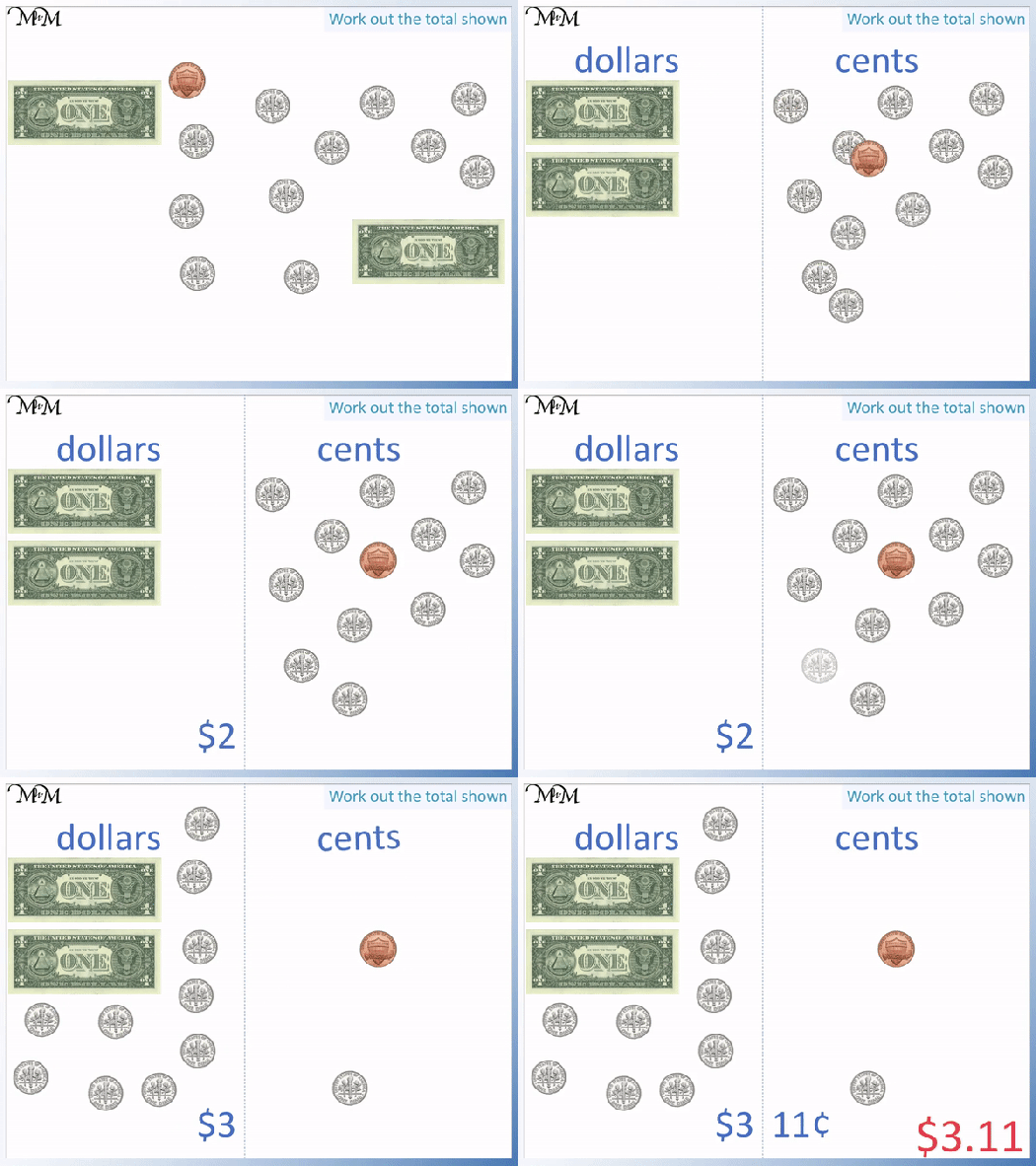
To add this sum of money, separate it into dollars and cents.
There are 2 dollar bills and the rest are coins.
We look for groups of coins that add to make a dollar. We have ten dimes.
We can move these across to the dollars pile to make $3 in total.
We have a dime and a penny left over. This is worth 11 cents.
There is $3.11 in total.
When teaching children to add money, it is helpful to count the dollars and cents separately. This provides them with a strategy to use to break down the process.
In the example below, there is some American money. We are asked to work out how much money there is in total.
We will start by separating the money into dollars and cents.

We can now add the money by first counting the dollars and then counting the cents.

Looking at the dollars on the left, we can see that there are two one dollar bills. So, this is worth a total of $2.
Looking at the cent coins that we have, we can see that there are three dimes. Each dime is worth 10¢. So, this is worth a total of 30¢.
Altogether, we have two dollars and thirty cents.
We write this as $2.30, separating the dollars and cents with a decimal point.
We can think of the digit before the decimal representing how many dollars we have and then the two digits after the decimal representing how many cents we have.
In some cases, there will be a group of cent coins that can make another dollar.

We will begin by separating the US money into dollar bills and cent coins.

Now we have separated the paper notes from the coins, we will count the dollar bills.
There is a one dollar bill, so we have $1 in total from the paper bills.
Next, we will count the cent coins.
Remember that we are looking out for any of the combinations of coins that can add up to make a dollar.
We can make a dollar from any combination of coins that add up to 100 cents.
A tip for teaching this topic of counting money is to look for the largest value coins first as they will help us to reach 100 cents faster.

The cent coin with the largest value is the quarter.
Looking at this group of cent coins, we can see that we have four of these quarter dollar coins.
These four quarters make a total of one dollar.
This is because they are each worth 25¢ and
4 x 25¢ = 100¢.
We can move these four coins over to the dollars. We now have $2; one dollar from the paper bill and one dollar made from the four quarter dollar coins.
We can say that we have collected the four quarters into a group of one dollar. When teaching this in schools, this process may be referred to as ‘regrouping’ or ‘carrying’, since we have regrouped 100 cents into 1 dollar.
Finally, we’ll look at the cent coins that remain.

Looking at the cents, we can see that we have two dimes remaining. Each dime is worth 10¢. So, two dimes are worth a total of 20¢.
Altogether, we have two dollars and twenty cents. We write this total as $2.20.
Remember that the ‘2’ in front of the decimal point tells us the total amount of dollars that we have made and the ’20’ after the decimal point tells us that we have twenty cents on top of this.
Below, is our final example of adding money with regrouping.

Again, we begin by separating the money into paper dollar bills and cent coins.

Looking at the dollars, we can see that we have a one dollar note. This is a total value of $1.
Next, we’ll look to see if we can make another dollar out of any of the coins that we have. This means that we need to make a total of 100 cents by adding up the coins.
Remember that when teaching this topic, we encourage you to look for the coins with the largest value first as they bring us closer to 100 cents in the fastest way.

Our largest value cent coin is the quarter. There are two quarter dollars, each worth 25¢.
25¢ + 25¢ = 50¢
So far we have 50¢.
Our next largest value coin is the dime, so we now look to move the dimes over until we get to 100 cents or until we run out of dimes.
We have four dimes in total. Each dime is worth 10¢, so four dimes are worth a total of 40¢.
50¢ + 40¢ = 90¢
So far we have 90¢.
We need 10¢ more.
The next largest value coins are nickels, which are each worth 5¢.
So, two nickels are worth a total of 10¢.
90¢ + 10¢ = 100¢
100¢ = $1
Having moved these two nickels over, we have a total of 100¢. We only moved two nickels over, we left another two nickels behind as we made 100 cents without them.
There are 100¢ in a dollar. So, in total, we now have $2. One dollar from the paper dollar bill and one dollar from the collection of different coins that made 100 cents.
Now, we will count the cents that are remaining on the right.

There are two nickels which are each worth 5¢.
5¢ + 5¢ = 10¢
Two nickels are worth 10¢ in total.
We also have four pennies. These are each worth 1¢.
4 x 1¢ = 4¢
Four pennies are worth 4¢ in total.
Two nickels plus four one cent coins make a total of 14¢.
10¢ + 4¢ = 14¢
Altogether, we have two dollars and fourteen cents.
We write this as $2.14.

Now try our lesson on Adding US Money by Regrouping Cents to Dollars where we learn how to regroup cents to make a dollar and use this to work out larger totals of money.
How to Make a Dollar with Coins

- Here are some common combinations of ways to make a US dollar by making a total of 100 cents.
- A dollar is worth 100 cents and each dollar bill is the same value as 100 penny coins.
- Each dime is worth 10 cents so ten dimes make one dollar because 10 x 10 = 100 cents.
- Each nickel is worth 5 cents so twenty nickels make one dollar because 20 x 5 = 100 cents.
- Each quarter is worth 25 cents. 4 x 25 = 100 cents and so four quarters make one dollar.

- We are asked to count the American money shown.
- We have one US dollar bill.
- We have four quarters which is one of the combinations of coins that make an American dollar.
- We have a dollar bill plus another dollar from the four quarters.
- We have two dollars in total, which we can write as $2.
Counting US Money Dollars and Cents: Interactive Question Generator
Adding US Dollars and Cents Worksheets and Answers


How to Make an American Dollar using Cents, Nickels, Dimes and Quarters
- 100 pennies
- 4 quarters
- 10 dimes
- 20 nickels
- 3 quarters, 2 dimes and a nickel
- 2 quarters and 5 dimes
There are many other ways to make a dollar and we will look at some of the common ways below.
Below is an American one dollar bill, which we commonly refer to as a dollar or US dollar.
Each dollar is worth 100 cents and each dollar bill holds the same value as one hundred cents. A dollar is therefore the same worth as one hundred 1¢ coins combined.
Instead of carrying one hundred 1¢ coins, we can use the one dollar note.

The symbol for a dollar is ‘$’.
Since one dollar is worth 100 cents we can write:
$1 = 100¢.

There are many different ways that we can make $1. We can make a dollar by using any combination of US coins that add up to 100¢.
One way to make a dollar is to use 100 cent coins.

Another way that we can make a dollar is with ten 10¢ coins (ten dimes).

This is because each dime is worth ten cents:
10¢ + 10¢ + 10¢ + 10¢ + 10¢ + 10¢ + 10¢ + 10¢ + 10¢ + 10¢ = 100¢
10 x 10¢ = 100¢

Another way to make a dollar is to use twenty nickel coins, which are each worth 5¢.

This is because 20 x 5 = 100.

20 x 5¢ = 100¢
100¢ = $1
Another way to make a dollar is with four quarter dollar coins. Each quarter is worth 25¢.
The name ‘quarter’ helps us to remember that four quarters make a whole dollar.

25¢ + 25¢ + 25¢ + 25¢ = $1
4 x 25¢ = 100¢
100¢ = $1

Examples of Counting Amounts of Money
In the example below, we are asked to work out the total amount of money. We count any coins that we have into groups that make one dollar.

We have a $1 bill and four quarter dollar coins. The four quarter dollar coins add to make a dollar because 4 x 25¢ = 100¢.
For every 100 cents that we can make, we have made one dollar.
We have a one dollar note plus the dollar made from the four quarters.
Altogether, we have $2.

In the example below, we have two $1 bills and twenty nickels (each worth 5¢).

Twenty nickels make one dollar. Each nickel is worth 5 cents and therefore we have $1.
Altogether, we have three American dollars, $3.

Now try our lesson on Adding American Money: Dollars and Cents where we learn how to add dollar bills and cent coins.
Adding US Money Dollars and Cents: Question Generator
What is the total sum of the coins below? Enter your answer in dollars with a decimal point.
Click on each value as you count it.
$
Counting US Coins: Dimes, Nickels, Pennies & Quarters

- This poster shows the values of the four common coins used in America.
- The value of each coin is based on how many cents it is worth.
- The Penny is worth 1 cent.
- The Nickel is worth 5 cents.
- The Dime is worth 10 cents.
- The Quarter is worth 25 cents.

- We have the following American coins: one quarter, one nickel, one dime and three one penny coins.
- One quarter is worth 25 cents.
- One nickel is worth 5 cents.
- We can add these two coins to make a multiple of ten. 25 + 5 = 30 cents.
- One dime is worth 10 cents. We add this coin to our total so far.
- 30 + 10 = 40 cents.
- We have three one penny coins left to add to our total.
- The total of the coins is 40 + 3 = 43 cents.
Supporting Lessons
Adding American Money: Interactive Activity
Adding American Coins Worksheets and Answers


Values of Pennies, Nickels, Dimes and Quarters
Value of a Penny Coin
The penny coin is also known as the one-cent coin. The penny coin is worth one cent and it is the American coin of lowest value. One hundred cent coins make a dollar.
Here is a picture of the one-cent penny coin.

The cent symbol is ‘¢’ and so we can write one cent as 1¢.
One hundred cents make one dollar.
In dollars, one cent is written $0.01.
Value of a Nickel Coin
The nickel is an American coin that is worth 5 cents. A nickel is worth 5¢ or $0.05.
Here is a picture of a nickel coin.

The President Thomas Jefferson is the man on the nickel.
One nickel coin is worth the same as five 1 cent coins.

A nickel is worth 5¢, which can also be written in dollars as $0.05.
Because one hundred cents make a dollar and 20 × 5 = 100, there are 20 nickels in a dollar.

Value of a Dime Coin
A dime is worth 10 cents. A dime is worth 10¢, which can be written in dollars as $0.10. Ten dimes are worth one dollar.
Here is a picture of a dime.

The dime coin is worth the same as ten one cent coins.


A dime is worth 10 cents and a nickel is worth 5 cents. Therefore two nickels are worth the same as one dime.

Both the nickel and dime coins are silver in colour but the main difference between them is the size. Although the dime is worth more, it is smaller than the nickel coin.

Value of a Quarter Dollar Coin
The quarter is an American coin worth 25 cents. The quarter is worth 25¢, which can be written in dollars as $0.25. Four quarters are worth one dollar.
Here is a picture of the quarter dollar coin.

A quarter dollar is worth the same as 25 one cent coins.


A quarter is worth 25¢ and can be made from any combination of coins that add up to make 25 cents.
For example, a quarter dollar can be made from two dimes plus one nickel.
Each dime is worth 10¢ and the nickel is worth 5¢.
10 + 10 + 5 = 25 and so two dimes plus a nickel add up to make 25¢.

Starting with 25 one cent coins, we can see that ten one cent coins can be replaced with a dime and five one cent coins can be replaced with a nickel.

Counting American Coins
We can use the values of the individual US coins to help us work out the totals of different combinations of coins.
We just need to remember the following values:
- A one cent coin is worth 1¢
- A nickel is worth 5¢
- A dime is worth 10¢
- A quarter is worth 25¢
In this example we have a quarter, a dime, a nickel and three one cent coins.
It is easiest to start with the largest value coins first.

We have a quarter which is worth 25¢.
We try to add coins to make multiples of 10 if we can.
We can add the nickel to the quarter. 5 + 25 = 30 and so 5¢ + 25¢ = 30¢.
We can easily add the dime to this total by adding 10¢.
30 + 10 = 40 and so 30¢ + 10¢ = 40¢.
Finally, we add the cent coins, which are each worth 1¢.
We have 3 one cent coins, worth 3¢ in total.
40 + 3 = 43 and so we have 43¢ in total.
Now try our lesson How to Make a Dollar with Coins where we learn the combinations of different American coins that can make a dollar.

Counting British Coins: Adding Pounds and Pence

- £1 is worth 100 pence and here are some common ways to make one pound.
- £1 is equivalent to two 50p coins.
- £1 is equivalent to a 50p coin, two 20p coins plus a 10p coin.
- £1 is equivalent to five 20p coins.
- £1 is equivalent to ten 10p coins.
- Any combination of coins that equals 100 pence is equivalent to one pound.
Here is a downloadable summary sheet showing some of the different ways to make a pound.


- We can count money more easily by separating it into pounds and pence.
- We have three pounds made from the £2 plus the £1.
- We have 90p made from the 50p plus the two twenty pence coins.
- We can write the £3 and 90p as £3.90.
How to Add British Money
Adding Pounds and Pence
Adding Pounds and Pence Interactive Activity
Adding Pounds and Pence with Carrying
Counting Pounds and Pence Worksheets


Adding Pounds and Pence Harder Worksheets


Counting Money: Pounds and Pence
How to Add Pounds and Pence
To add pounds and pence coins use the following steps:
- Separate the coins into pounds and pence.
- Add the pound coins together to find the total number of pounds.
- Gather the pence coins into groups worth 100 pence.
- Each group of 100 pence is worth 1 pound, which can be added to the pounds total.
- Count the remaining pence separately.
For example, here is a group of British coins, which we will add to find a total.
The first step is to separate the pound coins from the pence coins.

We have a two pound coin and a one pound coin.
2 + 1 = 3 and so £2 + £1 = £3. We have three pounds in pound coins.
We will now count the pence coins.
We have 50p + 20p + 20p.
50 + 20 + 20 = 90 and so, we have 90p.

In total we have £3 and 90p. We write this as £3.90.
To write pounds and pence, the pounds are written first, before the decimal point and the pence is written after the decimal point. £3 and 90 pence is written as £3.90.

Here is another example of counting pounds and pence.
We first separate the pound and pence coins.
We have two one pound coins making a total of £2.

Counting the pence coins, we have 50p + 20p + 10p, which equals a total of 80 pence.
In total we have £2 and 80 pence, which is written as £2.80. We separate the pounds and the pence with a decimal point.
How to Make a Pound with Coins
Here are some examples of how to make a pound using different pence coins:
- 100 × 1p
- 50 × 2p
- 20 × 5p
- 10 × 10p
- 5 × 20p
- 2 × 50p
Any combination of coins that add up to 100 pence are worth £1.
Here are some examples of how to make one pound.
We can add combinations of coins by grouping them into totals that equal 100 pence. Each group of 100 pence is worth a pound.
In this example we have a £1 coin along with two 50p coins and two 20p coins.
We have £1 in pounds and we will look for combinations of pence coins that add to 100 pence.

We have two 50p coins which both add to make 100p. Two 50p coins are worth £1.
We have £2 in total and two remaining 20p coins. 20p + 20p = 40p.
In total we have 2 pounds and 40 pence. We write this as £2.40. The decimal point separates the pounds and the pence.
Here is another example of finding the total of a combination of coins.

We have a £2 coin. We then look for combinations of coins that add together to make a pound.
We can see that we have ten 10p coins. 10 × 10p = 100p. Ten 10p coins are worth £1.


In total we have £3 and 20 pence. We write this as £3.20.
Here is another example of adding penny coins.
We do not have any pound coins and so, we first look for groups of penny coins that add to make 100 pence.
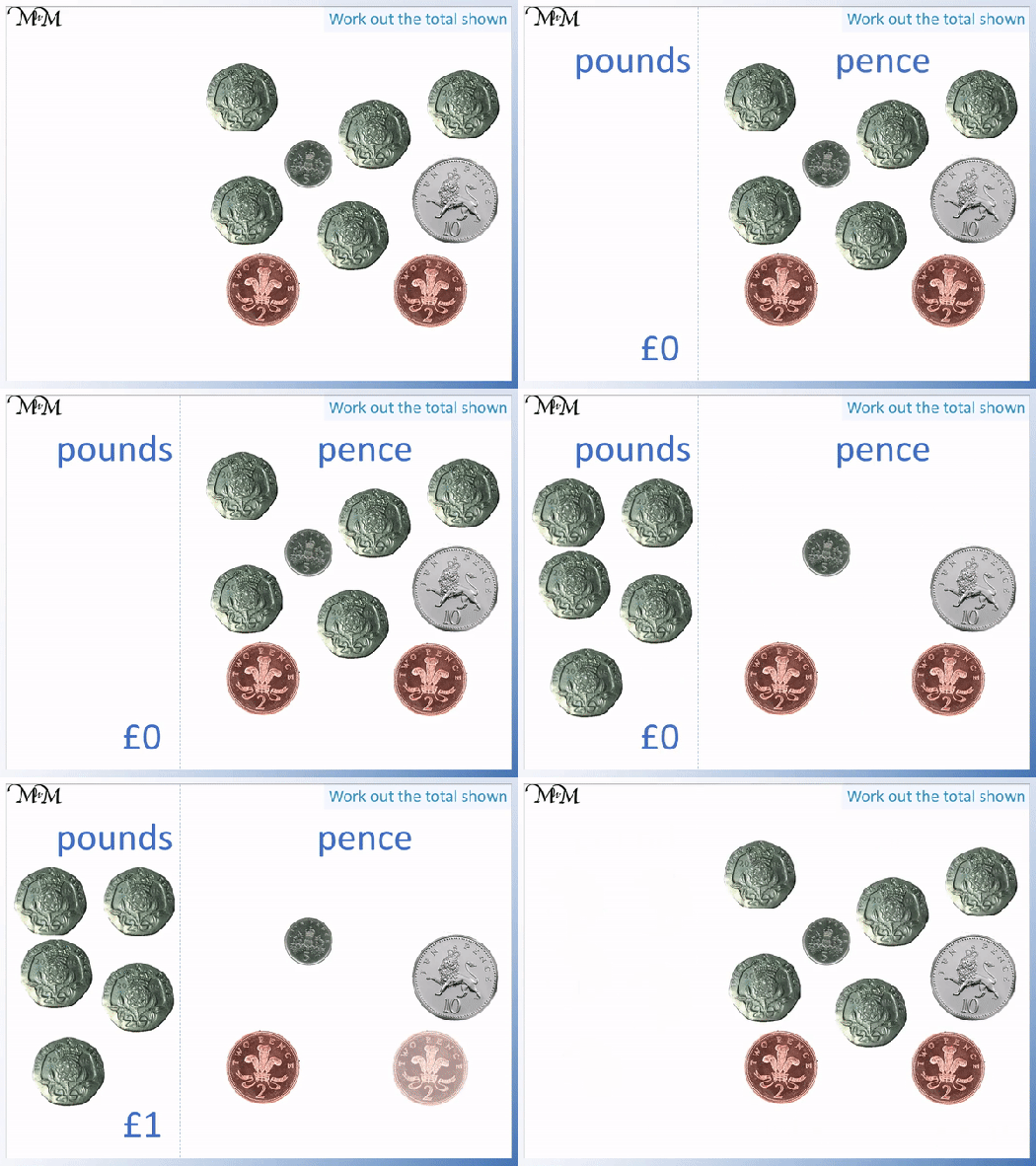
We have the combination of five 20p coins. Five times 20p equals 100p and so, five 20p coins are worth £1.
We have £1 and 19 pence, which is written as £1.19.
In this example, we have two pound coins and some pence coins.

We look for a combination of pence coins that also add to make one pound.
It is easiest to start by adding the largest value coins. We start with 50p. We can add the two 20p coins to this 50p.
50p + 20p + 20p = 90p. We need 10p more to make 100 pence.
Therefore 50p + 20p + 20p + 10p equals £1.
We move these coins over to the pounds total. There is 10 pence remaining in the form of two 5p coins.
We have £3 and 10 pence, which is written as £3.10.
Sometimes we cannot make exactly one pound because we cannot make a group of exactly 100 pence.
Here is a collection of coins, with £2 in pound coins and some more pence coins.

We cannot make 100 pence exactly so we look for a value that makes at least 100 pence.
We start with the 50p coin and add on the 20p coins.
50p + 20p = 70p.
50p + 20p + 20p = 90p.
50p + 20p + 20p + 20p = 110p.
We will move the 50p and the three 20p coins over to the pounds column. 110p is worth £1 and 10 pence.

In the pounds column, we have £3 and 10 pence. We have 24 pence in the pence column.
In total we have £3 and 34 pence, or £3.34.


We can also add pounds and pence by writing the pounds in terms of pence.
Each pound coin can be written as 100 pence and then the totals can be added using column addition.
Here is an example of a collection of coins that will be added together to find a total.
The £1 coin will be written as 100 pence.

The total can be found by adding the digits of each coin using column addition as shown below.
In the first column, we have 1 + 2 = 3.
In the next column, we have 2 + 5 = 7.
In the next column, we have 1.
In total, this is £1.73.

Here is another example of adding money using column addition.
We have a £2 coin, two 10p coins and a 5p coin.
We write the £2 coin as being worth 200 pence.
We add 200p, 10p, 10p and 5p.

In the first column, we have 5.
In the second column we have 1 + 1 = 2.
In the next column, we have 2.
In total we have £2.25.
If the coins can be easily counted into groups worth 100 pence, then it is easiest to group the coins into collections of pounds and add them.
For combinations of coins that cannot be made into pounds, then column addition can be an easier method for adding money.
Now try our lesson Reading Hours on a Clock where we learn how to tell the time to the hour.

Adding Pounds and Pence with Carrying: Question Generator
What is the total sum of the coins below? Enter your answer in pounds with a decimal point.
Click on each coin as you count it.
£


Adding Pounds and Pence: Question Generator
What is the total sum of the coins below? Enter your answer in pounds with a decimal point.
Click on each coin as you count it.
£
British Money: Learning Pound and Pence Coins
List of all British Pence Coins

- Above are all of the coins used in the United Kingdom that have a value of less than one pound (100 pence).
List of the British Pound Coins

A one pound coin is worth 100 pence and we write it with the symbol ‘£’.

- 1 ten Pence is worth the same as ten 1p coins.
- 10p is also worth the same as 5p + 5p.
- We could also make 10p from 5p + 2p + 2p + 1p.
Learning the British Pence Coins Video Lesson
Learning the British Pound Coins Video Lesson
Interactive Money Activities
Counting Penny Coins Worksheet


Counting Pound Coins Worksheet


Learning the British Coins
Pictures of British Coins and their Values
In Britain, there are 6 different coins that are worth pennies and 2 different coins that are worth pounds.
Here is a list of all of the British Penny coins with their name and value shown below.
In the UK, the coin with the lowest value is the 1 penny coin.
When we have more than 1 penny, we say that we have pence. So we have 2 pence, 5 pence, 10 pence, 20 pence and 50 pence coins.
The symbol for pence is ‘p’. This is because it is the first letter of the word pence.
We can write 1 penny as 1p, 2 pence as 2p, 5 pence as 5p, 10 pence as 10p, 20 pence as 20p and 50 pence as 50p.
In British money, the p is pronounced as ‘pee’ and is said after the number.
1 Penny Coin
The penny coin is the lowest value British coin. The penny coin is also known as 1 pence and is written as 1p for short. This is pronounced as ‘1 pee’.

2 Pence Coin
Here is a 2 pence coin. We say pence now, rather than penny because 2 is more than 1. We only say penny for the 1 penny coin. Whenever we have a coin that is worth more than 1 penny, the word penny changed to pence.

We say that we have 2 pence, or 2p. This is pronounced as ‘2 pee’.

2p is worth the same as two 1p coins.

1 + 1 = 2 and so, 1p + 1p = 2p.
5 Pence Coin
Here is a 5 pence coin.

5p is worth the same as five 1p coins.

5 = 1 + 1 + 1 + 1 + 1 and so, 5p = 1p + 1p + 1p + 1p + 1p.
5p can be made from any combination of coins that add up to make 5p.
For example, 2 + 2 + 1 = 5 and so, 2p + 2p + 1p = 5p.

Here we can see that 5p = 1p + 1p + 1p + 1p + 1p and for every two pennies we have, they can be replaced with a 2 pence coin.

5p = 2p + 2p + 1p.
10 Pence Coin
Here is a 10 pence coin, or 10p.

10p is worth the same as 10 1p coins. It is much easier to carry 1 single 10p coin around instead of carrying ten pennies.


5 + 5 = 10 and so, 5p + 5p = 10p.


Any combination of coins that add to make ten pence can be replaced with a ten pence coin.
For example, 5 + 2 + 2 + 1 = 10 and so ten pence can be made from a 5p, 2p, 2p and a 1p coin.


20 Pence Coin
Here is the 20 pence coin.

20p is worth the same as 10p + 10p.


50 Pence Coin
Here is a 50 pence coin. The 50 pence coin is the largest coin in terms of size. The 50 pence coin is the pence coin with the largest value. There is no other coin that is worth more than a 50p apart from the pound coins.

Any combination of coins that add to make 50 are worth the same as a 50 pence piece.
For example, 20 + 20 + 10 = 50 and so a 50 pence coin is worth the same as 20p + 20p + 10p.


British Pound Coins
Here are the 2 different coins that are worth £1 and £2.
1 pound is worth 100 pennies. Instead of 100 1p coins, a £1 coin can be used. Any combination of coins that add up to 100 pence can be replaced with a pound coin.
£1 = 100p
There are many different ways that we can make £1. We can make a pound by using any combination of coins that add up to 100p.
The £ symbol is the pound symbol. £1 is actually said with the number first and then the word pound. So we say £1 as ‘one pound’. We say £2 as ‘two pounds’.
For example, we can use two 50p coins to make a pound.

This is because 50p + 50p = 100p.

100p = £1
Another way to make £1 is to use a 50p coin, two 20p coins and a 10p coin.

50p + 20p + 20p + 10p = 100p
100p = £1

Here we have a combination of coins that add to make £1. We can keep adding the total together until we have 100 pence.
Here is a £2 coin.

The 2 pound coin is worth the same as 2 pound coins combined. A 2 pound coin is worth 200 pence.

Each pound is worth 100p and so 100p + 100p = 200p.

£2 = 200p and so any combination of coins that adds to 200 pence can be replaced with a £2 coin.
For example we have £1 + 50p + 50p.

The £1 is worth 100p. 100p + 50p + 50p = 200p, which is the same value as £2.

It is helpful to group combinations of coins that make £1. Counting pounds can be easier than counting pennies with larger amounts of money.
In this example, the two 50p coins can be combined to make £1.
£1 + £2 + £1 = £4.

Now try our lesson Counting British Coins: Adding Pounds and Pence where we learn how to add different groups of British coins.

Understanding Ratios with Examples and Pictures

- A ratio tells us how many of one object there are compared to another.
- There are 3 cats and 5 dogs, which makes 8 animals in total.
- We say there are 3 cats to every 5 dogs in this picture.
- We write the numbers of each object as a ratio, separated by a colon ‘:’.
- The ratio of cats to dogs is 3:5.
- We read this as ‘3 to 5’
- It is important to write the numbers in the same order in which they are mentioned.
- Writing the ratio the other way around, the ratio of dogs to cats is 5:3.

- We count the number of each coloured counter.
- We have 3 blue counters.
- We have 2 purple counters.
- We say that we have 3 blue to 2 purple.
- We write the ratio of blue to purple as 3:2.


Introduction to Ratios
What is a Ratio?
In simple terms, a ratio is the amount of one item compared to the amount of another. Ratios describe how much of an item there is for a given amount of the other.
Ratios are commonly used to help describe the number of items in a collection.
For example here is a collection of pets. We have both cats and dogs.

There are 8 animals in total.

There are 3 cats. 3 out of the 8 animals are cats.
We can say that 3 / 8 of the pets are cats.

There are 5 cats. 5 out of the 8 animals are dogs.
We can say that 5 / 8 of the pets are dogs.
It is easier to compare amounts by writing them as a ratio than as fractions. This is because ratios simply tell us how much of each thing there is compared to another.
We have 3 cats, so we write a 3.

We have 5 dogs, so we write a 5 next to the 3.
In between the 3 and the 5 we put a colon.
Colons are used to show that the numbers are written as part of a ratio. It is important to separate each number in the ratio with a new colon. The colon in a ratio is simply read as ‘to’. For example, the ratio 3:5 is read as ‘three to five’.
There are 3 cats to 5 dogs.

Order matters when writing ratios. The first number tells us how much of the first item described there is. The second number tells us how much of the second item described there is. We cannot put the numbers in a ratio in any order.
In this example, we say that the ratio of cats to dogs is 3:5.

Instead of the ratio of cats to dogs we were asked for the ratio of dogs to cats, we would have to reverse the ratio to say 5:3.

Here is another example of writing a ratio.
We have 6 toy bears to 4 toy cars.

We say that the ratio of bears to cars is 6:4.
Since both 6 and 4 are both even, we can simplify the ratio by halving both numbers.
We can halve 6:4 to make 3:2.
We can also say that the ratio of bears to cars is 3:2. This means that for every 3 bears there are, there are 2 cars. Every time I add 3 bears, I add 2 cars.
Examples of Where Ratios are Written in Real Life
Examples of where ratios are written in real life include:
- Ingredients in recipes
- Making drinks
- Food prices given in price per weight
- Calculating the time taken to reach a destination
- Voting
- Speed given as distance per hour in a car
Why do we Use Ratios?
Ratios are used to compare the amount of something compared to the amount of something else. They are paticularly useful for comparing large amounts in simple terms or for scaling up calculations. For example if you have enough ingredients for one cake, you can then work out how many of each ingredient you need to make ten cakes by using ratios.
Ingredients in recipes often contain ratios. For example, when baking a cake we might have a ratio of:
200g butter : 4 eggs : 180g flour : 1 spoon of baking powder : 3 spoons of milk.
This ratio tells us how much of each ingredient we need compared to the other. For example, if I put the ingredients above into a cake but instead of 3 spoons of milk I used 5 spoons, then the mixture might be too wet from adding too much milk.
Ratios also tell us how to scale up amounts. For example if I wanted to make 10 cakes, I could take the ingredients for 1 cake and multiply them by 10.
I would then need the following ingredients for 10 cakes:
2000g butter : 40 eggs : 1800g flour : 10 spoons of baking powder : 30 spoons of milk.
This helps me work out how much I need and I can buy the correct quantities at the shop.
Now try our lesson on Introduction to Sharing in a Ratio where we learn how to divide an amount in a given ratio by sharing parts.
