Be your child's best tutor


Ratios describe how to share out a given amount and are written with numbers separated by colons. The amount of numbers in the ratio tells us how many groups the quantity is being shared between. The size of each number tells us the proportion of the total amount each group gets.
For example, in the ratio 1:3 there are two different numbers: ‘1’ and ‘3’.
Because there are two numbers, we are sharing an amount between two people.
This ratio means that for every 1 part that the person on the left gets, the person on the right gets 3. The person on the right will have three times as much as the person on the left.

The person on the left will get $5 and the person on the right will get $15. Both numbers add to make the total of $20 but $15 is three times larger than $5. This is why the ratio is 1 to 3.
To calculate a ratio of a number, follow these 3 steps:
For example, share $20 in the ratio 1:3.
This means that in this ratio problem, we will be sharing $20 between two people with one person getting three times as much as the other.
We follow the 3 steps above to work out the ratio.

Looking at the ratio 1:3, we have:
1 + 3 = 4
So, we have four parts in total in our ratio.

The amount is $20 and the total number of parts is 4.
20 ÷ 4 = 5
Each of the four parts is worth $5.

We have four parts in total and each of these parts are worth $5.
We will multiply both numbers in the ratio 1:3 by $5.
1 x $5 = $5
3 x $5 = $15
The money is shared in the ratio $5:$15.
We have solved our ratio problem to find that one person gets $5 and the other person gets $15.
To check a ratio calculation, add the final values to see if the total is equal to the original amount. If the amounts shared can also be simplified to make the ratio given, the calculation is correct.
$5 + $15 = $20, which is the amount that we started with, so we can be confident that our calculation is correct.
To confirm our ratio calculation, we check that $5:$15 simplifies to give us our original ratio.
Dividing both $5 and $15 by 5, gives us 1:3, which is our original ratio and $15 is indeed three times as much as $5.

Now try our lesson on Sharing in a Ratio Between 3 People where we learn how to extend our steps for calculating ratio to examples where we share an amount between 3 people.

Multiply the ratio by the value of one part.


We are asked to share £50 in the ratio 2:3.
This means that for every two parts a person receives, a second person is given three parts.

We begin by finding the total number of parts.
There are two parts highlighted in green and three parts highlighted in orange.

We have five parts in our ratio in total.

In total, all five parts are worth £50.
To be able to find out how much money each person is given, we need to know how much one part is worth.

Each part in the ratio must have the same value.
This means that £50 must be shared equally over the five parts.
To share equally, we divide £50 by 5.
50 ÷ 5 = 10
So, each part is worth £10.

Now that we know that one part is worth £10, we can find out what two parts and three parts are worth.

If one part is £10, two parts must equal £20.
£10 x 2 = £20
If one part is £10, three parts must equal £30.
£10 x 3 = £30
The money in this ratio problem has been shared £20:£30.
One person receives £20 and the other receives £30. We can check our answer by adding the two amounts to see if they make our original total.
£20 + £30 = £50
Now try our lesson on How to Calculate a Ratio of a Number where we break down the process of sharing in a ratio into three steps.


Multiplication Using Factors: Interactive Questions
A factor is a number that divides exactly into another number. Instead of multiplying by a larger number in one go, it can be easier to multiply by the factors that multiply to make this number. For example, to multiply 3 × 70, it can be easier to multiply 3 × 7 and then multiply by 10.
Choose two factors of the larger number which will be easiest to multiply by. For example, multiplying 3 × 7 × 10 is easier than multiplying 3 × 2 × 35. Even though 2 × 35 = 70, 35 is not an easy number to multiply by.
3 × 7 = 21 and this is a known fact from our times tables. It is then simple to multiply by 10 by placing a 0 digit on the end of 21.

3 × 7 × 10 = 210 and so, 3 × 70 = 210.
Here is 5 × 6.
We can write 6 as 2 × 3.

5 × 6 can be written as 5 × 2 × 3.
5 × 2 = 10 and then 10 × 3 = 30.
5 × 2 × 3 = 30 and so, 5 × 6 = 30.
Factors can be used to help us work out any multiplication. This method can also be used for teaching and learning the times tables. If you knew the 2 and 3 times tables but were still learning the 6 times tables, you can multiply 5 by 2 and then by 3 to work out 5 × 6.
We choose to do 5 × 2 × 3 rather than 5 × 3 × 2 because 5 × 2 = 10 and this is an easy number to multiply by. When teaching multiplication by using factors, try to find groups of easier multiplications.
Here is 7 × 9.
9 = 3 × 3 and so, multiplying by 9 is the same as multiplying by 3 and then by 3 again.

7 × 9 = 7 × 3 × 3.
7 × 3 = 21 and 21 × 3 = 63. We can multiply 21 by 3 by multiplying each digit in 21 by 3.
2 tens × 3 = 6 tens and 1 × 3 = 3. 21 × 3 = 63.
7 × 3 × 3 = 63 and so, 7 × 9 = 63.
Multiplying by 3 and then 3 again can be used as a strategy to multiply a number by 9.
It is easier to multiply by factors of a larger number than it is to multiply by the larger number directly. Find two numbers that multiply to make the larger number and then multiply by these two numbers separately instead.
For example, here is 8 × 14.
14 = 7 × 2. We can write 8 × 14 as 8 × 7 × 2.

8 × 7 = 56 and then 56 × 2 = 112. We can work out 56 × 2 because it is doubling. Doubling means to add the number to itself. 56 + 56 = 112 because 50 + 50 = 100 and 6 + 6 = 12.
8 × 7 × 2 = 112 and so, 8 × 14 = 112.
Notice that we chose to multiply 8 × 7 × 2 rather than 8 × 2 × 7.
This is because 8 × 2 × 7 leads to 16 × 7, which is not an easy multiplication. With 8 × 7 × 2, we used a times table fact for 8 × 7 and then only had to double this answer.
Now try our lesson on Multiplying by Multiples of 10 and 100 where we learn how to multiply by numbers in the 10 and 100 times table.


The answer ends in the same digit that the sum of the units column ends in.

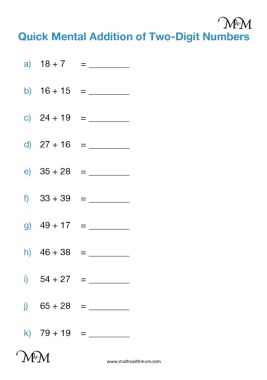
Mental Addition of 2-Digit Numbers: Interactive Questions
Mental addition means to add numbers in your head without writing down any steps or notes as part of the calculation. All of the calculations are done in your head.
There are various strategies for mental addition, however, with each method, it is important to hold values in your head. The fewer the steps, the better the method as it is easier to hold the numbers in your head.
To do mental addition, use the following steps:
We only hold the result of the tens column in our head while we add the units column.
To add 2-digit numbers, it is first worth knowing the following 1-digit additions:
In this first example, we have 32 + 29.

The first step is to add the digits in the tens column.
3 + 2 = 5.

The next step is to add the digits in the units column.
2 + 9 = 11
11 is larger than 10 and so, we need to add 1 to our result from adding the tens column. This is because adding 11 is the same as adding ten and then adding 1.

The 5 in the tens column becomes a 6.

Because 11 ends in a 1, we know that our digit in the units column of our answer is also a 1.

32 + 29 = 61

In this next example we have the mental addition of the 2-digit numbers 44 + 28.

The first step to adding two 2-digit numbers mentally is to add the digits in the tens column.
4 + 2 = 6

The next step is to add the digits in the units column.
4 + 8 = 12
To add 12, we add 10 and 2.
This means that we increase the tens column by 1 and our answer ends in a 2.

The 6 increases to a 7.
The answer ends in a 2 because 12 ends in a 2.

44 + 28 = 72
When teaching mental addition, we recommend trying to hold the first result in your head whilst carrying out the next part of the calculation. When first learning mental addition, start by writing the result a few times until you get the hang of the method.
Once you get better at performing the written method you will find that it is easier to remember the steps and it will be easier to hold numbers in your head.

In this example of mental addition we have 28 + 25.
We will try and speed up our method.
We add the tens:
2 + 2 = 4

8 + 5 = 13 and so, we increase 4 to 5 in the tens column. Our answer ends in 3.
28 + 25 = 53
Here is another example of adding 2-digit numbers mentally.
We have 36 + 49.
Adding the tens digits we have 3 + 4 = 7.
Adding the units digits we have 6 + 9 = 15.
We increase the 7 to an 8 and our answer must end in a 5.

36 + 49 = 85
In this example of adding mentally, we have 69 + 29.
Adding the tens, 6 + 2 = 8.
Adding the units, 9 + 9 = 18.
Therefore, we increase the 8 in the tens column to a 9 and our answer ends in an 8.

69 + 29 = 98
With practice, this method is one of the quickest ways to add 2-digit numbers mentally.
When teaching mental addition, if your child struggles with the process, it is worth focusing on writing the steps down until they are mastered. This will make it easier to transfer the process to holding numbers in their head.
Now try our lesson on 2-Digit Column Addition where we learn how to use the column addition method.

We can use this to find out what the angles in a triangle add up to.
If we move these angles so that they fit in next to each other, we can see that they rest on a straight line.

Angles on a straight line add up to 180°.
Therefore, angles in a triangle also add up to 180°.
You can test this at home by following these steps:
1) Cut out a triangle

2) Mark the outer angles

3) Cut these angles off

4) Place these marked angles together

You should be able to place these angles onto a straight line.

Angles in a triangle add up to 180°.

Count


The commutative property of multiplication is a rule in mathematics that means that the order of multiplication does not matter. In simple terms, switching the order of the numbers being multiplied does not change the answer. The commutative property of multiplication states that a × b = b × a. For example, 3 × 5 = 15 and 5 × 3 = 15.
The order of multiplication does not matter.
To teach the commutative property of multiplication, multiplication arrays can be used. A collection of counters can be arranged in an array and grouped into amounts showing each number. For example, 15 counters can be grouped into 3 groups of 5 and then 5 groups of 3 to show that the order does not matter.
Here are 15 counters.
We can make 3 lots of 5. This represents 3 × 5.

We can take the same group of counters and group them as 5 lots of 3.
This represents 5 × 3.

Since the total number of counters did not change, the result must be the same.
When teaching the commutative property of multiplication, use physical objects such as counters arranged in a multiplication array. Gather the counters into groups of each number to show that the total number is the same.
Alternatively, another way to teach the commutative property is to learn the times tables or use a multiplication grid and simply compare the answers to each.
If we know that 3 × 5 = 15 and that 5 × 3 = 15, we can easily compare the two multiplication sentences to discover the commutative law. The order of multiplication does not matter because the answer is the same.

A multiplication grid is a grid that has numbers along the top and side. The numbers on the top of each column and side of each row are multiplied to make the numbers in each grid.
We can see that 3 × 5 = 15 and 5 × 3 = 15.

A multiplication grid can be provided and then the answers compared to see that they are the same. When teaching the commutative property, you can look for pairs of common answers in the multiplication grid.
Here is an example of the commutative property, 8 × 5 = 40 and 5 × 8 = 40. The order of the multiplication does not matter.
Now try our lesson on How to Find Multiples where we learn how to find the multiples of any number.


Division by Sharing Equally: Interactive Activity
Division by sharing equally is a method used to introduce the concept of division. It involves sharing an amount equally between groups one at a time until there is the same amount in each group. Division by sharing is often taught using physical objects such as counters.
Division by sharing equally is the best method for introducing the idea division. This is because it only involves simple counting skills and the sharing method lends itself to physical objects such as counters, which children enjoy using.
We can think of division as sharing.
The number before the division sign is the total amount being shared. The number after the division sign is the number of groups that the total is being shared between.
The answer to the division is the amount that is shared into each group.

For example here is the division question of 6 ÷ 3. This is read as 6 divided by 3.
It means to share the 6 counters between the 3 pots and the answer is how many counters there are in each pot.
We place a counter into each of the 3 pots, one at a time until no more counters remain. To do this division equally, we take it in turns to place a counter in each pot.
We have shared the counters equally among the three pots.
There are 2 counters in each pot and so, 6 shared equally between 3 is 2.

We write this as 6 ÷ 3 = 2. The answer to a division is the amount that is shared equally into each group.
Equal sharing means that a total amount has been split up into groups so that each group contains the same number.
When teaching division by sharing, it is important to make sure that there are the same number in each group and that all counters have been shared out into a group.
To share equally, follow these steps:
For example, here is 10 ÷ 2.

The first step is to create as many groups as the number being divided by. We are dividing by 2 so we draw 2 circles as our 2 groups.
The next step is to move the total number one at a time into each group. It is important to keep the same number of items in each group.
The total number is 10. The total number is the number before the division sign.
The total has been fully shared between the two groups. We know this because there are no more counters remaining.

After sharing equally, the amount in each group is the answer to a division.
Equal sharing means to divide a total amount into groups so that there is the same number in each group. If a total has been equally shared, there will be the same amount in each group with nothing left over.
Here are some examples of division by equal sharing.
Here we have 6 ÷ 3.
The total amount is 6.
We are sharing 6 between 3 and so, we draw 3 groups.

We share the counters equally so that there are the same number of counters in each group.
6 ÷ 3 = 2 because there are 2 counters in each group.
Here is an example of 20 ÷ 5.
This time the total is 20 and we are dividing it into 5 groups.

We place each of the 20 counters one at a time into the 5 groups.
There are 4 counters in each group and so 20 ÷ 5 = 4.
Division by sharing is the best way to introduce division to children. This is because this method only involves knowing how to count. The method is also enjoyable and easy to use because it involves physical objects and there are lots of opportunities to use this method in daily life.
When teaching division, it is useful to explain to children what division means.
Division means to share an amount equally. There are lots of opportunities to practise division at home. This can be done with food, toys or counters.
The idea of sharing equally is easy for children to pick up. They will just need to check that each group receives the same amount.
After practising the method using physical objects, division by sharing can be used as a strategy to help with division calculations.
For example, here is 12 ÷ 4.

Instead of actually using 12 counters and 4 pots, we can draw 4 pots and draw dots for the counters.
We can draw the same number of circles as the number we are dividing by.
We then draw dots in each circle one at a time until we have the total number that we are dividing.

We place one dot in each circle one at a time until all 12 have been drawn. We can count the number of dots as we draw them in.
There are 3 dots in each circle and so 12 ÷ 4 = 3.
Now try our lesson on Finding Half of a Number where we learn how to halve a number.

Add the result of these divisions to find the answer.

Mental Division Strategy: Interactive Questions
To divide a number by partitioning, write the number as the sum of two or more smaller numbers that can be divided exactly. Divide these numbers and then add the results to find the answer.
Partitioning simply means to write a number as two or more smaller numbers added together.
For example in 44 ÷ 2, 44 can be written as 40 + 4.
We choose to partition 44 into 40 and 4 because both 40 and 4 can be divided easily by 2.

4 ÷ 2 = 2 and so, 40 ÷ 2 = 20.
We can simply divide the digits one at a time.
44 ÷ 2 = 22
Both digits of 44 can be simply divided by 2 to make the digits of the answer.
A number can be easily divided mentally if the digits can be grouped into numbers that divide exactly.
For example, here is 63 ÷ 3. We can see that both digits 6 and 3 can be divided by 3.
6 ÷ 3 = 2 and so, the tens digit of the answer is 2.

3 ÷ 3 = 1 and so, the ones digit of the answer is 1.

The digits in the number can be divided exactly and so, this division can be done mentally.

If all digits of a number can be divided exactly then the division can be done by dividing each digit individually. If this is not possible, it may be possible to group the digits into numbers that are divisible exactly.
For example, here is 128 ÷ 2.
Looking at the first digit, 1 is not divisible by 2 exactly. If the first digit of the number cannot be divided exactly, combine it with the next digit and see if this new number is divisible exactly.
The first two digits of 128 is 12. 12 can be divided by 2.

12 ÷ 2 = 6 and so, there are 6 tens in the answer.
Now all that remains is to divide the 8 by 2.

8 ÷ 2 = 4 and so, there are 4 ones in the answer.
The final step is to combine the digits of the answer. 128 ÷ 2 = 64.
Here is another example of 105 ÷ 5.

1 is not divisible by 5 and so, we combine it with the next digit along to make 10.
10 ÷ 5 = 2, therefore there are 2 tens in the answer.
The remaining digit is 5. 5 ÷ 5 = 1 and so, there is 1 unit in the answer.
105 ÷ 5 = 21
The split strategy for division is a method used to divide larger numbers by writing them as the sum of smaller numbers. Divide the smaller numbers first and then add the results to find the answer.
The split strategy for division is another name for division by partitioning. When teaching these methods, it can be helpful to start by partitioning the numbers into tens and ones.
For example, 86 ÷ 2 can be written as 80 + 6.
Since 8 ÷ 2 = 4, 80 ÷ 2 = 40.
6 ÷ 2 = 3.
>

40 + 3 = 43 and so, 86 ÷ 2 = 43.
It does not matter how the number is split when using the split strategy. For example, we could write 86 as 60 + 26.
We then divide these two numbers. 60 ÷ 2 = 30 and 26 ÷ 2 = 13.
We add the results so that 30 + 13 = 43. We still get the same answer.
Here is another example of 729 ÷ 9.
We can split 729 into 720 + 9.
72 ÷ 9 = 8 and so, 720 ÷ 9 = 80.
9 ÷ 9 = 1.
80 + 1 = 81 and so, 729 ÷ 9 = 81.
Again we could have split 729 into any other combination of numbers as long as they are divisible by 9.
For example, 729 can be written as 630 + 99.
630 ÷ 9 = 70 and 99 ÷ 9 = 11.
70 + 11 = 81 and so, the answer is the same.
Division by partitioning or the split strategy, teaches students to break down larger numbers into manageable chunks. These methods are used to build up strategies for mental division.
If a number cannot be divided exactly, then there will be a remainder or the division answer will be a decimal.
For example, if we have 206 ÷ 5, we can see that 200 ÷ 5 = 4, however 6 ÷ 5 = 1 remainder 1.
206 ÷ 5 = 41 remainder 1.
Now try our lesson on Short Division without Remainders where we introduce the short division method.