Finding Half of a Shape

Finding Half of a Shape
videolesson.JPG

half of a shape coloured in and shown as a fraction

  • To find half of a shape divide it exactly into two equal parts.
  • The line in the example above divides the shape into two parts which are both exactly the same size.
  • To show one half, we colour one side of this dividing line.
  • We have a half if two of these parts fit into the whole shape.
  • We have coloured in 1 out of 2 equal parts.
  • One half is written as a fraction by writing 1 out of 2 as   1 / 2  .

A half is one of two equally-sized parts.

We have half of a shape if we can fit two of these parts into the whole shape exactly.

videolesson.JPG

Recognising One Half 6

  • We are asked to decide if the shaded section of the shape is one half or not.
  • If a shaded section is one half then it will fit exactly twice into the whole shape.
  • If we add another of these sections, the whole shape is still not complete.
  • The shaded section is less than one half.
  • If the shaded section was one half then the whole shape would be divided into two equally sized sections.
  • We can see that the shaded section is smaller than the other unshaded section and that they are not equal in size.

practiseqs.JPG

Finding Half of a Shape Worksheets and Answers

Finding Half of a Shape

In this lesson we learn how to recognise one half of a shape and how to decide if a shaded section is half of a shape or not.

One half is one of two equally sized parts.

Below is an example of splitting a rectangle into two equal halves.

What is one half? A half is one of two equal parts.

The rectangle above is split into two halves by dividing it down the middle.

The rectangle is divided so that there are a total of 2 parts and both parts are exactly the same size.

One half of a rectangle coloured in.

When teaching finding and recognising one half of a shape, the most common mistake is that a child will misidentify a half because they did not check that both parts are of an equal size.

In order to decide if we have half of a shape, we must check if there are two sections and if they are both the same size.

Just because the shape is split into two sections does not mean that we have a half.

Below is another rectangle.

Recognising and writing one half as a fraction

We can divide it through the middle, into two equal parts.

The top part is shaded in and it is exactly equal in size to the part on the other side of the dividing line. Therefore the shaded section is one half.

We have one out of two equal parts.

We can write one half as a fraction   1 / 2.

This fraction can be read as ‘one out of two’. We can recognise this fraction as being called one half.

Below is a triangle and we will shade in one half of it.

To shade in a half we need to divide it into two equal sections.

A common technique in primary school questions is to try and split the shape vertically or horizontally down the middle.

Drawing one half of a triangle

The darker coloured side on the left is exactly the same size as the yellow shaded triangle on the right.

When teaching shading one half, it can be useful to first look for lines of symmetry and you can get a mirror or fold the shape along the dividing line. If it looks the same, we know it is a line of symmetry.

If we have a line of symmetry, we have one half. However, just because we have a half does not always mean that the dividing line is a line of symmetry.

We are sometimes asked to shade in or draw one half of a real life object.

Below we have a half full glass of water.

One half full glass of water

We know that we have a half if it fits exactly into the whole shape twice.

Another way to teach this is that we can double our half to make a whole.

If we double the amount of water in the glass, it fills the whole glass.

In the example below, we are asked to decide if the shaded section is equal to one half of the rectangle shape.

If we double the shaded shape, we can see that it does not fit the whole rectangle.

Less than one half of a rectangle

We can double the shaded section and it is still less than the whole rectangle shape.

And so, the shaded section is less than one half.

The easiest check to do is to look at the two original parts that the whole rectangle has been divided into and to decide if they are equal in size.

The shaded section is smaller than the section of the rectangle that is not shaded and so, the shaded section is less than one half.

Here is another example of deciding if we have one half of a shape or not.

We can double the original shaded section to see.

More than one half of a shape

Two of the shaded sections are more than the whole shape.

The shaded section is more than one half.

We can see that the original shaded section is larger than the section that is unshaded. This shape is not divided into two equal parts

nextlesson.JPG

Now try our lesson on Introduction to Halving Numbers where we learn how to halve numbers.

Faces, Edges and Vertices of 3D Shapes

Faces, Edges and Vertices of 3D Shapes

videolesson.JPG

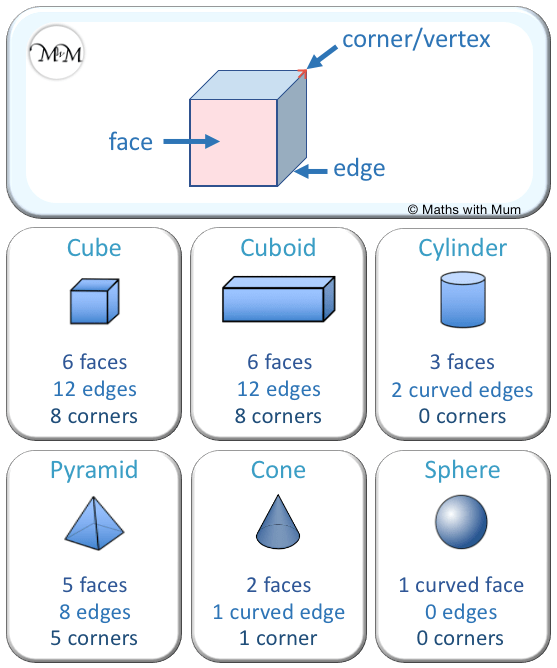
3d shape properties summary of the number of edges, faces and vertices (corners)

  • 3D means three dimensional.
  • Three dimensional shapes can be picked up and held because they have length, width and depth.
  • Faces are the surfaces on the outside of a shape.
  • Edges are the lines where two faces meet.
  • Vertices (or corners) are where two or more edges meet.

3 Dimensional shapes have length, width and depth.

The properties of a 3D shape are the number of faces, edges and vertices that it has.

videolesson.JPG

Properties of the cuboid 3D shape with faces, edges and vertices

  • The above 3D shape is a cuboid, which is box shaped object.
  • A cuboid has 6 rectangular faces, which are the outside surfaces of a 3D shape.
  • A cuboid has 12 straight edges, which are the lines between the faces.
  • A cuboid has 8 vertices, which are its corners where the edges meet.
  • A cuboid has exactly the same number of faces, edges and vertices as a cube.
  • A cuboid is different from a cube in that its edges are longer in at least one direction, whereas a cube has edges that are all equal in length.

Faces, Edges and Vertices of 3D Shapes

What are the Properties of 3D Shapes?

The properties of 3D shapes are faces, edges and vertices.

  • Faces are the flat or curved surfaces that make up the outside of a 3D shape.
  • Edges are the lines where two faces on a 3D shape meet.
  • Vertices are the corners of a 3D shape formed where two or more edges meet.

For example, a cube has 6 faces, 12 edges and 8 vertices.

The poster below shows the faces, edges and vertices of 3D shapes labelled on a cube.

faces edges and vertices of 3D shapes

The following table lists the number of faces, edges and vertices for some common 3D shapes:

Name Faces Edges Vertices
Cube 6 12 8
Cuboid 6 12 8
Sphere 1 0 0
Cylinder 3 2 0
Cone 2 1 1
Square-Based Pyramid 5 8 5
Triangular-Based Pyramid 4 6 4
Sphere 1 0 0

3D is short for three-dimensional. All three dimensional shapes have the the three dimensions of length, width and depth.

A shape is 3D if it can be picked up and held in real-life.

When teaching the properties of 3D shapes, it is worth having a physical item to look at as you identify and count each property.

There are also printable nets for each 3D shape above that can be downloaded and assembled to accompany this lesson. Alternatively, there are some online interactive 3D shapes in the practice section above that you can use to count the faces, edges and vertices.

When teaching this topic, it can be helpful to count the number of each property on the net before assembling it.

You can colour in each face a different colour, or write a number from 1 – 6 on each square face. You can mark each edge as you count it by drawing a line on each one. You could put a sticker or piece of plasticine on each vertex as you count it.

Marking the faces, edges and vertices as you count them is important as it can be easy to count them twice or miss one out.

Faces, Edges and Vertices of a Cube

A cube has 6 faces, 12 edges and 8 vertices. Each face of a cube is a square. All of its edges are the same length.

Counting the number of faces, edges and vertices on a cube

Each of the 6 faces of a cube is square-shaped because all of its edges are the same size. A cube is a 3D square.

There are 12 edges on a cube, which are all the same length. There are 4 horizontal edges around both of the top and bottom square faces. There are also 4 vertical edges connecting the top square face to the bottom square face.

faces edges and vertices of a cube

There are 8 vertices on a cube. There are 4 vertices on the top square face and 4 vertices on the bottom square face.

Faces, Edges and Vertices of a Cuboid

A cuboid has 6 faces, 12 edges and 8 vertices. Each face of a cuboid is a rectangle. It is an elongated cube.

A cuboid is a 3D box shape and it has rectangular faces. A cuboid is also known as a rectangular prism.

Properties of a cuboid. Counting the number of edges, vertices and faces of a cuboid.

A cuboid has 6 rectangular faces. The opposite faces on a cuboid are equal in size.

A cuboid has 12 edges. It has 4 horizontal edges around the top rectangular face and 4 horizontal edges around the bottom rectangular face. It also has 4 vertical edges connecting the vertices of the top rectangular face to the 4 vertices of the bottom rectangular face.

A cuboid has 8 vertices. It has 4 around the top rectangular face and 4 around the bottom rectangular face.

faces edges and vertices of a cuboid

A cuboid has the same number of faces, edges and vertices as a cube. This is because a cube is a special type of cuboid that has all of its edges the same size.

The difference between a cube and a cuboid is that a cube has equal edge lengths, whereas a cuboid is longer in at least one direction.

When teaching 3D shape names, it is worth comparing a cube and cuboid alongside each other to identify the differences between the two.

The opposite faces on a cuboid are equal and can be coloured in the same colour on your net.

Faces, Edges and Vertices of a Sphere

A sphere has 1 curved surface, 0 flat faces, 0 edges and 0 vertices. A sphere is a 3D circle.

A sphere is ball-shaped and is perfectly round, which means that it is not longer in a particular direction than any other.

Properties of a sphere. Number of edges, faces and vertices

A sphere contains no flat faces but it has one continuous curved surface. A sphere is a shape that contains no edges or vertices. This means that it feels smooth to touch all the way around.

edges vertices and faces of a sphere

It can help to pick up a spherical object and feel for edges and vertices. Whilst the net may be useful to help visualise the shape, we recommend using a ball or perfect sphere for this exercise as the net will be very difficult to make spherical with no clear edges or vertices.

Faces, Edges and Vertices of a Cylinder

A cylinder has 2 flat faces, 1 curved surface, 2 circular edges and no vertices. The top and bottom faces are flat and circular. A curved surface wraps around the outside of these 2 faces.

Number of edges, vertices and faces of a cylinder

The cylinder has two identical circular faces on the top and bottom. When viewed from the top or bottom, a cylinder looks circular.

A cylinder has 2 curved edges that wrap around the circular faces on the top and bottom of the shape.

A cylinder has no vertices. This is because it has only 2 edges and the 2 edges do not meet each other.

faces edges and vertices of a cylinder

The curved face of a cylinder forms a rectangle when it is rolled out flat and the net of a cylinder can help to show this.

Everyday objects that are cylinders include food tins and batteries. Toilet rolls are also common cylindrical objects but they do not have the top and bottom circular faces that a true cylinder should have.

With cylinders containing circles and spheres being rounded in appearance, it can be common to mix these two shape names up. The easiest way to tell the difference between a cylinder and a sphere is that a cylinder has edges.

It is worth comparing the two alongside each other and feeling the edges on a cylinder, which the sphere does not have.

Both a cylinder and a sphere will roll since they both contain a curved face. Spheres will roll in every direction, however, the cylinder will only roll in one direction when placed on its side.

Faces, Edges and Vertices of a Square-Based Pyramid

A square-based pyramid contains 5 faces, 8 edges and 5 vertices. The bottom face is a square and there are also 4 more triangular faces around the side of the shape. There are 4 vertices around the square base plus one more on the tip of the pyramid.

Number of edges, vertices and faces on a rectangular based pyramid

A square-based pyramid contains 5 faces. The base is a square face and there are 4 triangular faces around the sides. These 4 triangular faces meet together at the tip of the pyramid.

The square-based pyramid contains 8 edges. There are 4 horizontal edges around the square base and 4 more sloping edges between each triangular face.

The square-based pyramid contains 5 vertices. There are 4 around the square base and one more at the tip of the pyramid.

faces edges and vertices of a square based pyramid

The Egyptian pyramids are examples of real-life square-based pyramids.

There are several types of pyramid, which are named by the face of the base.

Faces, Edges and Vertices of a Cone

A cone contains 1 flat circular face, 1 curved surface, 1 circular edge and 1 vertex. The vertex is formed from the curved surface and it is directly above the centre of the circular base.

number of edges, faces and vertices on a cone

A cone contains 1 flat circular face on its base. It also has a curved surface wrapping around this curved base. Technically it has 1 face in total but often the curved surface is included in the count to make 2 faces.

A cone contains 1 circular edge that wraps around the bottom circular face.

A cone contains 1 vertex which is on the very top of the shape directly above the centre of the circular base. It is formed from the curved surface.

faces edges and vertices of a cone

It is possible that your child may mix a cone up with either a cylinder or a pyramid.

The difference between a pyramid and a cone is that a cone has a circular base and can roll on its side.

A cone and a cylinder both contain a circular base and you can hold the completed nets up and look directly at their base faces to see that they look identical from this orientation.

The cone converges to a point, whereas the cylinder does not.

You can compare how they roll to see the difference between them. A cone rolls in a circle because one end is wider than the other. A cylinder rolls in a straight line.

Traffic cones and ice-cream cones are common examples of the cone shape in real-life.

nextlesson.JPG

Now try our lesson on Classifying Angles as Acute, Obtuse, Right or Reflex where we learn how to describe angles.

Comparing Lengths as Longest, Shortest and Tallest

Comparing Lengths as Longest, Shortest and Tallest
videolesson.JPG

Comparing Length using the words long and short

  • The length of an object is its biggest distance from one end to the other.
  • We can compare the length of two objects by lining them up at one end.
  • We can line the start of the snake up with the start of the tortoise.
  • The distance from one end of the snake to the other is bigger than the distance from one end of the tortoise to the other.
  • We say that the snake is long compared to the tortoise.
  • We say that the tortoise is short compared to the snake.

Comparing height using the words short and tall

  • The height of an object is measured vertically, directly from the ground upwards.
  • The height of an object is its length upwards.
  • The tree is longer than the flower but with height we use the word tall.
  • Compared to the flower, the tree is tall.
  • The flower is short compared to the tree.

Length is the largest distance from one side of an object to the other.

We use the words short and long to describe length but the words short and tall to describe height.

  • Something is the shortest if it is described as short compared to everything else.
  • Something is the longest if it is described as long compared to everything else.
  • The whale is longer than all of the other animals and so the whale is the longest.
  • The mouse is shorter than all of the other animals and so the mouse is the shortest.

videolesson.JPG

Comparing Lengths of animals to see which is the longest or shortest

practiseqs.JPG

Comparing Lengths and Heights Worksheet

How do we Compare Lengths Using the Words Shortest, Tallest and Longest?

Length is the biggest distance from one end of an object to the other.

In this lesson we are comparing objects to see which is the longest and shortest.

In the first example below, we have a tortoise and a snake.

Teaching Length to preschoolers with an example of comparing the lengths of a snake and a tortoise

When teaching comparing length, it can help to make sure that the two objects are lined up to start at the same place. This makes it much easier to visualise and understand this concept if it is new.

The snake’s length is bigger than the tortoise’s length since it is bigger from one end to the other.

We say that the snake is long compared to the tortoise. Or we say that the snake is longer.

We say that the tortoise is short compared to the snake.

We can say that the tortoise is shorter than the snake.

Remember that both long and short are comparative words. Whilst the snake is long compared to the tortoise, the snake can still be short compared to something longer.

Here is an example of comparing the lengths of three animals.

Comparing Length of animals to describe them as longest or shortest

Remember that to compare their lengths, it is easiest to line the objects up first.

We can see that the horse is long compared to both the dog and the tortoise.

If something is longer than everything else, we say it is the longest.

The horse is the longest animal.

If something is shorter than everything else, we say it is the shortest.

The tortoise is the shortest animal.

The concept of height is very similar to length. Height is the length of an object upwards, its total distance from the ground up.

In the example of comparing heights below, we have a tree and a flower.

Comparing Height by using the words short and tall

Just like with length, the object with the smallest distance is called short.

The flower has a smaller height compared to the tree and so it is short.

The tree is long compared to the flower, however we use the word tall instead of long when talking about height.

In the example below, we have 5 plants that we will compare the heights of.

Comparing heights using the words shortest and tallest

This plant is shorter than all of the others and so, it is the shortest.

The stalk on the right is taller than all of the other plants and so it is the tallest.

In the example problem below, we are asked to find the longest and shortest animals.

Comparing Length of animals describing them as the longest or shortest

The whale is long compared to every other animal and so, it is the longest.

The mouse is short compared to every other animal and so, it is the shortest.

In the example below, we are comparing heights to find the shortest and tallest plants.

Comparing heights of plants using the words shortest and tallest

The tree on the left is taller than all of the other plants and so it is the tallest.

The plant on the right is short compared to every other plant and so, it is the shortest.

nextlesson.JPG

Now try our lesson on Measuring Centimetres Using a Ruler where we learn how to use a ruler to measure the length of objects.

Names of 3D Shapes

Names of 3D Shapes
videolesson.JPG

names of common 3d shapes summary list

  • 3D means three-dimensional
  • 3D shapes can be held and picked up
  • 3D shapes have faces, edges and corners (or vertices)
  • Faces are the outside surfaces of a 3D shape
  • Edges are the straight lines where two faces meet
  • Corners (or vertices) are where one or more edges meet

videolesson.JPG

Naming 3D Shapes example of a cube

  • This is a cube.
  • A cube has 6 square faces.
  • Therefore each of the 6 faces are the same
  • A cube has 12 edges that are all the same length.
  • A cube has 8 corners.
  • Some common everyday objects that are cubes are: a dice, a Rubik’s cube and an ice cube.

practiseqs.JPG

Naming and Describing 3D Shapes

What are the Names of 3D Shapes?

In this lesson we are learning the names of 3D shapes and looking at examples of some common everyday objects that have these shapes.

3D means three-dimensional. A three-dimensional shape has depth as well as length and width.

If you can hold or pick up an object, then it is 3D. This means that all real objects are actually made from 3D shapes.

We will look at the following common 3D shapes:

  • Cubes
  • Cuboids
  • Spheres
  • Cylinders
  • Pyramids
  • Cones

The first shape we will look at is a cube.

Naming the 3D shape called a cube

All of a cube’s surfaces are the same and all of a cube’s edges are the same length.

A cube will not roll, it will slide.

When teaching shapes it is useful to have some real life examples to show.

Dice are cubes, a Rubik’s cube is a cube and an ice cube is a cube.

Can you think of any more?

Our next shape is a Cuboid.

It is very similar to a Cube, but the difference is that it is longer than it is wide, whereas every length of a cube is the same.

Naming cuboids with real life examples

A cuboid is shaped like a box and some people describe it as a 3D rectangle.

Some examples of cuboids are bricks, either house bricks or toy bricks.

A cuboid will also slide instead of rolling as it does not have any curved surfaces.

Below is a sphere.

A sphere is a ball shape, however we do not call it a ‘ball’.

It might be perceived as a 3D circle, however we do not call it a circle’ either.

Naming the 3D Shape of a circle

A sphere has one completely round face and will roll when pushed in any direction.

All types of ball are spheres, such as footballs and tennis balls.

The next 3D shape is called a cylinder.

A cylinder has a circle on its top surface and a circle on its base, along with one continuous curved side.

Naming 3D Shapes 4

A cylinder is similar to a sphere in that it rolls, however it is different because it has two edges.

When teaching the names of 3D shapes it is important to be clear on the difference between similar shapes such as a cylinder and a sphere.

It can help to take real life examples and in this example we can feel the edges on the cylinder and compare this to the lack of edges on a sphere.

Common everyday objects that are cylinders are tins and batteries.

The next 3D shape we will look at is a pyramid.

A pyramid is a 3d shape

It is similar in appearance to a cone below.

A cone is a type of 3D shape

A pyramid is different to a cone in a couple of ways.

A cone has a circular base, whereas a pyramid does not. In the example we have shown above, the pyramid has a rectangular base, however it can have other shaped bases too such as a triangle or a hexagon.

A cone will roll and a pyramid will not. This is because a cone has a curved face, whereas a pyramid has flat surfaces.

nextlesson.JPG

Now try our lesson on What is the Volume of a Cuboid? where we learn how to find the volume of a cuboid.

Full, Half Full and Empty

Full, Half Full and Empty
videolesson.JPG

Teaching the concept of empty and not empty to preschoolers

  • Empty is a word that means that there is nothing inside a container.
  • The word empty can only be used if there is strictly nothing inside.
  • As soon as a container contains anything, we can no longer use the word empty.

Empty means that there is nothing inside the container.

Not empty means that there is something inside the container.

Teaching the concept of full and half full to preschoolers

  • Full means that we have filled the whole container with no more space.
  • However we sometimes say the word full if the container is very close to full and there is a small amount of space left.
  • This is because sometimes it is difficult or not practical to entirely fill a container.
  • For example, when pouring a hot drink, you would not usually fill the cup completely to the top.
  • We say half full if we have filled exactly half of the container.
  • If we double the contents of a half full container, we get a full container.

Full means that there is no more space in the container.

Half full means that exactly half of the container is full.

videolesson.JPG

Supporting Lessons

practiseqs.JPG

Full and Empty Worksheets and Answers

The Meaning of Full, Half Full, Empty and Not Empty when Teaching Capacity

This is a lesson teaching the concept of full and empty, when first introducing capacity to children.

We will start with the word empty.

Empty means that there is nothing inside a container.

Here are some examples of empty containers.

teaching the concept of empty with an empty bucket, teacup and room

We have an empty bucket.

An empty room.

An empty teacup.

Empty is the easiest concept to start teaching when talking about capacity and you can find some examples of empty containers to help show this.

We have started teaching capacity with the word empty and so, we will now look at some items that are not empty.

For your child to understand the word empty, they must be able to distinguish between empty and not empty.

Intro to Capacity different between the concept of empty and not empty

You can teach this concept by picking empty objects such as an empty box, putting objects in and out of it, whilst saying empty and not empty as you do so.

The next concept to teach is the opposite of empty.

The word full means that the container has no more space inside.

We can see a full container in the example below.

teaching the concept of full to preschoolers

It is important to mention that we sometimes use the word full, despite the container having some small amount of space inside.

We can see in the examples above, there is still some space in the bucket, the cup and the paper bin, despite us describing them as full.

It is important to explain that while they are technically not full, we may use the word full if we cannot realistically put any more contents inside.

For example, we may not wish to completely fill a bucket or a hot drink as it is much easier to spill the contents.

The final term we will look at is half full.

Intro to Capacity and the meaning of half full

Full means that the container is filled completely to the top.

Half full means that we have exactly half of this.

Half full means that the container has the same amount of space as contents inside it.

To teach this concept it is important to first compare half full with simply not empty.

You can start with an empty flask, slowly fill it with water and ask your child to stop you when they think you have reached half full.

nextlesson.JPG

Now try our lesson on Introduction to Fractions where we learn how to write fractions.

Learning the Order of Months

Learning the Order of Months

videolesson.JPG

A month is a collection of approximately 30 days.

There are 12 months in a year.

order of the months

  • A month is a collection of approximately 30 days
  • The names of the 12 months of the year in order are:

  1. January – 31 days
  2. February – 28 days (29 days on a leap year)
  3. March – 31 days
  4. April – 30 days
  5. May – 31 days
  6. June – 30 days
  7. July – 31 days
  8. August – 31 days
  9. September – 30 days
  10. October – 31 days
  11. November – 30 days
  12. December – 31 days

Months 2.gif

The names of the 12 months in order are January, February, March, April, May, June, July, August, September, October, November and December.

videolesson.JPG

Order of the Months Flashcards

Which month is missing? Click on the question flashcard to reveal the answer.

Click on the answer to generate a new question.

Learning the Order of the Months

Teaching and learning the order of the first 6 months of the year by finding the missing month. The missing month is may.

  • To learn the order of the months of the year, learn 6 months at a time.
  • These 6 months are the first half of the year.
  • Which month is missing, after April and before June?
  • It is May, the fifth month of the year.

practiseqs.JPG

Printable Months of the Year Cards

Learning the Order of the 12 Months of the Year

What is a Month?

A month is a collection of approximately 30 days. Months were originally chosen from the period of time it takes for the moon to orbit the earth. There are 12 months in a year.

The moon takes about 29.5 days to fully orbit the earth. Therefore each month is chosen to last approximately 30 days.

The 4 months of April, June, September and November all have 30 days.

The 7 months of January, March, May, July, August, October and December all have 31 days.

February is the only month that has 28 days. It has 29 days on a leap year (every 4 years). Every year that is a multiple of 4 contains an extra day: February 29th.

A month is approximately 4 and a half weeks long. We can see this in the image below.

a month is 30 days long

List of the Months in Order

The names of the 12 months in order are:

  1. January – 31 days
  2. February – 28 days (29 days on a leap year)
  3. March – 31 days
  4. April – 30 days
  5. May – 31 days
  6. June – 30 days
  7. July – 31 days
  8. August – 31 days
  9. September – 30 days
  10. October – 31 days
  11. November – 30 days
  12. December – 31 days

January is the first month of the year and January 1st is known as new year’s day.

December the final month of the year and December 31st is known as new year’s eve.

At midnight on December 31st the year ends and a new year begins with January 1st.

The animation below shows the months in order.

List showing the order of the 12 months of the year

How to Remember the Months of the Year

To remember the months of the year, use the the rhyme ’30 Days Hath September’ or use the knuckle trick. It also helps to use posters and to ask questions such as, “Which month comes next?” or, “Which month is missing?” from a list. It also helps to remember which months are associated with memorable holidays and birthdays.

Rhyme to Remember the Order of the Months

30 days hath September, April, June and November. All the rest have 31, except February alone. That has 28 days clear and 29 in each leap year.

rhyme to remember the number of days in each month

This rhyme helps us to memorise how many days are in each month. Quickly say the rhyme to find how many days there are in a particular month.

Firstly decide if the month you need is either September, April, July or November. If it is then it has 31 days.

If the month is February, then it has 28 days or 29 days on a leap year.

If the month is none of these months so far, it has 30 days.

The Knuckle Trick For Learning the Months

Place your closed fists forward knuckle side up. Each knuckle represents a month with 31 days and each gap between the knuckles is a month with 30 days (28/29 days for February). Start with the little finger knuckle of the left fist as January and move right through the months, continuing on from July at the end of the left fist to August on the left knuckle of the right fist.

the knuckle trick for learning the months

Use our free downloadable and printable set of cards above, with the names of the 12 months on.

When teaching the months of the year, it is important to be familiar with the names before considering the order in too much detail.

Having the names printed out can allow you to move them around as you follow through the video lesson above and you can talk through the order of the months with your child.

Two copies of the months cards can be printed off and you can play snap with the cards to memorise the order of the months.

Generally having the months on display is useful and it is worth referring to a calendar and asking things such as, “What month is it?”, “What month were you born in?” to familiarise your child with the names.

However, to memorise the order of the months more quickly, it can be useful to test your child on small chunks of the year. Splitting the year into two halves or 4 quarters can help to chunk this memorisation up.

We will look at the 6 months in each half of the year, starting with the first 6 months from January to June.

What month is missing below?

January is the first month of the year It is January, the first month of the year.

Can you think of anything that happens in January?

New Year’s Day is in January.

It is helpful to link events, holidays or birthdays to each month to help remember them.

Which month is missing below?

May is the fifth month of the year

It is May.

Here are some examples from the second half of the year, starting in July and ending in December.

Which is the month missing below?

December is the last month of the year

It is December, the last month of the year.

Christmas is in December.

Which month is missing below?

September is the 9th month of the year

It is September, the ninth month of the year.

Months that have 30 Days

The 4 months that contain exactly 30 days are September, April, June and November.

Months that have 31 days

The 7 months that contain exactly 31 days are January, March, May, July, August, October and December.

What is a Leap Year?

A leap year contains 366 days compared to a normal year which contains 365 days. Leap years occur every 4 years. On these years, an extra day is added on February 29th.

A year is a leap year if the number made from its last two digits is divisible by 4. If the last two digits are 00, then it is only a leap year if the number made by the first two digits is divisible by 4.

For example:

The year 2020 has a final two digits of 20. 20 is divisible by 4 and so, 2020 is a leap year.

The year 1988 has a final two digits of 88. 88 is divisible by 4 and so, 1988 is a leap year.

The year 2014 has a final two digits of 14. 14 is not divisible by 4 and so, 2014 is not a leap year.

The year 2002 has a final two digits of 02. 2 is not divisible by 4 and so, 2002 is not a leap year. The year 1900 has a final two digits of 00. In this case, we look at the first two digits of 19. 19 is not divisible by 4 and so, 1900 is not a leap year.

Learning Each Month

order of the months

January

January is the first month of the year. It is named after the Roman god of beginnings, Janus. It contains 31 days, with the 1st of January called New Year’s Day.

Australia day is celebrated on the 26th January.

Chinese New Year sometimes falls in January.

January is the second month of winter in the northern hemisphere.

February

February is the second month of the year. It is named after the Roman purification festival of Februa. February contains 28 days but this increases to 29 days on a leap year. This extra day on the 29th February is called a leap day.

14th February is Valentine’s day.

Shrove Tuesday and Ash Wednesday often take place in February.

Chinese New Year sometimes falls in February.

February is the final month of winter in the northern hemisphere.

March

March is the third month of the year. It is named after the Roman god of war, Mars. March contains 31 days.

Easter is sometimes takes place in March. Shrove Tuesday and Ash Wednesday may also take place in March.

March is the first month of spring in the northern hemisphere.

April

April is the fourth month of the year. This month is named after the Roman month Aprilis. April contains 30 days.

The first of April is April Fool’s day. Easter is often celebrated in April.

April is the second month of spring in the northern hemisphere.

May

May is the fifth month of the year. It is named after the Roman god of fertility, Maia. May contains 31 days.

The first of May is May day. The last Monday in May is Memorial day.

May is the final month of spring in the northern hemisphere.

June

June is the sixth month of the year. It is named after the Roman god of women, Juno. June contains 30 days.

June is the first month of summer in the northern hemisphere.

July

July is the seventh month of the year. It is named after the Roman leader, Julius Caesar. July contains 31 days. The first of July is Canada day and the 4th July is American Independence Day.

July is the second month of summer in the northern hemisphere.

August

August is the eighth month of the year. It is named after the Roman Emperor, Augustus. August contains 31 days.

August is the final month of summer in the northern hemisphere.

September

September is the ninth month of the year. It is called September because sept means seven in Latin and this month was originally the seventh month in the Roman calendar. September contains 30 days.

Children in England return to school in September.

The first Monday in September is Labor day in the USA.

September is the first month of autumn in the northern hemisphere.

October

October is the tenth month of the year. It is called October because oct means eight in Latin and this month was originally the eighth month in the Roman calendar. October contains 31 days, with October 31st being Halloween. The festival of Diwali sometimes falls in October.

October is the second month of autumn in the northern hemisphere.

November

November is the eleventh month of the year. It is called November because nove means nine in Latin and this month was originally the ninth month in the Roman calendar. November contains 30 days.

The first of November is called All Saint’s Day.

The fifth of November is Bonfire Night in England.

The festival of Diwali sometimes falls in November.

American elections take place in November. The fourth Thursday of November is Thanksgiving in the USA.

November is the final month of autumn in the northern hemisphere.

December

December is the twelfth month of the year. It is called December because dec is Latin for ten and this month was originally the tenth month in the Roman calendar. December contains 31 days.

The 24th December is Christmas Eve, the 25th December is Christmas day and the 26th December is Boxing day.

The 31st December is New Year’s Eve.

nextlesson.JPG

Now try our lesson on Telling Time: Reading Hours (o’clock) on an Analogue Clock where we learn how to tell the time to the nearest hour.

Teaching More or Less Than for Comparing Quantities

Teaching More or Less Than for Comparing Quantities
videolesson.JPG

Comparing amounts of teddy bears when teaching more than or less than for preschoolers

  • We are comparing the number of teddy bears to write who has more or less:
  • When teaching more or less, it is first important to have a strong understanding of the concept of number order and counting.
  • As you count each item, we can move along one place on a number line.
  • We can teach that the biggest number is the number that is furthest along the number line.
  • 5 is more than 3 and so I have more than my friend.
  • We can also compare quantities by pairing them up as shown.
  • This helps us to see that I have 2 more than my friend.

We can count on a number line to compare quantities using numbers.

We can pair objects by lining them up to see who has the most.

videolesson.JPG

Teaching Comparing Quantities using marbles to explain most and equal to to preschoolers

  • We are comparing the marbles below by counting them and writing down the number of each.
  • James has 6, Oscar has 2 and Isabella has 2.
  • The biggest number is 6 and so James has the most.
  • Oscar and Isabella both have 2 marbles, the same number.
  • The word equal can be used to mean the same number as.

practiseqs.JPG

Teaching More and Less Worksheets and Answers

How to Teach Comparing Quantities using More than and Less than

This is a lesson introducing the comparison of quantities to children by using the words more than, less than and equal to.

When teaching the comparison of quantities, it is first important for a child to have a good understanding of number order and this can be taught by using a number line.

Once the order of numbers can be visualised in a sequence, then we can move on to practise counting objects.

Below is our first example.

Comparing the number of marbles by counting

We will count the number of my marbles and count the number of my friend’s marbles.

I have 1 marble.

My friend has 4 marbles.

We know that 4 is a bigger number than 1 because we know the sequence of numbers and know that 4 comes after 1.

However it may help to reinforce the comparative size of each number using a number line.

More means bigger.

Since the number of marbles that my friend has is a bigger number than my number of marbles, we say that:

My friend has more than me.

The opposite of more than is less than

I have less than my friend.

Here is another example:

Comparing amounts by counting marbles

We will compare the amounts of marbles by counting.

I have 3 marbles and my friend has 2 marbles.

3 is after 2 and so it is a bigger number.

We can see that 3 is further along the number line than 2 is.

I have a bigger number of marbles than my friend.

I have more marbles than my friend.

My friend has less marbles than my friend.

Here is another example of teaching more than or less than.

One way to help teach more than or less than is to line the items up alongside each other.

Teaching more than or less than by pairing up

Counting the number of my bears, I have 5.

My friend has 3 bears.

We can teach the concept of more than by pairing off one of each object at a time.

We can see that having paired off all of the three of my friend’s bears, I still have some left.

I have more than my friend.

We can see that I have 2 more than my friend.

In this new example below, my friend is given some more teddy bears.

Who has the most now?

Comparing equal quantities by pairing off

I still have the same number of teddies.

I have 5 teddy bears.

My friend now has 5 bears as well.

We have the same number of bears.

Equal is the word we use to mean that the numbers are the same.

We can see that the number of bears is equal by pairing them up.

We can teach this by grouping each pair in a box as above, or by physically holding the two items in each hand as you pick them up. You can ask your child to pick one of each group up in each hand as you count them.

In the following examples, we will compare more than two groups of items using the following definitions:

If something is the most it means that it is more than everything else. There is nothing more than this.

The least means that it is less than everything else. There is nothing less than this.

In this example, three people have marbles.

Tom has 3 marbles.

Sarah has 2 marbles.

Charlie has 5 marbles.

Comparing amounts of marbles with the words the least and the most

Sarah has the smallest number of marbles, less than Tom and Charlie. Sarah has the least.

Charlie has the largest number of marbles, more than Tom and Sarah. Charlie has the most.

Here is another example of comparing the number of apples.

Teaching most and least by counting apples

John has 1 apple.

Claire has 1 apple.

Chris has 3 apples.

Chris has the largest number of apples and has the most.

John and Claire both have the same number of apples.

The word for this is equal.

John and Claire have an equal number of apples.

In this example, John and Claire both have the least.

In the example below we are asked to fill in the blanks relating to the number of marbles.

James has 6 marbles.

Oscar and Isabella have 2 marbles.

Comparing Quantities 7

James has the most number of marbles because he has more than everyone else.

Because Oscar and Isabella both have the same number of marbles, we say that they have an equal number of marbles.

Here is another example of comparing quantities.

Lily has 1 teddy bear.

Max has 4 teddy bears.

Harriet has 2 teddy bears.

Comparing Quantities of teddy bears belonging to three people

Comparing Max’s teddy bears to Harriet’s teddy bears, Max has more than Harriet.

Lily has less than Max and less than Harriet.

Lily has the least.

nextlesson.JPG

Now try our lesson on Greater Than and Less Than Signs where we learn how to compare numbers.

Sequencing Events: Morning, Afternoon and Evening

Sequencing Events: Morning, Afternoon and Evening
videolesson.JPG

sequencing the events of the afternoon using the words before and after

  • There are three activities in the afternoon.
  • Before I eat lunch, I ride my bike.
  • Before means in front of.
  • The activity of riding a bike happens and then I eat lunch.
  • After I eat lunch, I go to the shops.
  • After means behind.
  • The activity of eating lunch happens and then I go to the shops.

Before means in front of.

After means behind.

videolesson.JPG

sequencing events in the evening using before and after

  • Here is the sequence of events in the evening.
  • Before I eat dinner, I watch a movie.
  • Compared to eating dinner, watching a movie happens first.
  • After I eat dinner, I read a book.
  • Compared to eating dinner, reading a book happens last.

videolesson.JPG

practiseqs.JPG

Sequencing Events to Tell a Story with Pictures: Printable Worksheet Activity

How to Teach Sequencing Daily Events using Before and After

This lesson looks at sequencing events in the day, specifically looking at events in the morning, afternoon and evening.

This is an introduction to sequencing further events and this skill precedes sequencing numbers. We will be teaching the sequencing of events using the words with the following meanings:

  • Before: means in front of
  • After: means behind
  • First: there is nothing before this
  • Last: there is nothing after this

The first part of the day that we will look at is the morning.

The morning is the start of the day, when we wake up, after the sun rises.

Morning is when the sun rises at the start of the day

We say first, I wake up.

This means that there is nothing I do before I wake up.

It means that every other activity will happen after this.

Here are the next activities that I do in the morning.

sequencing morning activities using before and after

Before I eat breakfast, I get dressed.

Before is a comparative word.

When teaching sequencing events, we should emphasise this and you can download out accompanying activity cards to help with this. You can cut out each of the day’s activities on a card to help work through this lesson in a more physical manner.

When we read, “Before I eat breakfast”, we can take the breakfast card and hold it. The word before tells us that the other activity is in front of this. You can move the getting dressed activity card in front of the breakfast card.

We can think of this as meaning ‘Compared to eating breakfast, getting dressed happens first’.

The next activity to sequence is shown below:

After I eat breakfast, I brush my teeth.

 example of using the word after to sequence the morning events

After is another comparative word.

When we read, “After I eat breakfast”, we can hold the breakfast card. The word after means that the other activity is behind this card. You can place the brushing teeth card to the right of the breakfast card.

It can be useful to work in terms of left and right to represent before and after as this is how sequences are usually represented.

When we use the word before, the other card goes to the left.

For the word after, the other card goes to the right.

Here is the complete sequence of the morning’s events.

the sequence of the morning's events

When teaching sequencing events, it is helpful to use pictures to tie it to a ‘story’ and it is helpful to retell the story of events after sequencing them, to reinforce the use of the language.

Next is the afternoon, which is the middle part of the day. It is after the morning.

Before I eat lunch, I ride my bike.

It is helpful to use routines such as mealtimes to help learn parts of the day such as breakfast in the morning, lunch in the afternoon and dinner in the evening.

sequencing events in the afternoon example of before lunch I ride my bike.

Again the word before here means that compared to eating lunch, riding my bike happens first.

Before tells us that compared to the eating lunch card, we place the riding bike card to the left.

Now we are told that after I eat lunch, I got to the shop.

after lunch I go to the shop is an example of sequencing daily events

After eating lunch tells us that compared to eating lunch, going to the shop happens last.

The word after tells us that the going to the shop card goes to the right of the lunch card.

Here is the full sequence of activities in the afternoon sequence of activities in the afternoon

I ride my bike, then I eat lunch and then I go to the shops.

Next is the evening. The evening is the end of the day and it occurs after the afternoon.

We are told that before I eat dinner, I watch a movie.

before I eat dinner I watch a movie sequence of events with pictures

After I eat dinner, I read a book.

teaching sequencing events in the evening

Here is the evening’s series of events. Animation of teaching before and after to children when sequencing

Finally, I go to bed.

finally I go to bed is the last activity in the sequencing of the day's events

This is the last activity that we all do and this helps to reinforce the definition of the meaning of last.

When teaching these three parts of the day, we have only started with three events at a time.

Before moving onto more complex sequences, a child must be able to compare two events.

We can start by teaching the use of the words first and last.

This allows the child to get used to ordering events.

You can print the accompanying activity cards and create your own picture sequencing events. You can take two cards and start by asking your child which happens first and which happens last.

Once this is understood, the natural progression is to look at sequencing three activities, such as those in the morning, afternoon and evening above.

If your child understands the meaning of first and last and is able to order two events, then they can use the words before and after.

The word ‘before’ can be used in the same way that the word ‘first’ can when comparing two events.

The word ‘after’ can be used in the same way that the word ‘last’ can when comparing two events.

I recommend printing the activity cards and using them physically, along with adding your own pictures. Your child could even create a story board of their own day.

nextlesson.JPG

Now try our lesson on Learning the Days of the Week where we learn the 7 days of the week.

Learning the Days of the Week

Learning the Days of the Week
videolesson.JPG

Days of the Week Wheel for learning the order of the days of the week

  • A week is made of the following seven days:
  • Monday, Tuesday, Wednesday, Thursday, Friday, Saturday and Sunday.
  • The days of the week always go in this order.
  • The first day of the week is Monday and Sunday is the last day of the week.
  • After Sunday, a new week starts with the next day being Monday.
  • Monday to Friday are known as the Weekdays.
  • Both Saturday and Sunday are known as the Weekend.

There are seven days in a week:

Monday, Tuesday, Wednesday, Thursday, Friday, Saturday and Sunday.

videolesson.JPG

meaning of the concepts of today tomorrow yesterday summary

Days of the Week teaching the concepts of today and tomorrow example question

  • Here are the days of the week and we are told that today is Thursday.
  • Tomorrow is the next day after today.
  • We can see that if today is Thursday, then tomorrow is the day after this.
  • The day after Thursday is Friday and so, tomorrow is Friday.

Yesterday has finished and was the day before today.

Tomorrow hasn’t happened yet and it is the next day after today.

videolesson.JPG

Supporting Lessons

practiseqs.JPG

Blank Days of the Week Printable Chart

Teaching Days of the Week Worksheets and Answers

How to Teach and Learn Days of the Week

In this lesson we are learning the days of the week.

Download and print your accompanying days of the week chart to complete as you work through this lesson:

There are seven days of the week, which are made of five weekdays and two days in the weekend.

The five weekdays are:

  1. Monday
  2. Tuesday
  3. Wednesday
  4. Thursday
  5. Friday

These weekdays are shown in the chart below.

Days of the Week 1

When teaching days of the week, we try and link each day to a memory or an event.

Ask your child to write or draw an activity that they do on each day of the week.

Some examples of activities that they could draw for each day could be:

  • First day of school (Monday)
  • Last day of school (Friday)
  • Eating a certain meal on each day
  • A certain television show is on this day
  • They visit a relative on this day
  • They do a sport or club on this day
  • They go somewhere special (park or friends house) on this day

Friday is the final day of the weekdays.

On our chart above we have drawn in what we like to do on these weekdays.

  • Monday is the day that lots of people return to work or school after the weekend
  • Tuesday is the day I play football
  • Wednesday is the day that I always have my favourite meal
  • Thursday is the day that my favourite TV show in on
  • Friday is the day before the weekend, so I go to the park and have fun

Next we can fill in the two remaining days: the weekend.

The weekend is two days: Saturday and Sunday.

The days of the weekend are Saturday and Sunday.

  • Saturday is the day that I go to the beach
  • Sunday is a day that I stay at home and bake

Here are all of the days of the week.

All Days of the Week shown in a chart with activities shown

There are 7 days in total to remember and they are always in this order.

It can help to have the chart printed out as a poster to help remember each day.

When teaching days of the week it helps to tell your child which day of the week it is on each day by saying, “today is…” and pointing on the chart.

Doing this each day helps reinforce the order in which the days pass and to help understand the concept of today, yesterday and tomorrow.

teaching the concepts of today tomorrow yesterday summary

  • Today is the day that it is right now.
  • Yesterday has finished and it is the day that came before today.
  • Tomorrow is the day after today.

Clearly to understand the concepts of yesterday and tomorrow, it is first important to be able to identify today.

When teaching today, yesterday and tomorrow, you can ask:

  • “Show me what day it is today.”
  • “What did you do yesterday?”.
  • “What do you want to do tomorrow?”.

This helps to reinforce the idea that after Sunday, we start again at Monday with a new week.

Days of the Week after sunday a new week starts with monday

We can ask questions such as, “What did we do last Saturday?” or “On Friday you will finish school for the Week”, to help build an understanding of the passing of time.

A good way to visualise the days can be as a wheel:

Learn and Teach Days of the Week as a Wheel

We will practise learning the days of the week by identifying which day is missing out of the seven.

Here is our first example:

Which day of the week is missing?

Days of the Week which day is missing? It's Wednesday.

Wednesday was the missing day of the week.

This can be an easy way to memorise the days of the week and more examples like this can be found on the video above.

Here is another example:

If today is Thursday, which day is tomorrow?

Days of the Week understanding the concept of today and tomorrow

We first need to identify today.

Thursday is here.

Whichever day today is, tomorrow is always the next day afterwards. We move from left to right across out chart.

Tomorrow must be Friday.

Here is another example like that that can be slightly more tricky when the days of the week are presented in a chart form like so.

If today is Sunday, which day is tomorrow?

Days of the Week - after sunday the week starts again tomorrow with monday.

Remember that tomorrow is the day after today.

Sunday is at the end of the week, so the next day is a new week. The day after Sunday is Monday.

If today is Sunday, tomorrow is Monday.

In this situation, it can be helpful to teach the days of the week shown as a continuous wheel as opposed to a typical chart display.

The following question asks, “Which days are in the weekend?”.

Saturday and Sunday are the two days in the weekend

Saturday and Sunday are the two days that make up the weekend.

No other day is a day of the weekend.

Here is an example of going back in time and finding yesterday.

Remember that yesterday whichever day it was before today.

We are told that today is Wednesday and we can mark it on our days of the week chart.

Days of the Week finding yesterday when told what day today is.

Yesterday is the day before this and so, we move left to go back in time to the previous day.

We get to Tuesday.

If today is Wednesday, yesterday was Tuesday.

When teaching days of the week to children, it can be helpful to say, “Today is….”, “Do you remember that yesterday we said it was …. today?”.

Asking simple questions like this regularly can help children to understand that while the 7 days of the week remain constant, the day which is ‘today’ will change every new day.

In the last example, we are told which day was yesterday.

Yesterday was Thursday, so we identify Thursday on our chart.

Days of the Week 10

We know that today is the day after yesterday. We need to move on one day from yesterday to reach today.

We arrive at Friday.

If yesterday was Thursday, then today is Friday.

It can be helpful to refer to the diagram of yesterday, today and tomorrow above to help understand this.

nextlesson.JPG

Now try our lesson on Learning Months of the Year where we learn the 12 months of the year.

Subtraction Missing Numbers

Subtraction Missing Numbers
videolesson.JPG

Subtraction missing number problem with the missing number to be filled in at the end of the subtraction sentence

  • In this subtraction problem we have a missing number at the end of the subtraction sentence, after the equals sign.
  • This means that the missing number is equal to 8 – 3.
  • We work out the left hand side of the equals sign by subtracting 3 counters from the 8 counters.
  • 8 – 3 = 5.
  • If the missing number is after the equals sign then simply evaluate the subtraction before the equals sign.

Example of filling in a missing number in a subtraction problem 8 - 3 = 5

  • In the original subtraction question we had 8 – 3 = 5.
  • Below is the same subtraction but we are asked to fill in a missing number in a different position.
  • To find the value of this missing number we think ‘which number subtract three equals five?’.
  • From the previous question above we know the number is eight, however we can add the two other numbers together to obtain the answer.
  • 5 + 3 = 8.

videolesson.JPG

Subtraction missing number problem example of 12 - missing number = 10

  • In this subtraction problem we are missing a number that is being subtracted.
  • To fill in this subtraction missing number, we think ’12 subtract which number equals 10?’.
  • We can subtract numbers from 12 until we reach 10.
  • Starting from 12 we count down: 11 and then 10, which are 2 more numbers. We have subtracted 2.
  • Alternatively we can subtract the other number from 12.
  • 12 – 10 = 2.

practiseqs.JPG

Addition Missing Number Worksheets and Answers

How to Fill in Subtraction Missing Numbers

In this lesson we will be filling in missing numbers in subtraction problems.

We will be looking specifically at the typical questions encountered in primary school mathematics with three numbers in the complete subtraction sentence.

In these typical styles of subtraction missing number problems, there will be a largest number at the beginning of the subtraction, take away a smaller number. This will be equal to another number that is smaller than the first.

Below is a summary of the three cases of missing number problems that we may encounter.

Summary and guide for the three different types of subtraction missing number problems.

In summary, we have three cases of subtraction missing number problems that are solved as follows:

  • If the missing number is immediately after the equals sign: Subtract the second number from the first.
  • If the missing number is being subtracted from a larger number: Subtract the given answer from the larger number.
  • If the missing number is immediately before the subtraction sign: Add the two other numbers together.

This summary is a quick guide to finding missing numbers in simple subtraction questions, however it is necessary to understand why this works and how to apply it.

We will consider the examples below to understand this further.

Our first example considers a direct subtraction of 8 take away 3.

Ideally we would recommend knowing basic subtraction facts very thoroughly as a prerequisite for these lessons.

We would aim to simply remember that since 3 + 5 = 8, then 8 – 3 = 5.

To practise this, we can teach the subtraction using counters as shown below.

Subtraction missing number problem example of 8 - 3 = 5 shown with counters

We can this teach simple subtraction by starting with the 8 counters, removing 3 and counting how many are left.

8 - 3 = 5 subtraction number sentence with the filled in answer

This is the most common type of subtraction missing number question, in which the missing number is simply at the end of the number sentence, after the equals sign.

Subtraction an the inverse of addition animation

The largest number that is immediately before the subtraction sign is 8.

We can see from the animation above, that the number directly before the subtraction sign is equal to the other two numbers added together.

8 = 3 + 5 addition as the inverse of subtraction in a subtraction number sentence.

8 = 3 + 5

This can help us to work out missing numbers in further subtraction sentences.

Below is the same subtraction sentence, however this time the missing number is at the beginning, immediately in front of the subtraction sign.

filling in Subtraction missing number problems by comparing the answer to a known subtraction sentence.

In this example we can easily see that if we know the answer to the original subtraction, then we can compare it with the missing number problem below it.

The first type of missing number problem is generally easier to solve, since it is written as an outright subtraction.

One way to solve subtraction missing number problems with a missing number before the equals sign is to compare it to a simple subtraction that you know.

We can see another example of this strategy below:

example of 7 - 5 = 2 subtraction sentence used to fill in the missing number in a subtraction

7 – 5 = 2 is a routine subtraction and simply involves taking away five from seven to obtain the answer.

Children typically find the missing number problem below this to be a little more challenging.

It is asking ‘seven subtract what number gives an answer of five?’.

A simple strategy is to compare the question with the one above it: 7 – 5 = 2.

In order to do this, we actually need to remember the addition fact that 7 is made up of 2 + 5.

Knowing simple number facts such as these mean that the process is much easier as it helps to compare this missing number question with the one above it: 7 – 5 = 2.

We can see that an alternative to find the missing number of 7, is to add the two other numbers together.

2 + 5 = 7.

We can see that if the missing number in a subtraction is immediately before the subtraction sign ‘-‘, then we can add the number we are subtracting to the number after the equals sign to obtain the answer.

We will use this strategy of addition to fill in the following subtraction missing number more quickly and fluently.

solving a subtraction missing number problem using addition

Since the missing number is immediately before the minus sign ‘-‘ then we can simply add the number we are subtracting to the number after the equals sign ‘=’.

7 + 3 = 10.

And so 10 – 3 = 7.

In the next example, we look at a subtraction with a missing number immediately after the subtraction sign ‘-‘ and before the equals sign ‘=’.

example of a missing number in the subtraction problem 12 - 2 = 10

The missing number is the answer to the question ’12 subtract what number equals 10?’.

We can start at 12 and count down until we reach 10.

After 12 we have: 11 and then 10, which is 2 more numbers.

12 – 2 = 10.

Again it helps to know subtraction facts such as these, however there is another trick we can use.

12 is the total. To fill in the missing number in this problem, we can subtract the other number from 12.

12 – 10 = 2.

We can work out a missing number immediately after a subtraction sign by taking away the number after the equals sign ‘=’ from the number immediately before the subtraction sign ‘-‘.

We will use this method to work out the missing number in our final subtraction example:

Fill in the missing number in the subtraction sentence 8 - 4 = 4

The missing number will be the answer to the question ‘8 subtract what number equals 4?’.

We can subtract the other given number from 8 in order to find our answer.

8 – 4 = 4.

These techniques allow us to work out the three main styles of subtraction missing number problems, however it is important that a mastery of number order and a basic knowledge of addition and subtraction facts are understood first.

However, these problems can be a very good way of reinforcing these facts.

nextlesson.JPG

Now try our lesson on Greater Than and Less Than Signs where we learn how to compare numbers.

error: Content is protected !!