How to Tell if a Number if Divisible by 3

How to Tell if a Number if Divisible by 3

videolesson.JPG

example of how to tell if a number is divisible by 3

  • A number is divisible by 3 if the sum of the digits is also divisible by 3.
  • If a number is divisible by 3 it means that the number is in the 3 times table.
  • Firstly, add the individual digits of a number.
  • 7 + 7 + 1 = 15.
  • Then check to see if this answer is in the 3 times table.
  • 15 is in the 3 times table and so 771 is also in the 3 times table.
  • 771 is divisible by 3.
  • This divisibility by 3 rule works for every number.
  • The rule can be applied to the result of sum of the digits to check that too.
  • In this example, we know that 15 is divisible by 3 because 1 + 5 = 6 and 6 is divisible by 3.
Add the digits of the number.

If this answer is divisible by 3, the original number is divisible by 3.

videolesson.JPG

example showing how a large number is divisible by 3

  • The rule for divisibility by 3 works for all numbers no matter how large.
  • Add the digits of the number and check if this result is also divisible by 3.
  • We add the individual digits of the number 7, 749, 984.
  • 7 + 7 + 4 + 9 + 9 + 8 + 4 = 48.
  • We might not be sure if 48 is divisible by 3.
  • The rule can be applied again to 48 to see if 48 is divisible by 3.
  • 4 + 8 = 12, which is in the 3 times table.
  • 12 is in the three times table, therefore so is 48 and so is 7, 749, 984.
  • 7, 749, 984 is divisible by 3, which means that 7, 749, 984 is in the 3 times table.

videolesson.JPG

Supporting Lessons

practiseqs.JPG

Divisibility by 3: Interactive Questions

Divisibility by 3: Interactive Questions

Divisibility by 3 Worksheets and Answers

How to Tell if a Number is Divisible by 3

How to Tell if a Number is Divisible by 3

To test if a number is divisible by 3, follow these steps:

  1. Add the individual digits of the number to make a total.
  2. If this total is divisible by 3, the original number is divisible by 3.
  3. If you are not sure if the total is divisible by 3, apply the first two steps to that number.

If a number is divisible by 3, it means that the number is in the 3 times table. A number that is divisible by 3 is a multiple of 3. The number can be divided exactly by 3 to leave no remainder.

In this example, we will use the divisibility by 3 rule to test 5502. Is 5502 in the 3 times table?

A number is divisible by 3 if the sum of its digits is also divisible by 3. For example, 5502 is divisible by 3 because 5 + 5 + 0 + 2 = 12. 12 is divisible by 3 and so, 5502 is divisible by 3.

5 + 5 + 0 + 2= 12 so 5502 is divisible by 3

The first step is to add the digits of the number.

5 + 5 + 0 + 2 = 12.

The next step is to check if this new, smaller number is divisible by 3.

12 is 4 × 3. 12 is in the three times table and so, 5502 is also in the three times table.

how to test if a number is a multiple of 3

We can also check that each number in the working out is a multiple of 3 by adding its digits.

12 is a multiple of 3 because 1 + 2 = 3.

Here is another example of using the rule for divisibility by 3 to test if a number is a multiple of 3.

Is the number 409 a multiple of 3?

4 + 0 + 9 = 13 which is not in the 3 times table so 409 is not divisible by 3

The first step is to add the digits of the number.

4 + 0 + 9 = 13.

The next step is to decide if the sum of the digits is a multiple of 3.

13 is not a multiple of 3. It is not in the 3 times table. We can also see that 1 + 3 = 4 and 4 is not a multiple of 3, therefore 13 is not a multiple of 3.

example of a number that is not divisible by 3, 409

13 is an example of a number that is not divisible by 3 and so, 409 is not divisible by 3.

A number is not divisible by 3 if the sum of its digits is not divisible by 3. 409 is not divisible by 3 because 4 + 0 + 9 = 13 and 13 is not divisible by 3.

Prime numbers are not divisible by 3 because they are ony divisible by 1 and themselves. For example, 13 is a prime number and so it not divisible by 3.

The rule for divisibility by 3 works for all numbers no matter how large.

For example, here is the number 529, 943.

The first step is to add the digits of the number.

5 + 2 + 9 + 9 + 4 + 3 = 32

example of a number not divisible by 3 shown using the rule for divisibility by 3

The next step is to test if the sum of the digits is divisible by 3.

32 is not divisible by 3. We know this because 30 and 33 are multiples of 3 and 32 is in between these numbers.

We can also use the same test on 32 to show that it is not divisible by 3. We add the digits. 3 + 2 = 5 and 5 is not a multiple of 3.

32 is not a multiple of 3 and therefore 529, 943 is not a multiple of 3 either. 529, 943 is an example of a number that is not divisible by 3.

Here is an example of testing a large number to see if it is in the 3 times table.

Is 7, 749, 984 a multiple of 3?

Start by adding the digits.

7 + 7 + 4 + 9 + 9 + 8 + 4 = 48

example of a large number that is divisible by 3

48 is 16 × 3 and so, it is a multiple of 3.

If we were not sure if the number was a multiple of 3, add the digits and see if the total is a multiple of 3.

4 + 8 = 12, which is 4 × 3. 12 is a multiple of 3 and so, 48 is a multiple of 3 and 7, 749, 984 is also a multiple of 3

Why Does the Divisibility Rule for 3 Work?

The divisibility rule for 3 works because the number represented by each digit can be written as a multiple of 9 plus that digit. 9 is divisible by 3 so if the sum of the digits is divisible by 3, the number itself is too.

Here is the proof that 3174 is divisible by 3.

The digit 3 stands for 3000, which is 1000 × 3.

This is the same as 999 × 3 plus one more 3.

The digit 1 stands for 100, which is 100 × 1.

This is the same as 99 × 1 plus one more 1.

The digit 7 stands for 70, which is 10 × 7.

This is the same as 9 × 7 plus one more 7.

The digit 4 stands for one lot of 4.

proof of why the rule for divisibility by 3 works

The multiples of 9, 99 and 999 are all divisible by 3.

9, 9 and 99 are divisible by 3

3174 is equal to 999 × 3 + 99 × 1 + 9 × 7 plus 3 + 1 + 7 + 4.

The multiples of 9, 99 and 999 are all divisible by 3, so we only need to check the sum of the digits: 3 + 1 + 7 + 4.

proof of why the rule for divisibility by 3 works

3 + 1 + 7 + 4 = 15, which is divisible by 3.

Since the multiples of 9, 99 and 999 along with the sum of the digits are all divisible by 3, the entire number is divisible by 3.

All numbers are written in base 10. This means that the digits of each number represent a multiple of 9 plus that digit. The multiples of 9 are divisible by 3, so we simply need to test the sum of the digits to see if the whole number is divisible by 3.

No matter what the number, add the digits to check if it is divisible by 3.

List of Numbers Divisible by 3

Here is a list of 2-digit numbers less than 100 that are divisible by 3:

3, 6, 9, 12, 15, 18, 21, 24, 27, 30, 33, 36, 39, 42, 45, 48, 51, 54, 57, 60, 63, 66, 69, 72, 75, 78, 81, 84, 87, 90, 93, 96 and 99.

There are 33 2-digit numbers that are divisible by 3. The largest 2 digit number divisible by 3 is 99, which is 33 × 3.

This list can help us to identify some common multiples of 3, which helps us to identify if a larger number is divisible by 3.

Prime numbers are not be divisible by 3. This is because prime numbers can only be divided by 1 and themselves.

Even numbers can be divisible by 3. For example, the even number of 12 is divisible by 3.

All numbers that are divisible by 9 are also divisible by 3. This is because 3 divides exactly into 9.

nextlesson.JPG

Now try our lesson on Rule for Divisibility by 9 where we learn how to test if a number is divisible by 9.

Subtraction with Regrouping

Subtraction with Regrouping

videolesson.JPG

2-Digit Column Subtraction with regrouping 36 - 18

  • We write the digits in the larger number above the digits in the same place value columns of the smaller number.
  • We subtract the digits from right to left.
  • We cannot take 8 from 6, so we need to regroup.
  • We borrow a ten from the 3 tens in 36.
  • 3 tens is reduced to 2 tens and this borrowed ten is moved across to join the 6.
  • 6 becomes 16.
  • We now subtract 8 from 16. 16 – 8 = 8.
  • Now we subtract the tens digits so 2 – 1 = 1.
  • 36 – 18 = 18.
  • We need to regroup whenever we need to take away a larger digit from a smaller digit.

We regroup when we need to subtract a larger digit from a smaller digit.

We borrow ten from the next place value column along.

videolesson.JPG

Column Subtraction of 3 digit numbers involving borrowing example of 674 - 482

  • We write the digits in the larger number above the digits in the same place value columns of the other number.
  • We subtract from right to left.
  • In the ones column, 4 – 2 = 2.
  • In the tens column, 8 is larger than 7, so we need to regroup.
  • We borrow ten from the next place value column along.
  • The 6 is reduced to 5 and we add 10 to 7 to make 17.
  • Now we can subtract 8 from 17. 17 – 8 = 9.
  • In the hundreds column, 5 – 4 = 1.
  • 674 – 482 = 192.

videolesson.JPG

2-Digit Subtraction with Regrouping

3-Digit Subtraction with Regrouping

Subtraction with Borrowing Twice

practiseqs.JPG

2-Digit Subtraction: Interactive Questions

2-Digit Subtraction with Regrouping: Interactive Questions

3-Digit Subtraction: Interactive Questions

3-Digit Subtraction with Regrouping: Interactive Questions

Subtraction with Borrowing Twice: Interactive Questions

Subtraction with Borrowing Twice: Interactive Questions

Mixed Practice of Column Subtraction

Mixed Practice of Column Subtraction: Interactive Questions

2-Digit Subtraction with Regrouping Worksheets and Answers

3-Digit Subtraction with Regrouping Worksheets and Answers

Subtraction with Borrowing Twice Worksheets and Answers

Download our printable workbooks for further practice of column subtraction with Borrowing / Regrouping!

Column Subtraction

Subtraction with Regrouping

How to Subtract Numbers using Regrouping

  1. Write the largest number first and the number being subtracted below it, lining up the digits.
  2. Working from right to left, subtract each digit on the bottom from the digit above it.
  3. If any digit on the bottom is larger than the digit above, then regrouping is needed.
  4. Subtract 1 from digit that is directly to the left of the digit in the top number.
  5. Add 10 to the digit of the top number.
  6. Now subtract the bottom number from the top number, writing the answer between the answer lines.

For example, we will look at 592 – 226.

The largest number is 592 and it is written first. The smaller number of 226 is written directly below, with the digits in each place value column lined up.

592 - 226 displayed using the column subtraction method

We subtract the digits below from the digits above from right to left.

We can see that 6 is larger than 2 and so, regrouping is needed.

592 - 226 shown as a column subtraction looking at the tens for borrowing regrouping

The digit that is too small is the 2. To regroup (or borrow), we subtract 1 from the digit to the left of this number and add 10 to this number.

We subtract 1 from the 9 tens to leave 8 tens.

We add 10 to the 2 to make 12.

592 - 226 shown as a column subtraction with regrouping

We can now subtract 6 from 12. 12 – 6 = 6 and so, we write 6 below.

592 - 226 shown as a column subtraction borrowing regrouping from the tens column

We now subtract the tens column digits.

8 – 2 = 6 and so, we write 6 below.

592 - 226 shown as a column subtraction involving borrowing

We finally subtract the hundreds column digits.

5 – 2 = 3 and so, we write 3 below.

592 - 226 = 366 shown as a column subtraction with borrowing

592 – 226 = 366. The full subtraction process involving regrouping can be seen below.

sutraction with regrouping

What is Subtraction with Regrouping?

Subtraction with regrouping is the process of exchanging one ten with ten ones between place value columns so that a number can be subtracted. This process is commonly known as borrowing.

Regrouping is used in subtraction when the digit being subtracted is larger than the digit you are subtracting from.

For example, in the subtraction of 36 – 18, regrouping is needed because the digit 8 in the ones column is larger than the digit 6.

36 - 18 laid out in column subtraction on square paper

Regrouping is part of the column subtraction method shown above, where the number being subtracted is written below the number we are subtracting from.

In column subtraction, we always write each digit in one number directly in line with the digit in the other number that is in the same place value column. When teaching column subtraction, it is helpful to use square grid paper and write each digit in its own box. This helps to keep the digits in the same place value columns in line.

The subtraction is carried out digit by digit, from right to left. Since we cannot subtract 8 from 6, we need to use regrouping.

36 - 18 column subtraction example of regrouping

We look at the 3 tens in the tens column.

We regroup by subtracting one from this ten and increasing the units column by ten.

The 3 tens decrease to become 2 tens and because we did this, we add 10 to 6 to make it become 16.

the regrouping step shown in the subtraction of 36 - 18

We have borrowed ten from the tens column and moved it to the units column. Subtraction by regrouping is often referred to as subtraction by borrowing.

Now the regrouping has been done, we are able to do the subtraction in the units column.

16 – 8 = 8 and so, we write 8 in the answer lines below the subtraction.

36 - 18 column subtraction with borrowing looking at the units column

Now we subtract from the tens column.

We simply have 2 – 1 = 1 and so, we write a 1 between the answer lines below the subtraction.

example of subtraction with regrouping 36 - 18 = 18 shown with the column subtraction method

In the column subtraction method we read our answer from the digits between the lines at the bottom.

36 – 18 – 18

Here is the full column subtraction process with the regrouping method shown.

2-Digit Column Subtraction with regrouping method of 36 - 18 = 18

Teaching Subtraction with Regrouping

When teaching subtraction it is helpful to explain regrouping using counters or base ten blocks.

Each number in the subtraction of 36 – 18 can be shown below using counters.

36 is made up of 3 tens and 6 ones. This is shown below with the purple counters. There are 3 rows of ten in the tens column and 6 individual ones in the ones column.

18 is also shown below in green counters. 18 is made up of 1 ten and 8 ones. There is 1 row of ten in the tens column and 8 ones in the ones column.

explaining regrouping using counters in the subtraction of 36 - 18

We teach regrouping by trying to subtract the 8 counters from the 6 in the units column.

We do not have enough counters. 8 is 2 larger than 6.

We need to borrow some counters from the tens column. The counters in the tens column only come in sets of ten and so, we move an entire row of ten over from the tens column to the units column.

regrouping shown with counters borrowed from the tens column

We now only have 2 rows of ten purple counters remaining in the tens column but there are 16 individual purple counters in the ones column.

column subtraction of 36 - 18 shown as counters with a regrouping of ten borrowed

This process is called regrouping. We have exchanged one ten for ten ones between the place value columns.

We can now subtract the 8 from the 16.

When teaching subtraction with counters, we can pair up the counters we have with the counters we are subtracting. Every time they pair up we can remove them.

5.png

We have 8 counters remaining in the units column.

teaching column subtraction with counters

We can now subtract the tens column in the same way.

Each time a green counter pairs up with a purple counter it can be subtracted.

subtraction shown with counters

Once the counters have been removed, we can count how many are left in each place value column.

36 - 18 column subtraction done with counters

We have 1 group of ten in the tens column and 8 ones in the units column.

36 – 18 = 18 and the full regrouping process is shown taught with counters below.

2-Digit Column Subtraction Borrowing 1

When teaching column subtraction, it can be helpful to show the regrouping process with counters or base ten blocks. It can be helpful to allow the child to play with the counters and try different subtractions until they feel comfortable with the process.

However, it is important to relate this back to the written method and encourage fluency with the written column subtraction procedure.

2-Digit Subtraction with Regrouping

When subtracting 2-digit numbers, regrouping is used to exchange 1 group of ten with ten ones.

The digit in the tens column is reduced by 1 and the digit in the ones column is increased by ten.

Here is the example of 92 – 27.

We set the subtraction out as a column subtraction, with the larger number on top and the smaller number directly below. The digits in the smaller number are written directly below the digits in the same place value columns of the larger number.

We subtract the digits from right to left, starting with the units column.

2-Digit Column Subtraction of 92 - 27

Since 7 is larger than 2, we need to borrow from the tens column.

This means that we borrow a ten from 90 and add it to the 2.

90 becomes 80 and so, 2 becomes 12.

We can now subtract the digits in both columns.

12 – 7 = 5 and

8 – 2 = 6

92 – 27 = 65.

Here is another example of subtracting 2-digit numbers using regrouping.

We have 64 – 36. Looking at the digits in the units column, 6 is larger than 4 and so, regrouping will be used.

We borrow ten from the tens column.

This means that in the number 64, 60 becomes 50 and the 4 becomes 14.

2-Digit Column Subtraction Borrowing example of 64 - 36

We can now do the subtraction.

14 – 6 = 8 and

5 – 3 = 2

64 – 36 = 28.

3-Digit Subtraction with Regrouping

When subtracting a 3-digit number, we may need to regroup one ten as ten ones or we may regroup one hundred as ten tens.

Here is an example of subtracting a 3-digit number using regrouping. We have 674 – 482.

We write the number being subtracted below the larger number, lining up the digits in each place value column.

We start by subtracting the digits in the ones column on the right.

674 – 482 shown as column subtraction looking at the units

4 – 2 = 2

In the tens column, 8 is larger than 7, so we will need to regroup one hundred as ten tens.

674 – 482 shown as column subtraction borrowing from the hundreds

We subtract one from the digit of 6 to make 5 hundreds.

We add ten to the digit of 7 to make 17 tens.

One hundred was exchanged for ten tens.

674 – 482 shown as column subtraction borrowing regrouping from the hundreds

We can now subtract the digits in the tens column.

17 = 8 = 9 and so, we write 9 in the answer space below.

674 – 482 shown as column subtraction borrowing regrouping from the hundreds

We now subtract the digits in the hundreds column.

5 – 4 = 1 and so, we write 1 below in the answer space.

674 – 482 = 192 shown as column subtraction with borrowing regrouping

674 – 482 = 192. The full 3-digit subtraction process including the borrowing steps is shown below.

Column Subtraction of 3-digit numbers including borrowing

Here is another example of subtracting 3-digit numbers involving borrowing.

We have 835 – 561.

We first subtract the ones column digits like usual.

5 – 1 = 4

Next we look at the tens column digits and see that 6 is larger than 3. We need to regroup from the hundreds column.

Column Subtraction of 3-digit numbers example of 835 - 561

We subtract 1 from the hundreds column and increase the tens column by 10.

8 becomes 7 and 3 becomes 13.

We can now subtract the tens column digits.

13 – 6 = 7 and so, we write 7 below.

We can now subtract the hundreds column digits.

7 – 5 = 2 and so, we write 2 below.

835 – 561 = 274

Subtraction with Regrouping Twice

Subtracting 3-digit numbers may sometimes result in regrouping twice. Regrouping twice occurs if both the digits in the tens and ones columns of the smaller number are larger than the tens and ones digits of the larger number.

For example in the 3-digit subtraction of 346 – 178, we can see that both the digits in the tens and ones columns of the smaller number are larger than the digits in the tens and ones columns of the larger number.

We start by looking at the units column where 8 is larger than 6.

346 – 178 shown as a column subtraction

We will need to regroup from the tens column.

346 – 178 shown as a column subtraction looking at regrouping

We subtract one from the tens column so that 4 becomes 3.

We add ten to the ones column so that 6 becomes 16.

346 – 178 shown as a column subtraction borrowing from the tens column

Now we can subtract the units column digits.

16 – 8 = 8

346 – 178 shown as a column subtraction with regrouping twice

We now look at the tens column but 7 is larger than 3. We need to regroup again.

346 – 178 shown as a column subtraction with borrowing twice

We will regroup one hundred as 10 tens.

We will subtract 1 from the hundreds column and increase the tens column by 10.

346 – 178 shown as a column subtraction with the borrowing twice steps shown

The 3 becomes 2 in the hundreds column and in the tens column, we add 10 to 3 to make 13.

regrouping twice in subtraction example of 346 - 178

We can now subtract the tens column digits so that 13 – 7 = 6. We write 6 below in the answer space.

346 – 178 shown as a column subtraction subtraction borrowing from the hundreds

We can finally subtract the hundreds column digits.

2 – 1 = 1

example of subtraction with regrouping twice

We can see that 346 – 178 = 168.

The full process of regrouping twice is shown below.

Column Subtraction with regrouping twice

Here is another example of subtraction with regrouping twice.

We have 651 – 254.

We can see that in this example, the ones column of the smaller number is larger than the ones column of the larger number. The tens digits in both numbers are both 5.

Since 4 is larger than 1, we first regroup from the tens column.

In the tens column, 5 is reduced to a 4 and in the ones column, 1 is increased to 11.

We can subtract 4 from 11 to get 7 in the ones column.

651 - 254 example of regrouping twice in subtraction

Now we have reduced the tens column digit, we can no longer perform the subtraction in the tens column. 5 in the bottom number is larger than the 4 in the top number.

We need to regroup from the hundreds column.

6 is reduced to 5 in the hundreds column and the 4 is increased to 14 in the tens column.

We can now complete the subtraction.

In the tens column, 14 – 5 = 9 and in the hundreds column, 5 – 2 = 3.

651 – 254 = 397

Here is another example of subtraction with borrowing twice. We have 432 – 386.

We can see that the tens and ones digits in the smaller number are larger than the tens and ones digits of the larger number.

We regroup from the tens column so that the 3 becomes a 2 and in the ones column, the 2 becomes a 12.

We can subtract the ones column digits so that 12 – 6 = 6.

432 - 386 column subtraction with borrowing twice

We cannot subtract the tens digits without regrouping because 8 is larger than 2.

We regroup from the hundreds column so that 4 becomes 3 and in the tens column, 2 becomes 12.

We can now subtract the tens column digits so that 12 – 8 = 4.

In the hundreds column, 3 – 3 = 0.

We do not have any hundreds remaining so we do not write them.

432 – 386 = 46

nextlesson.JPG

Now try our lesson on Subtraction Borrowing from Zero where we learn how to borrow from zero in a subtraction.

Subtraction without Regrouping

Subtraction without Regrouping

videolesson.JPG

How  vertical column subtraction works teaching visually

  • We will subtract 12 from 35 by partitioning the numbers into their tens and units.
  • The number 35 is made up of 5 individual ones and 3 groups of ten.
  • The number 12 is made up of 2 individual ones and 1 group of ten.
  • We start with the units column and subtract the number below from the number above.
  • In the units column, 5 – 2 = 3.
  • In the tens column, 3 – 1 = 2.
  • There are 2 groups of ten and 3 units remaining.
  • 35 – 12 = 23.

videolesson.JPG

Example of vertical column subtraction without borrowing 35 subtract 12 equals 23

  • We set up the vertical column subtraction by writing the digits of each number above each other, with one digit per box.
  • We write the larger number above the smaller number.
  • We subtract the digits below from the digits above, working from right to left.
  • 5 – 2 = 3.
  • 3 – 1 = 2.
  • The answer is 23.

Write the larger number above the smaller number, lining up the digits.

Subtract the digits below from the digits above, working from right to left.

practiseqs.JPG

Vertical Column Subtraction without Regrouping: Interactive Questions

Vertical Column Subtraction without Regrouping: Interactive Question Generator

Vertical Column Subtraction without Regrouping Worksheets and Answers

Vertical Column Subtraction Workbook

Download our printable workbooks for further practice of column subtraction without borrowing / regrouping!

Column Subtraction

The Vertical Column Subtraction Method to Subtract Numbers without Regrouping

Vertical subtraction is also known as column subtraction. It is the most common written method used for subtracting numbers that is introduced in primary school.

When first learning column subtraction, we first learn how to subtract numbers without regrouping. Regrouping is an extra step that is introduced to allow us to subtract larger digits from smaller digits.

Subtractions without regrouping are subtractions in which all digits being subtracted are smaller than their corresponding digits being subtracted from. Regrouping may also be known as exchanging or borrowing when used in subtraction.

The column subtraction method can be used to subtract numbers without regrouping with the following steps:

  1. Write down the larger number.
  2. Write down the smaller number directly below the larger number, lining up the digits in each place value column.
  3. Work from right to left, subtracting each digit individually.

We will introduce column subtraction visually, using counters.

Here we have the subtraction of 35 – 12.

35 is made up of 5 units (ones) and 3 groups of ten.

35 split into tens and units columns taught with counters for subtraction

We will subtract 12.

12 is made up of 2 individual units (ones) and 1 group of 10.

35 - 12 shown as counters in the tens and units column when teaching subtraction

We now subtract the twelve from the thirty-five.

To perform the subtraction, start in the units column and move to the left.

In the units column, 5 – 2 = 3.

35 - 12 subtracting the digits in the units column

Now we have subtracted the digits in the units column, we move left to the tens column.

3 – 1 = 2

35 - 12 = 23 taught visually with counters for column subtraction

Here is the overall process of subtraction.

Column Subtraction with no borrowing example of 35 - 12

35 – 12 = 23

We will now look at the same example but with the correct written method.

When teaching vertical column subtraction, it is recommended that you use paper with large boxes to write each digit in. Grid or graph paper is best. Using grid paper helps to keep the digits of each number in line when subtracting them.

We write the largest number first. 35 is larger than 12. We write each digit in a separate box.

We write the smallest number below. 12 is written directly below 35.

We write the units digit below the units digit of the other number, so 2 below 5.

We write the tens digit below the tens digit of the other number, so 1 below 3.

We draw to horizontal lines to write the answer between.

35 - 12 = 23 set out for the column subtraction method

We start with the columns on the right.

We subtract the digits in the units column.

5 – 2 = 3

35 - 12 calculated using the vertical column subtraction method subtracting the units column

Now we subtract the digits in the tens column.

3 – 1 = 2

35 - 12 = 23 with the column subtraction method

Here is the full column subtraction process.

Column Subtraction method without borrowing example of 35 subtract 12

We will look at another example of the column subtraction method.

Here we have 78 – 43.

We write each digit in a separate box, with the smaller number written below the larger number.

Column Subtraction without regrouping example of 78 - 43

Subtracting the digits in the units column, we have:

8 – 3 = 5

Subtracting the digits in the tens column, we have:

7 – 4 = 3

The answer is 35.

78 – 43 = 35

Here is another example of a subtraction without borrowing.

We have 64 – 34.

We line up the digits in their place value columns.

64 is larger than 34 and so, we write 64 above the 34.

Column Subtraction method with no borrowing example of 64 subtract 34

Starting in the units column, 4 – 4 = 0.

We need to write a zero in the answer box here.

Subtracting the digits in the tens, we have:

6 – 3 = 0

Therefore, 64 – 34 = 30.

nextlesson.JPG

Now try our lesson on 2-Digit Column Subtraction with Borrowing / Regrouping where we learn how to use vertical column subtraction when regrouping is involved.

How to do Long Multiplication

How to do Long Multiplication

videolesson.JPG

73 × 62 using the long multiplication method

  • Write the larger number above the smaller number with a multiplication sign next to the smaller number.
  • Multiply the ones digit of the top number by the ones digit of the bottom number and write this answer below.
  • Multiply the tens digit of the top number by the ones digit of the bottom number and write this to the left of the first answer.
  • If any of the answers have two digits, write the first digit in the next box to the left, smaller than the other digits.
  • Now write a 0 digit below these first answers.
  • Multiply the ones digit of the top number by the tens digit of the bottom number and write this answer next to the 0.
  • We write it next to a zero because we are multiplying by tens digit and we need to make the result 10 times larger.
  • Multiply the tens digit of the top number by the tens digit of the bottom number and write this result to the left of the previous answer.
  • Again, if any of these answers contain 2 digits, write the first digit in the box to the left, smaller than the other digits.
  • Now we add the two lines of working out to get our final answer.
Multiply the numbers digit by digit, writing a zero first if the bottom digit is in the tens column.

Add the results to get the final answer.

videolesson.JPG

example of how to do long multiplication with 3 digit numbers

  • We multiply the digits of the top number by the digits of the bottom number.
  • We put a 0 on the end if the bottom digit is in the tens column.
  • We put two 0’s on the end if the bottom digit is in the hundreds column.
  • 8 × 5 = 40, so we write a 0 below and a small 4 in the box to its left.
  • 2 × 5 = 10 but we must add the 4 that we carried to make 14. We write a 4 and carry the 1.
  • 6 × 5 = 30 but we must add the 1 that we carried to make 31. We write a 1 and carry the 3
  • So far we have found that 628 × 5 = 3140.
  • Now we multiply 628 by the 0 in the tens column.
  • 628 × 0 is just 0 so we do not need to write anything and we move on to look at 628 × 200.
  • The digit of 2 represents 200 and so, we write two 0’s in so that we can multiply 628 × 2 instead.
  • 8 × 2 = 16, so we write the 6 next to the two 0’s and then carry the 1.
  • 2 × 2 = 4 but we must add the 1 that we carried to make 5. We write the 5.
  • 6 × 2 = 12, so we write the 2 and carry the 1.
  • We can see that 628 × 200 = 125600.
  • We now add the results of 628 × 5 and 628 × 200 to find the answer to 628 × 205.
  • 3140 + 125600 = 128740 and so, 628 × 205 = 128740.

videolesson.JPG

Long Multiplication with 2-Digit Numbers

Long Multiplication with 2-and-3-Digit Numbers

Long Multiplication with 3-Digit Numbers

practiseqs.JPG

Long Multiplication of 2-Digit Numbers: Interactive Questions

Long Multiplication of 2-Digit Numbers: Interactive Questions

Long Multiplication of 2-and-3-Digit Numbers: Interactive Questions

Long Multiplication of 2-and-3-Digit Numbers: Interactive Questions

Long Multiplication of 3-Digit Numbers: Interactive Questions

Long Multiplication of 3-Digit Numbers: Interactive Questions

Long Multiplication Worksheets and Answers

Long Multiplication

What is Long Multiplication?

Long multiplication is a method used for multiplying two numbers that both contain more than 1 digit. The method involves multiplying each digit in each number separately and then adding the result at the end.

We teach the long multiplication method when the numbers being multiplied have more than 1 digit.

Long Multiplication of 2-Digit Numbers

To do long multiplication of 2-digit numbers, follow these steps:

  1. Multiply the ones digit of the top number by the ones digit of the bottom number.
  2. Multiply the tens digit of the top number by the ones digit of the bottom number and write this alongside the answer to step 1 to make one number.
  3. Write a 0 below.
  4. Multiply the ones digit of the top number by the tens digit of the bottom number and write this answer to the left of the 0.
  5. Multiply the tens digit of the top number by the tens digit of the bottom number and write this alongside the answer to step 4 to make one number.
  6. Add the two lines of working out to get the final answer.

For example, here is the long multiplication of the two 2-digit numbers 84 × 57.

84 x 57 setting out long multiplication

To set out long multiplication, write the larger number number above the smaller number with each digit in a separate grid of the paper.

Step 1 is to multiply the ones digit of the top number by the ones digit of the lower number.

We multiply 4 by 7 to get 28. In long multiplication, only write one digit per grid on the paper.

We write the 8 in the box below the ones column and carry the 2 tens by writing them in the box to the left, smaller than the other numbers.

84 x 57 multiplying by the units, 4 x 7 = 28

Step 2 is to multiply the tens digit of the top number by the ones digit of the bottom number.

8 × 7 = 56.

We must add the 2 that we carried from the previous calculation.

56 + 2 = 58, so we write 58 tens to the left of the 8 written previously.

84 x 57 multiplying by the units, 80 x 7 = 56

We have multiplied the top number by the ones digit of the bottom number.

84 × 7 = 588.

Step 3 is to write a zero in the line below. We do this because we are about to multiply the top number by the tens digit of the bottom number.

Because we are multiplying by the tens digit, we write the 0 first to provide the effect of multiplying by 10.

Here we are multiplying by 50, not 5. By writing a 0, we can multiply by 5 instead, which makes our calculations easier.

long multiplication writing a zero to hold the place value

Step 4 is to multiply the ones digit of the top number by the tens digit of the bottom number.

4 × 5 = 20. We write the 0 and carry the 2.

84 x 57 multiplying by the tens and 50 x 4 = 200

Step 5 is to multiply the tens digit of the top number by the tens digit of the bottom number.

8 × 5 = 40. We Add this to the 2 that we carried to make 42.

84 x 57 multiplying by the tens and 50 x 80 = 4000

84 × 50 = 4200.

Step 6 is to add the two lines of working.

We add 84 × 7 and 84 × 50 to find the answer to 84 × 57.

588 + 4200 = 4788 and so, 84 × 57 = 4788.

84 x 57 = 4788 using long multiplication

how to long multiplication with 2 digit numbers

Long Multiplication of 3-Digit Numbers

To do long multiplication of 3-digit numbers, multiply all 3 digits of both numbers together individually. When multiplying by the tens digit of the bottom number, write a 0 on the end of your answer. When multiplying by the hundreds digit of the bottom number, write two 0’s on the end of your answer. Add the three numbers together to obtain the final answer.

For example, here is the long multiplication of the two three digit numbers 265 × 374.

To set out long multiplication, write one number above the other with a separate digit in each box.

3 digit multiplication 265 x 374 set out as a long multiplication method

We will first multiply 265 by the ones digit of the bottom number.

265 x 374 set out as a long multiplication

Multiplying 5 × 4 = 20, we write the 0 and carry the 2.

265 x 374 set out as a long multiplication

Next we multiply the 6 in the tens column by the 4.

6 × 4 = 24. We add this to the 2 carried previously to make 26. We write the 6 and carry the 2.

265 x 374 set out as a long multiplication

Next we multiply the 2 in the hundreds column of the top number by the 4.

2 × 4 = 8. We add this to the 2 carried previously to make 10. We write the 0 an carry the 1 to the next column to the left.

265 x 374 set out as a long multiplication

265 × 4 = 1060.

Next we multiply the digits in the top number by the tens column digit of the bottom number.

Because we are multiplying by the tens digit, we first write a zero to provide the effect of multiplying by 10.

We are now multiplying 265 by 70. By writing the 0 in place, we can simply multiply 265 by 7 instead.

265 x 374 set out as a long multiplication

We multiply 5 by 7 to get 35. We write the 5 and carry the 3.

265 x 374 set out as a long multiplication

Next we multiply the 6 in the tens column of the top number by 7.

6 × 7 = 42 and when we add the 3 carried previously, we get 45. We write the 5 and carry the 4.

265 x 374 set out as a long multiplication

Next we multiply the 2 in the hundreds column by the 7.

2 × 7 = 14. We add this to the 4 that we carried to get 18. We write the 8 and carry the 1.

265 x 374 set out as a long multiplication

265 × 70 = 18550.

Next we multiply 265 × 300.

Because the digit of 3 represents 300, we write two 0 digits in the next line of working out.

Adding two 0 digits to the end of a number has the effect of multiplying by 100. This way, we can multiply by 3 instead of 300, which keeps the calculation easier to manage.

265 x 374 set out as a long multiplication

We multiply the 5 in the ones column of the top number by 3 to get 15. We write the 5 and carry the 1.

265 x 374 set out as a long multiplication

Next we multiply the 6 in the tens column of the top number by 3 to get 18. We add this to the 1 that we carried to get 19. We write the 9 and carry the 1.

265 x 374 set out as a long multiplication

Next we multiply the 2 in the hundreds column of the top number by 3 to get 6. We add this to the 1 that we carried to make 7.

265 x 374 set out as a long multiplication

We can see that 265 x 300 = 79500.

The final step is to add the three lines of working out.

Adding 265 x 4, 265 x 70 and 265 x 300 we will find the answer to 265 x 374.

We add the three numbers column by column from right to left.

In the ones column we have 0.

Adding the 6 and 5 in the tens column, we have 11. We write 1 and carry 1.

Adding the 0 + 5 + 5 in the hundreds column to the 1 that we carried, we get 11. We write 1 and carry 1.

Adding the 1 + 8 + 9 in the thousands column to the 1 that we carried, we get 19. We write the 9 and carry the 1

Adding the 1 + 7 in the ten-thousands column to the 1 that we carried, we get 9, which we write down.

265 x 374 = 99110 set out as a long multiplication

1060 + 18550 + 79500 = 99110 and so, 265 x 374 = 99110.

how to do long multiplication of two 3-digit numbers

How to do Long Multiplication

To do long multiplication, follow these steps:

  1. Write the larger number above the smaller number.
  2. Multiply each digit of the top number by the ones digit of the bottom number to create a number to write in the first line of working out.
  3. Write a zero in the second line of working out below, in the ones column.
  4. Multiply each digit of the top number by the tens digit of the bottom number to create a number to write to the left of the 0 in the second line of working out.
  5. Write two 0’s in the third line of working out below, in the ones column.
  6. Multiply each digit of the top number by the hundreds digit of the bottom number to create a number to write to the left of the two 0’s in the second line of working out.
  7. Continue these steps if there are more digits in the bottom number, writing an extra 0 for each new line of working out.
  8. Add the lines of working out to find the final answer below.

Here is an example of 287 x 35.

287 x 35 set out in long multiplication method

We multiply 287 by 5 and then by 30 before adding the results together.

Multiplying the ones digits of both numbers, 5 x 7 = 35. We write the 5 and carry the 3.

287 x 35 set out in long multiplication with 5 x 7 = 35

Next we multiply the tens digit of the top number by the ones digit of the bottom number.

8 x 5 = 40. We add this to the 3 we carried to get 43. We write the 3 and carry the 4.

287 x 35 set out in long multiplication with 5 x 80 = 400

Next we multiply the hundreds digit of the top number by the ones digit of the bottom number.

2 x 5 = 10. We add this to the 4 we carried to get 14. We write the 4 and carry the 1.

multiplying a 3 digit number by a 2 digit number 287 x 35 set out in long multiplication method

287 x 5 = 1435.

We now multiply 287 by 30.

We write a 0 in the next line of working out to give the effect of multiplying by 10. This means that we only need to multiply 287 by 3 rather than 30.

287 x 35 set out in long multiplication with the 3 representing 30

7 x 3 = 21. We write the 1 and carry the 2.

287 x 35 set out in long multiplication with 30 x 7 = 210

Next we multiply the tens digit of 287 by the 3.

8 x 3 = 24. We add this to the 2 that we carried to get 26. We write the 6 and carry the 2.

287 x 35 set out in long multiplication with 30 x 80 = 2400

Next we multiply the hundreds digit of 287 by the 3.

2 x 3 = 6 and so, we add this to the 2 we carried to get 8.

287 x 35 set out in long multiplication with 30 x 200 = 6000

287 x 30 = 8610.

We have calculated 287 x 5 and 287 x 30. We add these two lines of working to find 287 x 35.

We add the digits from right to left using column addition.

In the ones column, 5 + 0 = 5.

In the tens column, 2 + 1 = 3.

In the hundreds column, 4 + 6 = 10. We write the 0 and carry the 1.

In the thousands column, 1 + 8 + the 1 we carried = 10. We write the 0 and carry the 1.

1425 + 8610 = 10045 and so, 287 x 35 = 10045.

example of how to do the long multiplication algorithm

nextlesson.JPG

Now try our lesson on Grid Method Multiplication where we learn how to use the grid method to multiply numbers.

The Grid Method of Multiplication

The Grid Method of Multiplication

videolesson.JPG

How to do the grid method of multiplication

  • The grid method is a way of multiplying two numbers with more than one
    digitAny of the numerals: 0, 1, 2, 3, 4, 5, 6, 7, 8 or 9 that we use to write our numbers with.
    .
  • We can
    partitionSplit our number into its tens and units.
    24 into 20 + 4.
  • We then partition 15 into 10 + 5.
  • Write the partitioned parts of each number outside the rows and columns of the grid.
  • Multiply the 2 numbers that are on the outside of each box and write the answer inside each box.
  • Finally add up the boxes to make the final answer.

Grid Method of mutliplication example of multiplying 597 by 24

videolesson.JPG

grid example

  • Having partitioned our numbers, we multiply each row and column together and write the answers in grid.
  • 20 x 10 = 200.
  • 20 x 5 = 100.
  • 4 x 10 = 40
  • 4 x 5 = 20
  • Now that we have multiplied all of the partitioned values we add all the numbers inside the boxes together to get the final answer.
  • In the top row: 200 + 100 = 300.
  • In the second row: 40 + 20 = 60.
  • The final answer is 300 + 60 = 360.

videolesson.JPG

The Grid Method of Multiplication (2-Digit Numbers)

The Grid Method of Multiplication (2-and-3-Digit Numbers)

practiseqs.JPG

Grid Method of Multiplication: Interactive Questions

Grid Method of Multiplication Worksheets

Printable, Blank Grid Method of Multiplication Templates

The Grid Method of Multiplication

What is the Grid Method of Multiplication?

The grid method is a written method of multiplication that is used to multiply two numbers that contain more than one digit. It involves partitioning the numbers into their place value columns and multiplying each part separately. These results are written in a grid and the final answer is found by adding them up to make a total.

Grid method multiplication may also be referred to as box method multiplication or grammar school multiplication.

Here is an example of the grid method used to multiply 254 × 63.

The two numbers are partitioned into 200 + 50 + 4 and 60 + 3.

multiplying a 3 digit and 2 digit number 254 x 63 set out as a grid method of multiplication with the numbers partitioned

In the grid method, each box has two partitioned numbers next to it. One number is above the box and one number is to the left of the box.

We multiply these two numbers together and write the answer in each box of the grid.

We’ll start with 200 x 60.

2 x 6 = 12

So, 200 x 60 = 12 000

We write ‘12 000’ where their column and row meet.

grid method of multiplication of 254 x 63 with 200 x 60 = 12000 shown

Next, we’ll multiply 200 by 3.

2 x 3 = 6

So, 200 x 3 = 600

We write ‘600’ in the corresponding box.

grid method of multiplication of 254 x 63 with 3 x 200 = 600 shown

Now, we’ll multiply 50 by 60.

5 x 6 = 30

So, 50 x 60 = 3000

grid method of multiplication of 254 x 63 with 50 x 60 = 3000 shown

Now, we’ll multiply 50 by 3.

5 x 3 = 15

So, 50 x 3 = 150

grid method of multiplication of 254 x 63 with 50 x 3 = 150 shown

Now, we’ll multiply 4 by 60.

4 x 6 = 24

So, 4 x 60 = 240

grid method of multiplication of 254 x 63 with 4 x 60 = 240 shown

Finally, we’ll multiply 4 by 3.

4 x 3 = 12

grid method of multiplication of 254 x 63 with all sub-calculations shown

Once all of the boxes in the grid are filled, these answers are added together to make a total.

We can add the numbers row by row and use column addition.

We’ll begin by adding the numbers in the first row of our grid.

12 000 + 600 = 12 600

grid method of multiplication of 254 x 63 with all sub-calculations shown and adding the top row

Next, we add the numbers in the middle row of our grid.

3000 + 150 = 3150

10.png

Finally, we add the numbers in the bottom row of our grid.

240 + 12 = 252

grid method of multiplication of 254 x 63 with all box calculations shown and adding the bottom row

We can now use column addition to find the total of the row totals.

12 600 + 3150 + 252 = 16 002.

grid method of multiplication of 254 x 63 = 16002 with all sub-calculations shown

Therefore 254 x 63 = 16002.

Why Use the Grid Method?

The grid method is used to provide structure to multiplying larger numbers as an alternative to long multiplication. This structure generally helps students to avoid mistakes as it breaks the multiplication down further and is easier to understand.

Whilst the grid method can be used as an alternative to the long multiplication method, an understanding of grid method multiplication is worthwhile in itself as the same concepts of multiplication can be applied to other mathematical topics such as area and algebra.

How to Do the Grid Method of Multiplication

To do the grid method of multiplication, follow these steps:

  1. Draw a grid containing as many columns as the number of digits in the first number and as many rows as the number of digits in the second number.
  2. Partition the first number into its place value columns and write each part above each of the boxes in the grid.
  3. Partition the second number into its place value columns and write each part to the left of each of the boxes in the grid.
  4. For each box multiply the number above it by the number to the left of it and write the answer inside the box.
  5. Add up the total of the numbers in each of the boxes to find the final answer.

For example, here is the grid method of multiplying 24 x 15 step-by-step.

The first step is to draw a grid containing the same number of rows as the number of digits in the first number and the same number of columns as the number of digits in the second number.

Both of the numbers 24 and 63 have 2 digits and so, we draw a grid with 2 rows and 2 columns.

The second step is to partition each number into its place value columns and write these above and to the left of each box respectively.

24 = 20 + 4 and 63 = 60 + 3.

24 x 15 set out partitioned in grid method of multiplication

The next step is to multiply the numbers above and to the left of each box and write the answer inside each box.

We’ll start with 20 x 10.

20 x 10 = 200 24 x 15 set out in grid method of multiplication with 10 x 20 = 200 shown

Next, we’ll multiply 20 by 5.

20 x 5 = 100

We write ‘100’ in the corresponding box.

24 x 15 set out in grid method of multiplication with 5 x 20 = 100 shown

Now, we’ll multiply 10 by 4.

10 x 4 = 40

24 x 15 set out in grid method of multiplication with 10 x 4 = 40 shown

Finally, we’ll multiply 4 by 5.

4 x 5 = 20

24 x 15 set out in grid method of multiplication with all sub calculations shown in boxes

The next step is to add the numbers in each box of the grid to find the total. We can add the numbers row by row to break this down.

We’ll start by adding the first row of our grid and writing the answer in the box at the end of this first row.

200 + 100 = 300

24 x 15 set out in grid method of multiplication adding the top row of sub-calculations

Next, we’ll add the second row of our grid.

40 + 20 = 60

24 x 15 set out in grid method of multiplication adding the bottom row of sub-calculations

The sum of the two row totals is 300 + 60 = 360.

24 x 15 = 360 set out in grid method of multiplication

Therefore using grid method multiplication, 24 x 15 = 360.

nextlesson.JPG

Now try our lesson on Lattice Multiplication where we learn how to use the lattice method of multiplication.

Multiples of 5

Multiples of 5

videolesson.JPG

multiples of 5 list

  • The multiples of 5 are numbers that can be divided exactly by 5, leaving no remainder.
  • The first few multiples of 5 are the numbers in the 5 times table.
  • For example 2 × 5 = 10 and so, the second multiple of 5 is 10.
  • For example 100 × 5 = 500 and so, the hundredth multiple of 5 is 500.
  • The multiples of 5 always end in 0 or 5.

A multiple of 5 is any number that can be divided by 5 exactly, leaving no remainder.

videolesson.JPG

Multiples of 5 Flashcards

Click on the multiples of 5 flashcards below to memorise the 5 times table:

×
×

=

practiseqs.JPG

Multiples of 5: Interactive Questions

Multiples of 5: Interactive Questions

Multiples of 5 Worksheets and Answers

Multiples of 5

What are Multiples of 5?

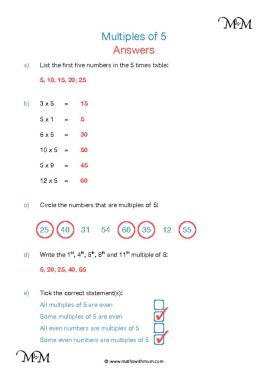
Multiples of 5 are numbers that can be divided by 5 exactly, leaving no remainder. They are made by multiplying any whole number by 5. For example, the third multiple of 5 is 15 because 3 × 5 = 15. The multiples of 5 always end in 0 or 5.

The first few multiples of 5 are simply the 5 times table.

the 5 times table

The first multiples of 5 are:

  • 1 × 5 = 5
  • 2 × 5 = 10
  • 3 × 5 = 15
  • 4 × 5 = 20
  • 5 × 5 = 25
  • 6 × 5 = 30
  • 7 × 5 = 35
  • 8 × 5 = 40
  • 9 × 5 = 45
  • 10 × 5 = 50
  • 11 × 5 = 55
  • 12 × 5 = 60

multiples of 5

Rule to Test if a Number is a Multiple of 5

Multiples of 5 only end in 5 or 0. If a number does not end in 5 or 0, it is not a multiple of 5. For example, 3470 is a multiple of 5 because it ends in a 0. The number 5526 is not a multiple of 5 because it ends in a 6.

Multiples of 10 are always multiples of 5. This is because 5 divides exactly into 10.

How to Find Multiples of 5

To find multiples of 5, multiply any whole number by 5. For example, the tenth multiple of 5 is 50 because 10 × 5 = 50. Alternatively, the multiples of 5 can be found by starting from 0 and counting up in fives.

Here we have the first multiples of 5 up to 100 shown on a chart.

We start at 0 and add on 5 each time to get from one multiple to the next.

0 + 5 = 5. Then 5 + 5 = 10. Then 10 + 5 = 15 and so on.

multiples of 5 chart

When teaching the multiples of 5, a number grid can be useful because we can easily see patterns in the position of the numbers. This helps us identify the multiples of 5. We can also see clearly that the multiples of 5 always end in a 5 or a 0.

pattern in the multiples of 5 always ending in 5 or 0

What are the Multiples of 5 up to 100?

There are 20 multiples of 5 up to 100, which are:

5, 10, 15, 20, 25, 30, 35, 40, 45, 50, 55, 60, 65, 70, 75, 80, 85, 90, 95 and 100.

We can see that there is a difference of 5 between each multiple of 5.

Here is a longer list of the first 100 multiples of 5:

5, 10, 15, 20, 25, 30, 35, 40, 45, 50, 55, 60, 65, 70, 75, 80, 85, 90, 95, 100, 105, 110, 115, 120, 125, 130, 135, 140, 145, 150, 155, 160, 165, 170, 175, 180, 185, 190, 195, 200, 205, 210, 215, 220, 225, 230, 235, 240, 245, 250, 255, 260, 265, 270, 275, 280, 285, 290, 295, 300, 305, 310, 315, 320, 325, 330, 335, 340, 345, 350, 355, 360, 365, 370, 375, 380, 385, 390, 395, 400, 405, 410, 415, 420, 425, 430, 435, 440, 445, 450, 455, 460, 465, 470, 475, 480, 485, 490, 495 and 500.

multiples of 5 to 100

nextlesson.JPG

Now try our lesson on Multiplying by Multiples of 10 and 100 where we learn how to multiply by a number that is in the 10 or 100 times table.

Multiples of 4

Multiples of 4

videolesson.JPG

A multiple of 4 is any number that can be divided by four exactly, leaving no remainder.

The first multiples of 4 are 4, 8, 12, 16, 20, 24, 28, 32, 36, 40, 44 and 48.

multiples of 4 chart

  • The answers to the four times table are the first few multiples of 4.
  • For example 3 × 4 = 12 and so, the third multiple of four is 12.
  • Multiples of 4 are all even and always end in the digits of 2, 4, 6, 8 or 0.

Screen Shot 2019-12-16 at 14.50.42.png
list of the multiples of 4 shown as a chart

videolesson.JPG

Multiples of 4 Flashcards

Click on the multiples of 4 flashcards below to memorise the four times table.

×
×

=

practiseqs.JPG

Multiples of 4 Interactive Question Generator

Multiples of 4: Interactive Questions

Multiples of 4 Worksheets and Answers

Multiples of 4

What are the Multiples of 4?

Multiples of 4 are the numbers in the four times table such as 4, 8, 12, 16, 20, 24, 28, 32, 36, 40 and so on. Multiples of 4 are always divisible by 4.

Here is a list of all of the multiples of 4 to 100.

4, 8, 12 ,16, 20, 24, 28, 32, 36, 40, 44, 48, 52, 56, 60, 64, 68, 72, 76, 80, 84, 88, 92, 96, 100.

multiples of 4 chart shown on a number grid

Here is a list of all of the multiples of 4 all the way up to 100, shown on a number grid.

We can see that the numbers always appear in certain columns. The multiples of 4 only appear in the even number columns with numbers ending in 0, 2, 4, 6 or 8.

Multiples of Four end in 0 2 4 6 8 and are even

However, not all numbers that end in 2, 4, 6, 8 or 0 are multiples of 4. For example 22 is not a multiple of 4 even though it ends in a 2 and 34 is not a multiple of 4 even though it ends in a 4.

List of the multiples of 4 up to 50:

  • The 1st multiple of 4 is 4
  • The 2nd multiple of 4 is 8
  • The 3rd multiple of 4 is 12
  • The 4th multiple of 4 is 16
  • The 5th multiple of 4 is 20
  • The 6th multiple of 4 is 24
  • The 7th multiple of 4 is 28
  • The 8th multiple of 4 is 32
  • The 9th multiple of 4 is 36
  • The 10th multiple of 4 is 40
  • The 11th multiple of 4 is 44
  • The 12th multiple of 4 is 48

How to Calculate Multiples of 4

To find a multiple of 4, simply multiply any whole number by four. For example, the one hundredth multiple of 4 is 400 because 100 × 4 = 400.

how to find a multiple of 4

For example, to find the 5th multiple of 4, multiply 5 by 4.

5 × 4 = 20

And so, the fifth multiple of four is 20.

The four times table is:

  • 1 × 4 = 4
  • 2 × 4 = 8
  • 3 × 4 = 12
  • 4 × 4 = 16
  • 5 × 4 = 20
  • 6 × 4 = 24
  • 7 × 4 = 28
  • 8 × 4 = 32
  • 9 × 4 = 36
  • 10 × 4 = 40
  • 11 × 4 = 44
  • 12 × 4 = 48

4 times table list
learning the multiples of 4

How to Decide if a Number is a Multiple of 4

A number is a multiple of 4 if it can be divided exactly by 4 with no remainder. Halve the number formed by the last two digits of a number. If the result is even, then the original number was a multiple of 4. For example 3044 is a multiple of 4 because 44 ÷ 2 = 22, which is even.

how to decide if a number is a multiple of 4

This trick works because a number is divisible by 4 if its last 2 digits are divisible by 4.

A number is divisible by 4 if it can be halved and halved again. Therefore if it is halved once and the result is even, we know that it can be halved again. We don’t actually need to halve it again.

To find a multiple of 4, its last two digits must be either 04, 08, 12, 16, 20, 24, 28, 32, 36, 40, 44, 48, 52, 56, 60, 64, 68, 72, 76, 80, 84, 88, 92, 96 or 00. If the number ends in different digits, it is not a multiple of 4.

how to find multiples of 4

E.g. Is 280 a multiple of 4?

Yes because its last two digits are 80. 80 is divisible by 4 and so, 280 is divisible by 4.

E.g. Is 4021 a multiple of 4?

No because its last two digits are 21. 21 is not divisible by 4 and so, 4021 is not divisible by 4.

Teaching the Multiples of 4

All multiples of 4 end in the same digits, which are 0, 4, 8, 2, 6.

2.png

This pattern repeats in this order. To get to the next multiple of 4 from the previous multiple of 4, simply add 4.

All multiples of 4 are also multiples of 2. This is because 4 is in the two times table and all multiples of 4 can be divided by 2. All multiples of 4 are even.

When teaching the four times table, we can simply start with the two times table, missing out every other number. If you get stuck, you can count on from the previous number in fours.

The two times table is shown below, with the multiples of 4 shown in bold.

2, 4, 6, 8, 10, 12, 14, 16, 18, 20, 22, 24, 26, 28, 30, 32, 34, 36, 38, 40, 42, 44, 46, 48.

multiples of 4 chart

We can also teach this by thinking of it as doubling every number in the two times table.

nextlesson.JPG

Now try our lesson on Finding the Lowest Common Multiple where we learn about the lowest common multiple.

Multiples of 2

Multiples of 2

videolesson.JPG

the two times table to 12 x 2
the first 12 multiples of 2

  • The multiples of 2 are numbers that can be divided by two exactly, leaving no remainder.
  • The answers to the two times table are the first few multiples of 2.
  • 1 × 2 = 2 and so, the first multiple of two is 2.
  • 5 × 2 = 10 and so the fifth multiple of two is 10.
  • Multiples of 2 are all even and always end in the digits of 2, 4, 6, 8 or 0.

A multiple of 2 is any number that can be divided by two exactly, leaving no remainder.

The two times table makes up the first few multiples of 2.

videolesson.JPG

Click on the multiples of 2 flashcards below to memorise the two times table.

×
×

=

practiseqs.JPG

Multiples of 2 Interactive Question Generator

Multiples of 2: Interactive Questions

Multiples of 2 Worksheets and Answers

What are the Multiples of 2

Multiples of 2 are numbers that can be divided exactly by 2, leaving no remainder.

The answers to the two times table make up the first few multiples of 2.

The first multiples of 2 are: 2, 4, 6, 8, 10, 12, 14, 16, 18, 20, 22, 24.

The chart below shows the full list of multiples of 2 to 100.

list of the multiples of 2 up to 100

There is no final multiple of 2 because the two times table keeps on going.

The two times table is one of the first times tables to learn because the numbers are smaller and more familiar.

Here is a chart showing the two times table.

Two Times Table chart

The two times table is as follows:

  • 1 × 2 = 2
  • 2 × 2 = 4
  • 3 × 2 = 6
  • 4 × 2 = 8
  • 5 × 2 = 10
  • 6 × 2 = 12
  • 7 ×2 = 14
  • 8 × 2 = 16
  • 9 ×2 = 18
  • 10 × 2 = 20
  • <11 × 2 = 22
  • 12 × 2 = 24

We usually learn the first twelve multiples when learning a times table.

two times table list chart

The answers to the two times tables are what we call the multiples of 2.

Multiples of 2 list

To find any particular multiple of two, multiply that given number by two.

For example:

  • 1 × 2 = 2 and so the 1st multiple of two is 2.
  • 2 × 2 = 4 and so the 2nd multiple of two is 4
  • 3 × 2 = 6 and so the 3rd multiple of two is 6
  • 4 × 2 = 8 and so the 4th multiple of two is 8
  • 5 × 2 = 10 and so the 5th multiple of two is 10
  • 6 × 2 = 12 and so the 6th multiple of two is 12
  • 7 ×2 = 14 and so the 7th multiple of two is 14
  • 8 × 2 = 16 and so the 8th multiple of two is 16
  • 9 × 2 = 18 and so the 9th multiple of two is 18
  • 10 × 2 = 20 and so the 10th multiple of two is 20
  • <11 × 2 = 22 and so the 11th multiple of two is 22
  • 12 × 2 = 24 and so the 12th multiple of two is 24

list of the first multiples of 2

When teaching the two times table it is important to recognise patterns in the multiples of 2.

It is helpful to teach larger multiples of 2 using a number grid.

We will use this number grid to 100 to list all multiples of 2 up to 100.

all multiples of 2 all the way up to 100

The list multiples of 2 up to 100 are:

2, 4, 6, 8, 10, 12, 14, 16, 18, 20, 22, 24, 26, 28, 30, 32, 34, 36, 38, 40, 42, 44, 46, 48, 50, 52, 54, 56, 58, 60, 62, 64, 66, 68, 70, 72, 74, 76, 78, 80, 82, 84, 86, 88, 90, 92, 94, 96, 98, 100.

All of the multiples of 2 can be divided by 2 with no remainder. We can see that the multiples of two always fall within the same columns of the number grid.

We can recognise a pattern in the multiples of 2.

All multiples of 2 end in the digits: 2, 4, 6, 8, 0 and this pattern repeats in this order.

multiples of two end in 0, 2, 4, 6 and 8

The easiest way to remember the two times table is two repeat the pattern of 2, 4, 6, 8 and 0 and increase the tens digit in front each time.

For example we first have 2, 4, 6, 8 and 10.

On the next row of the number grid we have these digits with a ‘1’ digit in front.

We have 12, 14, 16, 18, 20.

We then have a ‘2’ digit in front of the next row.

22, 24, 26, 28 and then 30.

Once you have taught this pattern, the multiples of two continue like this forever.

We can see this pattern in the number grid below, with the final digit in each column being the same but the tens digit increasing by one as we move down each row.

recognising a pattern in the multiples of two

Even is a word to describe numbers in the two times table.

We say that all multiples of 2 are even.

nextlesson.JPG

Now try our lesson on Multiples of 4 where we learn the numbers in the 4 times table.

Number Grid: Adding and Subtracting One

Number Grid: Video Lesson – Maths with Mum

Download the Number Grid to 100 below:

How do we Add or Subtract using the Number Grid?

If we choose a number on the number grid and move one place to the right, we are adding 1.

For example:

1.png

If we start at 14 and move one place to the right, we have added 1.

14 + 1 = 15.

If we begin with a number that is at the end of a row, we move to the beginning of the next row.

For example:

2.png

If we begin with 30, to add 1, we move to the beginning of the next row.

30 + 1 = 31.

If we choose a number on the number grid and move one place to the left, we are subtracting 1.

For example:

3.png

If we start at 77 and move one place to the left, we have subtracted 1.

77 – 1 = 76.

If we start with a number that is at the beginning of a row and subtract one, we move to the end of the previous row.

For example:

4.png

If we begin with 91, to subtract 1, we move to the end of the previous row.

91 – 1 = 90.

blankspace

Perimeter of Compound Shapes: Composite Rectangles

Perimeter of Compound Shapes: Composite Rectangles
summary

Perimeter Compound Shapes Summary

  • Perimeter is the total distance around the outside of a shape.
  • The two green
    horizontalGoing from left to right across this screen.
    sides must be the same length in total as the one longer red side.
  • The two green
    verticalGoing from up to down on this screen.
    sides must be the same length in total as the one longer red side.
  • We can use this fact to find missing sides before we add them to find the perimeter.

example banner

Perimeter of a Compound Shape

  • The missing
    verticalGoing from up to down on this screen.
    side plus 6 cm must equal 9 cm. The missing vertical side is 3 cm.
  • The missing
    horizontalGoing from left to right across this screen.
    side plus 4 cm must equal 12 cm. The missing horizontal side is 8 cm.
  • We find the perimeter by adding the outside edges of our shape.
  • 8 cm + 12 cm = 20 cm and 4 cm + 6 cm = 10 cm. We can add these four sides to make 30 cm
  • We add the remaining two sides to 30 cm. 30 cm + 9 cm = 39 cm and then 39 cm + 3 cm = 42 cm.
  • The perimeter of this compound shape is 42 cm.

practiseqs.JPG

Perimeter of Compound Shapes Worksheets and Answers

Calculating the Perimeter of a Compound Shape made from Rectangles

A compound shape (or composite shape) is a more complex shape that is made up of two or more simple shapes.

We will be looking at compound shapes made specifically out of two combined rectangles.

What is a compound shape made up of two rectangles?

We may be asked to find the perimeter of a compound shape like the one above.

For example: Finding the perimeter of a compound shape made of two rectangles

To find the perimeter, we simply add up the lengths of each outside edge.

It may be helpful to look out for number bonds when adding the sides.

For example, 7 + 3 = 10.

Finding the perimeter of a compound shape made of two rectangles

The total of all of the outer sides is 36, so the perimeter is 36 cm.

In some perimeter questions, the lengths of some of the sides may be missing.

For example:

Finding missing side lengths of compound shapes

Two of the side lengths of this rectangular composite shape are missing.

We can use the other side lengths to work out what these missing values are.

Finding missing side lengths of compound shapes

We’ll begin with the missing

verticalGoing from up to down on this screen.
length.

To find its value, we will look at the other vertical lengths.

Finding missing side lengths of compound shapes

Looking at the shape, the side that is 9 cm long is the same as both the missing side plus the side that is 6 cm long.

9 cm = ? cm + 6 cm

We can therefore find the missing length by subtracting 6 cm from 9 cm.

9 – 6 = 3

So, the missing side length is 3 cm.

Finding missing side lengths of compound shapes

Next, we’ll find the missing

horizontalGoing from left to right across this screen.
length.

Finding missing side lengths of compound shapes

To find the missing horizontal length, we will look at the values of the other horizontal lengths.

Finding missing side lengths of compound shapes

Looking at the composite shape, the side that is 12 cm long is the same as both the missing side plus the side that is 4 cm long.

12 cm = 4 cm + ? cm

We can therefore find the missing length by subtracting 6 cm from 9 cm.

12 – 4 = 8

So, the missing length is 8 cm.

Finding missing side lengths of compound shapes

Now that we know the lengths of all of the sides, we can find the perimeter of the composite shape.

Again, it may be helpful to look for number bonds to make the perimeter calculation easier.

For example, 12 + 8 = 20.

Perimeter of a compound shape with a perimeter of 42cm

The total is 42, so the perimeter of our composite shape is 42 cm.

nextlesson.JPG

Now try our lesson on Calculating Area of Rectangles and Squares where we learn how to find the area of rectangles including squares.

error: Content is protected !!